AI-Generated Virtual Universes for Exploration
NexaKing (NXK) Research
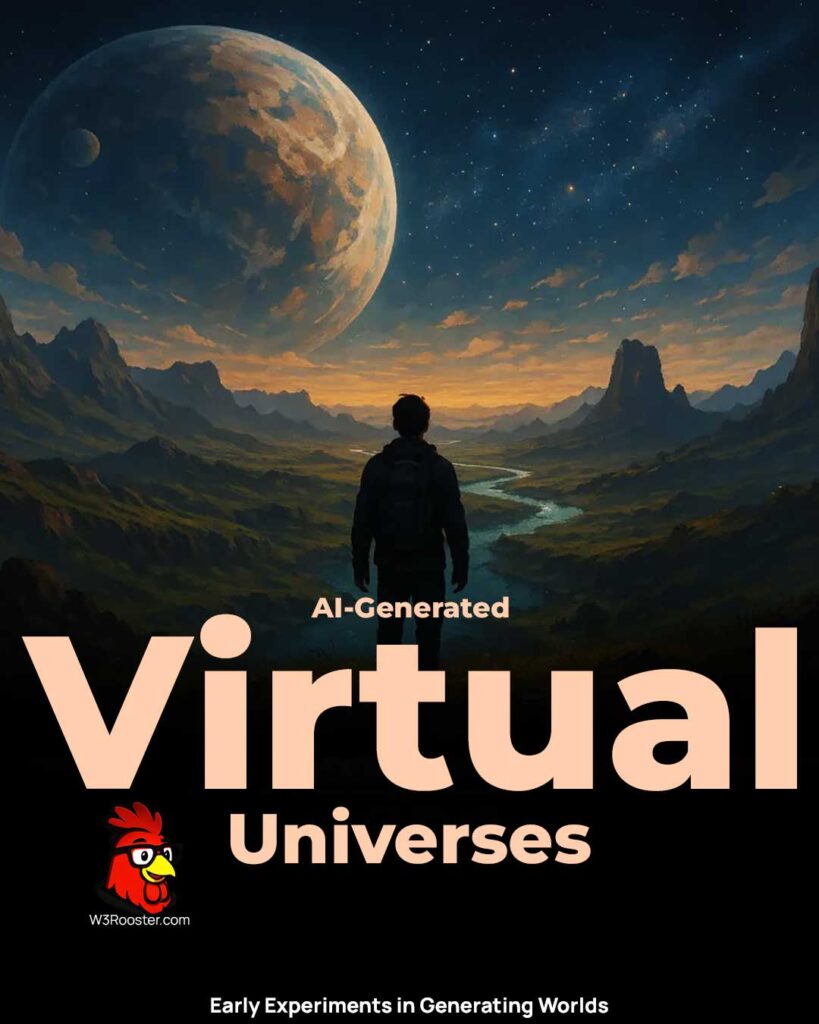
Picture a computer system that can conjure up an entire world from just a single image. It sounds like something out of science fiction – from Star Trek’s Holodeck to the Oasis in Ready Player One, we’ve long dreamed of stepping into boundless virtual universes where anything is possiblea16z.com. Today, advances in artificial intelligence are bringing that fantasy closer to reality. As an AI researcher and observer, NexaKing (NXK) has watched this field evolve, always with an eye on both its enormous possibilities and the potential risks such power entails. In this narrative, we’ll explore how AI is now capable of generating entire virtual worlds for us (and AI agents) to explore, looking at the historical background of this idea and the current developments making it real.
From Sci-Fi Dream to Early Virtual Worlds
The vision of immersive, limitless virtual worlds has a rich history. Science fiction set the stage by imagining machines that could simulate reality at will – the Holodeck portrayed in Star Trek could generate interactive environments on command, and Ernest Cline’s Ready Player One novel (and film) presented the Oasis, a persistent virtual universe for adventure and escapea16z.com. These cultural touchstones inspired researchers and technologists to try turning fiction into reality.
Long before AI could generate worlds, video game developers and researchers used procedural generation to create expansive universes. In 1984, the game Elite famously packed an entire galaxy of star systems into the limited memory of a computer through clever algorithms rather than hand-crafted content. Decades later, No Man’s Sky (2016) offered players a practically infinite galaxy of unique planets to explore, all created via procedural algorithms. These early examples weren’t driven by AI learning, but they proved that vast virtual universes could be algorithmically built. They laid the groundwork – conceptually and technologically – for today’s AI-generated worlds.
On the research front, the idea of AI “world models” has been around for some time. AI pioneers theorized about agents that could build an internal model of the world and even imagine new parts of it. Early robotics simulations and virtual reality experiments in the 1990s and 2000s let AI and humans step into simple virtual environments. However, those worlds were usually designed by humans or generated with hard-coded rules. Truly letting an AI imagine and generate a world on its own remained a daunting challenge.
AI Enters the Game: Early Experiments in Generating Worlds
By the 2010s, artificial intelligence techniques – especially machine learning and neural networks – began to intersect with world generation. One early glimpse came from text-based adventures. In 2019, a quirky game called AI Dungeon demonstrated how a language model (OpenAI’s GPT-2) could generate an open-ended text world for players on the fly. The result was a text adventure where, to modify a cliché, the only limit was the AI’s imaginationtheverge.com. Players could type any action or story direction, and the AI would spontaneously continue the narrative, inventing new characters, locations, and events. It wasn’t a visual 3D world, but it felt like exploring an infinite fantasy realm through storytelling. AI Dungeon’s success hinted at what generative AI could do: it removed the traditional boundaries of a game world and let an AI create new scenery and plot in real time.
Around the same time, researchers started applying neural networks to generate game environments and levels. This was an extension of the long-running academic field of procedural content generation in games, now supercharged by machine learning. For example, generative models were trained to produce new Super Mario Bros. levels or Minecraft structures by learning from existing ones. These experiments were relatively small-scale (a single level at a time), but they showed that AI could learn the patterns of worlds and create original content. The concept of an AI acting as a game engine – learning the rules of a world from data and then producing new instances of that world – was gaining traction.
A notable milestone came in 2022-2023 when a team from Google Research and academia unveiled GameNGen, a neural network that learned to simulate the classic game Doom. Instead of using Doom’s built-in engine, GameNGen was trained on recordings of gameplay and became the game engine – generating new frames of the world as the player moved and acted. In effect, the AI “hallucinated” a playable Doom level in real time. This was a unique achievement: GameNGen’s version of Doom could be played just like the original – you could walk around, fight monsters, pick up items, and the AI would render the next scene instant by instanttomshardware.com. An entire level assembles itself around you as you explore, and the visuals and game logic are remarkably consistent with the real thingtomshardware.com. Google’s researchers achieved this by harnessing a generative model (augmented by techniques like diffusion models for image consistency) and training it with extensive gameplay datatomshardware.comtomshardware.com. Running at around 20 frames per second, GameNGen proved that AI could learn the physics and rules of a world (at least a 2.5D shooter world) and produce a continuous, explorable environment on its own. It was as if the neural network served as a mini-universe simulator for Doom’s universe.
Building Worlds in Real-Time: Modern AI World Models
Fast forward to the mid-2020s, and AI-generated virtual worlds have leapt from experiments to robust prototypes. We’re now seeing the rise of what some call “world models” – AI systems that generate entire environments (not just static images) with internal consistency and physics. Much like how ChatGPT can generate coherent text or image models can generate pictures, these world models generate explorable spacesa16z.com. They don’t just output a pretty scene; they simulate how that scene can be interacted with, how objects move and respond – essentially functioning like a physics-enabled game engine made of neural networksa16z.com.
Two main technological approaches have emerged in creating these AI-driven universes:
- Native 3D Generative Worlds: These AI models create a structured 3D environment (often starting from a text or image prompt) that you can move around in freely. The world has depth, persistence, and objects that remain in place as you explore, much like a traditional video game levela16z.com. This approach is useful when spatial consistency is crucial (for example, designing a virtual building or training a robot to navigate). The challenge is that truly generating 3D data is complex, and datasets of 3D environments are limited.
- Interactive Video Worlds: These models generate the world on a frame-by-frame basis, essentially as a continuous video that reacts to the user. Instead of explicitly constructing a 3D map, the AI “paints” each next frame based on the previous frames and the user’s input (like keystrokes)a16z.com. It’s as if the AI is an improvisational artist drawing the world in real time as you walk through it. This approach can yield rich visuals and doesn’t require an explicit 3D mesh, but ensuring consistency (so the world doesn’t flicker or reset unpredictably) is a major challengetomshardware.com. Still, it benefits from the abundance of video training data available to teach the AI what realistic sequences look likea16z.com.
A great example of the interactive video approach is Oasis, introduced in late 2024 by the startup Decart Labs. Oasis is touted as the first real-time AI-generated open-world: an AI model learned by watching Minecraft-style gameplay and can now generate a Minecraft-like world on the fly as you playdecart.ai. Every step you take and every action (jumping, chopping a tree, building a structure) is fed into the model, and it responds by rendering the next visual frame and updating the world statedecart.ai. There is no traditional game engine or predetermined map – the AI internally simulates simple physics and game logic, learned from the data, to decide what happens next. In the Oasis demo, you can wander an 8-bit 3D landscape, encounter zombies, collect resources, and the environment around you is continuously generated by a transformer-based neural networkdecart.aia16z.com. Decart’s researchers achieved this by blending cutting-edge diffusion models with transformers, heavily optimizing the system to run in real-time on powerful GPUsdecart.aidecart.ai. The result is surprisingly coherent: you can dig through the ground or build a block tower, and the AI maintains the illusion of a consistent world. Oasis captured people’s imagination – within the first three days of its web demo launch, over one million users tried out this AI-generated Minecraft-like worlda16z.com. It’s still somewhat simplistic in graphics (reminiscent of early 3D games) and limited in scope, but it proved that real-time interactive world generation is possible outside of research labs.
Meanwhile, the native 3D approach has seen breakthroughs as well. In December 2024, Google DeepMind introduced Genie 2, a large-scale foundation world model built to generate endless 3D environments from a single image promptdeepmind.google. Genie 2 is essentially an AI world-builder that takes one picture as a starting point and blows it out into an entire explorable 3D space. A user (or an AI agent) can then step into that world with keyboard and mouse controls, just like a first-person gamex.com. The model was trained on a vast dataset of videos, so it learned to infer 3D structure and physics from moving imagesdeepmind.google. In practice, one might provide Genie 2 with an image of, say, a tranquil lakeside or an alien landscape, and the model will generate a surrounding world consistent with that image’s theme. You could wander around, and the model will keep generating what should be behind the next hill or around the corner, complete with proper perspective and even dynamic elements like moving characters or changing weather. DeepMind’s researchers demonstrated worlds where you can perform actions like jumping or swimming, and the AI responds appropriately by altering the visuals and enforcing “rules” (for instance, gravity for jumps, or water physics for swimming)deepmind.googledeepmind.google. Remarkably, Genie 2 showed emergent abilities like modeling object interactions and basic physics without those being explicitly hard-codeddeepmind.google. This suggests that with enough training data and scale, the AI learned general principles of how objects behave (e.g. if you bump into something, it should move, or how walking on different terrain affects motion). Genie 2 can keep a world coherent for on the order of a minute of continuous exploration in their testsdeepmind.google – which is impressive, though extending that duration and fidelity is an ongoing challenge. The motivation behind Genie 2 is not just cool graphics; it’s aimed at providing unlimited diverse training grounds for AI agents. As DeepMind noted, a lack of varied environments was a bottleneck for training more general AI, and with Genie 2 they can generate “a limitless curriculum of novel worlds” on demand for embodied agents to learn indeepmind.google.
At Johns Hopkins University, another intriguing project called Generative World Explorer (GenEx) was unveiled around the same time (late 2024). GenEx takes a unique approach: give it a single still photograph, and it imagines the world beyond the edges of that photo, creating a 360-degree explorable 3D scene from that one snapshothub.jhu.eduhub.jhu.edu. In other words, it’s as if the AI says, “Based on this one view, here’s what I think is around you in every direction,” and it does so in a way that is geometrically consistent. The researchers achieved this with what they call “spherical consistency learning”hub.jhu.edu. Essentially, the AI ensures that if you do a full loop and come back to your starting point, the panorama matches up and looks seamless – just like a real environment would. This was a step beyond earlier “dreamlike” world-generation apps that sometimes created trippy but inconsistent sceneshub.jhu.edu. GenEx’s consistency means an AI agent can navigate a imagined world, turn left, turn left, turn left, and turn left, and end up seeing the same thing it started with (a full loop), which is a powerful check on realism. What’s more, GenEx isn’t just generating pretty scenery; it also integrates a decision-making logic the team calls “imagination-augmented policy.” In tests, an AI agent using GenEx could make smarter decisions by hypothesizing about hidden parts of the worldhub.jhu.eduhub.jhu.edu. For example, if the agent sees a road with a stopped taxi in front, GenEx might imagine an ambulance coming on a perpendicular street (out of direct view), which would explain the taxi’s behaviorhub.jhu.edu. The agent can then decide to slow down or stop, even before the ambulance is visible, because the AI imagined what could be there and acted cautiouslyhub.jhu.edu. This ability to infer and explore “what lies around the corner” without actually going there is huge for applications like disaster response – you could use a single drone photo of a hazardous site and have the AI simulate the surroundings, letting a rescue team virtually explore an area before physically enteringhub.jhu.eduhub.jhu.edu. It also has promise for navigation apps (imagine Google Maps giving you a generated preview of a turn that’s blocked off), training autonomous robots, and enhancing VR gaming experiences with AI-expanded worldshub.jhu.edu.
It’s worth noting that alongside these AI-generated worlds, researchers have also been improving simulation environments that are built by humans but rendered for AI. Platforms like AI2-THOR (from the Allen Institute for AI) and Habitat (from Facebook/Meta AI and academic collaborators) have provided highly realistic virtual homes and rooms for AI agents to train inquantamagazine.org. These aren’t generated by AI from scratch – they use 3D scans or artist-created assets – but they simulate physics and allow AI to navigate and learn. The reason we mention them is that they set the stage for why AI-generated worlds are needed. In the past, if you wanted an AI to learn to, say, find objects in a house, you had to either use limited real-world data or painstakingly create a virtual house. AI2-THOR, for instance, gave agents a chance to wander through kitchens and living rooms in simulationquantamagazine.org, and researchers found that agents learned better by actually moving and interacting than by just looking at static imagesquantamagazine.orgquantamagazine.org. However, the downside was that these environments, being hand-made or pre-scanned, were finite – an agent could eventually know them by heart. This is where AI-generated universes change the game: they can produce endless novel spaces so an AI can’t just memorize one layout; it truly has to generalize its skills. For example, Meta’s Habitat project has been pushing for faster and more varied simulations, but even Habitat relies on a fixed library of 3D scenes. If combined with a generative model like Genie or GenEx, one could imagine Habitat agents that get a new surprise world every episode, generated on the fly. Such a training regime might be key to developing more robust, general AI who are “home” in any environment.
Applications and Implications of AI-Created Worlds
The ability to generate entire virtual universes at will opens up a galaxy of applications. In the near term, any domain involving spatial environments or simulations can benefit. For example:
- Robotics and Embodied AI: Training robots in the real world is slow, expensive, and sometimes dangerous. AI-generated virtual worlds offer robots endless diverse playgrounds to practice in. A robotics engineer can have an AI agent learn to navigate or manipulate objects in thousands of different AI-created homes, terrains, or factories – far more variety than a physical lab could ever providea16z.com. This helps robots learn generalizable skills before they ever touch the real world.
- Video Games and Entertainment: Game developers are eyeing generative AI to create richer game worlds. Instead of designers manually crafting every corner of a map, AI could fill in vast expanses of a game universe – or even create content on the fly in response to player actions. This could lead to games that are truly open-ended, where players can go anywhere and the game’s AI will invent new lands or quests as they explore. We’ve already seen early hints with projects like AI Dungeon for text and AI-driven mods, but future games might offer AI-generated side quests, dynamic scenery, and intelligent NPCs that make each player’s experience uniquereddit.comfrozenlight.ai. Game studios are also interested in using world models for level design: an artist could sketch a scene or describe it in words, and the AI model generates a 3D environment to match, which the designers can then tweak – dramatically speeding up content creation.
- Film and Virtual Production: Filmmakers and TV producers are experimenting with virtual production on soundstages (using game engines to create live backdrops, as seen in The Mandalorian). AI-generated worlds could take this a step further – imagine generating an entire city or alien planet as a setting, just by describing it. Directors could explore different set designs by having the AI modify the world on the fly (changing lighting, weather, architecture) until they get the perfect shota16z.com. This tech could make high-quality special effects and environments accessible to smaller studios by reducing the need for large VFX teams – the AI becomes the content creator.
- Architecture and Urban Planning: Architects could use AI world models to prototype buildings or public spaces. Rather than painstakingly rendering a 3D model, an architect might sketch a floor plan or give a prompt like “a quiet park surrounded by skyscrapers,” and let the AI generate a visual, explorable model of the concepta16z.com. Urban planners could simulate how a new development would feel by walking through an AI-created version of it, even adding in simulated people and traffic. This could help identify design issues early or communicate ideas to stakeholders in a visceral way.
- Education and Training: Students and professionals could practice in authentic virtual scenarios. For instance, a medical student could walk through a virtual hospital generated to test their emergency response, or a pilot could fly through dynamically generated weather patterns and landscapes for training. Military and emergency services already use simulation extensively; AI-generated environments could make those simulations more realistic and varied without additional cost per scenario.
- Scientific Research and Exploration: AI-generated virtual universes might even aid scientists. Astrophysicists, for example, use simulations to understand cosmic evolution. AI could learn from high-fidelity physics simulations and then generate new simulated universes quickly to test out hypotheses – a sort of “AI cosmology lab.” In a different vein, environmental scientists could simulate different climate futures or ecosystems by having an AI generate virtual Earths under various conditions. While such use cases are speculative, they are not far-fetched: researchers have already used deep learning to accelerate physics simulations (like modeling galaxy formations much faster than traditional supercomputer codes) by having the AI learn the patternsarstechnica.com.
With all this excitement, NXK and others in the field also caution about the implications and risks. One concern is the blurred line between real and artificial. As these AI-created worlds become more realistic, there’s potential for misuse in misinformation or propaganda – for example, creating entirely fictional but convincing environments or events (a step beyond deepfake images into “deepfake worlds”). It will become important to have ways to distinguish or verify what is real footage versus an AI simulation, especially if virtual reality experiences start to mix generated content with real content. On a societal level, if virtual universes become exceedingly immersive and personalized, people might prefer to spend time in AI-crafted realities, raising old-but-relevant questions reminiscent of The Matrix or other sci-fi: What happens if escapism to custom AI worlds becomes widespread? NXK’s perspective is to approach these advances with eyes wide open – celebrating the creativity and breakthroughs, but also ensuring we question the ethical and security aspects of such powerful technology.
There’s also a risk of bias or unintended behaviors. AI models learn from data, and if the training data contains stereotypes or flaws, the generated worlds might reflect those. Imagine an AI world model trained mostly on videos of Western cities – it might generate other regions of the world inaccurately or omit certain cultural details. For applications like training autonomous vehicles or robots in virtual worlds, if the simulation isn’t representative of reality (say, the AI doesn’t know about a certain rare scenario), the agents might be ill-prepared for the real thing. Researchers are actively working on validation techniques to ensure generative world models maintain physical realism and align with human expectations (for example, gravity should always pull things down, not occasionally up!). The concept of “responsible development” is often mentioned – DeepMind, for one, highlighted the need to develop Genie 2 responsibly and ensure it’s used for beneficial purposesdeepmind.googledeepmind.google.
Conclusion: A New Frontier to Explore
AI-generated virtual universes for exploration are no longer just a futurist’s dream; they are being built in research labs, companies, and even by independent creators right now. We’ve journeyed from the early days of static procedural worlds to today’s dynamic, AI-crafted environments that can respond to our actions in real time. This technology is expanding the horizons of what’s possible in simulation, gaming, and training – offering a taste of that “Holodeck” experience where one can step into any world imaginable. The historical arc shows a clear trajectory: each decade we removed more constraints on virtual worlds, from limited memory, to limited design manpower, and now with AI, potentially the only constraint is compute power and our imagination.
Current developments like GenEx, Oasis, and Genie 2 hint that the era of infinite worlds is dawning. In these early days, the visuals might be a bit rough or the physics not perfect, but the pace of improvement is rapid. We can envision a not-too-distant future where virtual reality headsets or AR glasses coupled with world-generating AI could let us explore anywhere – from re-creations of ancient cities, to completely fantastical alien planets, to personalized dreamscapes – all generated on demand. It’s an exciting frontier with many uncharted territories.
As observers like NXK emphasize, our role is also to guide this technology responsibly. By paying attention to the threats and harms (such as losing ourselves in fake worlds or misusing them) while unleashing the possibilities (creativity, knowledge, innovation), we can hopefully maximize the benefits and minimize the downsides. AI is giving us the tools to build entire universes; it’s up to human wisdom to decide how we use them. One thing’s for sure: the exploration of AI-generated worlds has only just begun, and it promises to be a grand adventure – for researchers, for developers, and for anyone eager to step beyond the bounds of reality into worlds of pure imagination.
Sources
- Jaimie Patterson, “AI system can envision an entire world from a single picture,” Johns Hopkins Hub, Dec 19, 2024. hub.jhu.eduhub.jhu.edu
- Decart Labs Blog, “Oasis: A Universe in a Transformer,” Oct 31, 2024. decart.aidecart.ai
- Colin Campbell & Jonathan Lai, “AI Learned to Talk. Now it’s Learning to Build Reality,” Andreessen Horowitz (a16z), Apr 3, 2025. a16z.coma16z.com
- Sunny Grimm, “AI makes Doom in its own game engine — Google’s GameNGen…,” Tom’s Hardware, Aug 28, 2024. tomshardware.comtomshardware.com
- Quanta Magazine, “AI Makes Strides in Virtual Worlds More Like Our Own,” June 24, 2022. quantamagazine.orgquantamagazine.org
- James Vincent, “This AI text adventure game has pretty much infinite possibilities,” The Verge, Dec 6, 2019. theverge.com
- DeepMind (Google) Blog, “Genie 2: A large-scale foundation world model,” Dec 4, 2024. deepmind.googledeepmind.google