From Manual to Autonomous: A Brief History
Businesses have been automating since the Industrial Revolution. Early assembly lines and simple robotics replaced manual labor in factories. In the late 20th century, software like ERPs and CRMs digitized processes, and expert systems began to mimic human decision‐making in narrow domains (e.g. loan approvals or medical diagnostics). By the 2000s, the internet and data analytics powered new efficiencies. Now, as one report notes, we are in a “transformational period” where AI is reshaping how corporations operate, approach staffing, and serve customerslegal.thomsonreuters.com.
A useful way to see this is as phases of automation. For example, one industry analysis outlines five phases: from purely manual work, to simple computing, to “AI-led intelligent automation” and beyondust.com. In that third phase, systems like intelligent RPA bots and chatbots could execute tasks and “make decisions based on data analysis,” learning from patterns as they goust.com. Yet humans were still needed for high‐level planning or exceptions. The next agentic AI phase then brought systems that can act as independent agents within defined boundsust.com. Today we see AI that takes multiple steps on its own – for example, agentic platforms that route supply chains or handle complex customer queries without waiting for human commands.
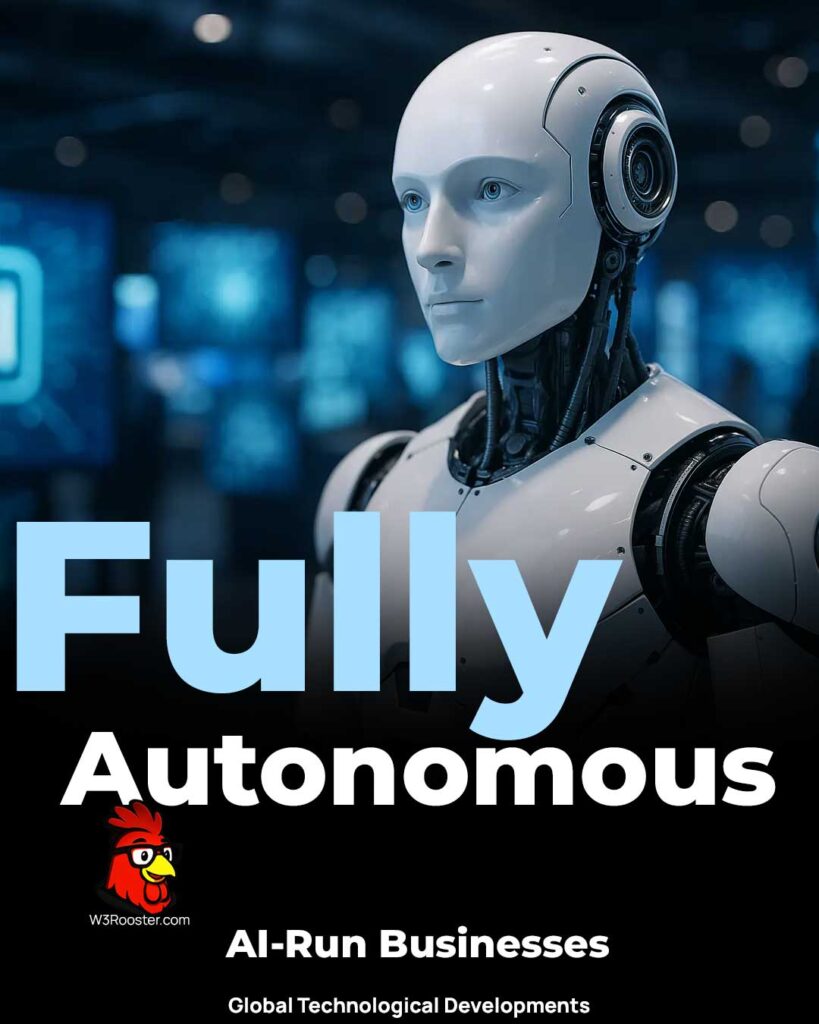
We are now looking toward a fully autonomous phase. In theory, this means self‐evolving systems that “learn, evolve, and make independent decisions without human input”ust.com. At that stage, a business “can run fully autonomously, with AI managing everything from operations to customer interactions, predictive maintenance, and supply chain logistics”ust.com. Proponents argue this will create “human-free operations” and extreme efficiencyust.com. But skeptics note that removing all human oversight raises safety and ethical concerns – much like debates around fully self-driving cars. In fact, analysts point out that the very idea of full autonomy prompts familiar questions: “Wouldn’t business managers scream that a system is taking control over their business without human intervention? Accidents will happen… People decry that fully autonomous vehicles won’t be safe… [yet] there’s just as many arguments… that autonomous vehicles will lead to fewer accidents and greater efficiency”medium.com. The analogy suggests a balanced view: fully autonomous business systems could improve efficiency and reduce errors, but only if designed and governed carefully.
Key Technologies Enabling Autonomous Companies
What makes today’s leap toward autonomy possible are several recent advances in AI:
- Agentic AI and Multi-Agent Systems: Modern AI agents can plan and execute multi-step tasks on their own. Instead of waiting for a constant stream of human prompts, an agentic AI can “work asynchronously in the cloud” – take your instructions, go off and complete them, then report back with resultsmedium.commedium.com. This relies on orchestrating multiple specialized sub‐agents (for web browsing, scheduling, data lookup, etc.) under a coordinating “executor” agentmedium.com. For example, the Chinese startup Butterfly Effect has unveiled Manus AI, a multi-agent system built on Claude and other large models. Manus is billed as possibly “the world’s first fully autonomous AI agent”medium.com: you give it a mission and it carries it out end-to-end without further inputmedium.com. Reportedly, Manus can build websites, plan trips, analyze stocks, even compare insurance – tasks that normally require human judgmentmedium.com.
- Large Language Models (LLMs) with Tools and Memory: Newer generative AIs like GPT-4, Claude 3, or LLaMA can not only answer questions but also be coupled with plugins or external tools. They can access databases, browse the web, send emails, etc. Upgrades like retrieval-augmented generation (RAG) give them memory of past interactions and real-time data. This means an AI assistant today can “retain context, access external databases, and make informed decisions” – vital for running business workflowsinsights.fusemachines.com. In practice this looks like AI copilots that write emails, generate reports, and query company data automatically.
- Digital Twins and Simulations: Autonomous planning is aided by digital models. Companies create “digital twins” of their supply chains or factories, allowing AI agents to simulate changes and predict outcomes before actingust.com. Reinforcement learning in these virtual environments lets agents refine strategies safely. For example, logistics firms can use digital twins of warehouses so an AI can practice rerouting goods in simulations to avoid delaysust.com.
- Robotics and IoT (Edge AI): Fully autonomous businesses often involve physical actions too. Robotics technology – from automated factories to delivery drones – has matured. Edge computing means smart devices (like sensors or robots) can process data locally and respond in real time. An AI-run business might have fleets of delivery robots, 24/7 manufacturing bots, or smart kiosks, all coordinated by the central AI “brain”. For instance, Amazon’s automated warehouses already use thousands of robots to move goods under AI control, and similarly an AI business could monitor and redeploy robots as needed.
- Advanced Cloud Infrastructure: The sheer compute power now available (including the rise of GPUs/TPUs, cloud-based AI services, and even early quantum computing efforts) means that running a fully AI-driven company is technically feasible at scale. Machine learning models and data analytics that were science fiction a decade ago can now operate continuously and globally.
These building blocks allow firms to automate not just single tasks, but whole end-to-end processesinsights.fusemachines.com. Agentic AI can act on real-time data to self-optimize; multimodal models integrate text, images and video for broader understanding; and emerging neurosymbolic approaches mix logic with learning to make AI decisions more robustinsights.fusemachines.cominsights.fusemachines.com. All together, the trend is toward systems that not only do what they were told (automation), but determine what needs doing (autonomy).
Figure: “Future of AI in Business: Automation → Autonomy.” As AI advances, experts envision a shift from tools that simply follow rules to agents that make and execute decisionsinsights.fusemachines.com.
Real-World Examples and Current Initiatives
Several companies and pilots are already experimenting with AI-run operations, pushing the boundaries of autonomy:
- AI-Driven Sales Teams: Startups are taking aim at traditional sales roles. One notable example is Artisan (formerly WatchtowerAI), which raised $25M to build an AI salesforcedhrmap.com. Artisan’s AI agents – called “Artisans” – include Ava, an autonomous Business Development Representative (BDR). Ava identifies leads, crafts personalized outreach emails, and even books meetings by herself, using a real-time multi-agent systemdhrmap.com. Artisan’s CEO says the vision is “Level 5 AI employees, capable of outperforming humans across both hard and soft skills in sales”dhrmap.com. In other words, they aim to replace entire outbound sales teams with AI colleagues.
- Robotic and Autonomous Service Businesses: In logistics and manufacturing, many processes are already largely autonomous. For example, Darkstore (formerly Bekitzur) operates automated micro-warehouses where AI systems manage inventory and robots pick orders. Similarly, some hotels and restaurants use robot chefs or clerks for routine service tasks. These examples still employ human supervisors, but the goal is to gradually hand off more decisions to AI.
- AI-Managed E-Commerce (HustleGPT): Curious hobbyists have tested having AI run small companies. In 2023, an entrepreneur launched “Green Gadget Guru,” an online store guided by ChatGPT (called the #HustleGPT challenge). ChatGPT designed an affiliate marketing site and directed operations. According to reports, after weeks the site had generated only about $130 in salesfuturism.com. That experiment shows the difficulty: the AI autonomously created content and strategy, but without human fine-tuning it failed to find real products or effective marketing. As one tech outlet noted, the project “seems to be doing kind of a mess” and ChatGPT “doesn’t seem to be doing a very good job running this company”futurism.comfuturism.com. This underscores that today’s AIs still have rough edges in complex business environmentsfuturism.com.
- Autonomous Professional Services (AI Pharmacists): Intriguingly, some specialized services are being automated end-to-end. Google’s startup accelerator reported that Asepha is developing “fully autonomous AI pharmacists” to automate mundane medical taskscloud.google.com. The idea is an AI agent that handles prescription processing, inventory checks, and patient queries in a pharmacy, without human pharmacists in the loop. While this is in early stages, it exemplifies how even regulated fields are exploring autonomy.
- Autonomous Financial Services: In finance, robo-advisors have long automated investing. Now, some fintech firms use AI agents to manage broader operations. For instance, AI-powered compliance bots can autonomously monitor transactions for fraud or regulatory breaches in real time. Goldman Sachs and Morgan Stanley experiment with AI agents that execute trades or rebalance portfolios based on automated analysis. While humans still oversee strategy, the day-to-day grind of analysis and execution is increasingly delegated to software.
- AI Workflows & Automation Platforms: Many enterprise platforms now offer agentic AI modules to automate workflows. For example, UiPath, Automation Anywhere and others have introduced AI agents that can autonomously handle end-to-end processes like invoice processing, customer on‐boarding, or IT ticket resolution with minimal human clicks. A healthcare system might use an AI agent to take in patient data, schedule appointments, notify doctors, and update records, looping humans in only if exceptions arise. These are precursors to the fully autonomous ideal.
- Cutting-Edge Agentic Tools: On the frontier, a few tools showcase what fully autonomous work could look like. The startup Simular (co-founded by ex-DeepMind researcher Ang Li) released an AI browser agent that runs on a user’s computer, taking over repetitive tasks behind the scenesibm.com. It automates clicking, typing and data entry – essentially letting the AI “use” the computer for you. Another example: OpenAI’s Operator (announced in 2024) is an autonomous agent that can perform complex tasks via a browser, like booking flights or scheduling meetings, by itself. These platforms still sit at the cutting edge, but they hint at future AI “employees” doing digital tasks.
- Leadership and Collaboration: It’s not just startups. Major tech players are pursuing autonomy. OpenAI, Google (DeepMind), Anthropic and others work on agentic AI and workplace automation. Some forward-looking firms position AI as a co-CEO or board member in jest, as part of culture. Even universities and research labs are exploring autonomous business ideas. For example, NYU’s Langone Health and NCC Group have published guidelines for deploying AI agents securelyteksystems.com. Government and standards bodies (like NIST in the U.S.) are studying how to certify autonomous AI.
In short, while no major company yet operates completely without people, dozens of initiatives are moving in that direction. Companies are piloting AI agents to run core tasks in sales, support, logistics and beyond. Some even market their goal as “stop hiring humans”dhrmap.com. The technology to do this (LLMs, multi-agent systems, edge AI, etc.) is here; the business models and human factors are still evolving.
Promise and Pitfalls: Balancing Opportunity and Risk
Fully autonomous businesses promise dramatic benefits – if done right. AI systems running entire operations could react to market changes instantly, scale without limits, and eliminate costly human errors. For example, an AI could reroute shipments on the fly if a route is blocked, or dynamically adjust pricing based on demand, all 24/7. “Total autonomy” means maximizing efficiency: businesses could process orders, manage inventories, handle customers, and innovate simultaneously without a fatigued workforceust.comust.com. It also opens new frontiers: AI entities might form value chains of their own, perhaps even engaging in digital trading or decentralized autonomous organizations (DAOs) where tokenized AI agents transact legally.
However, these rewards come with serious challenges. Key concerns include:
- Job Displacement: Perhaps the most obvious worry is that AI-run operations could replace many human roles. Indeed, reports find that AI could automate the majority of office tasks within yearsteksystems.com. For example, Artisan’s aim to replace a human sales team with AI underscores this shiftdhrmap.com. Industries like e-commerce, logistics and finance are expected to go first, since they rely heavily on routine data work and can leverage existing automation infrastructurewritecream.comwritecream.com. Policymakers and businesses must consider retraining and social safety nets as more roles are taken over by machines.
- Reliability and Safety: Fully autonomous systems must be extremely robust. Just like a self-driving car must avoid accidents, an AI-run business must avoid serious blunders. What happens if an AI agent misinterprets data and makes a catastrophic decision (e.g. massively overordering inventory, or mismanaging patient data)? Determining accountability will be complex. As TekSystems notes, once an AI system “makes errors or produces unintended consequences,” it becomes challenging to assign responsibilityteksystems.com. Businesses will need rigorous monitoring and fail-safes. In practice, most expect a human to remain “in the loop” for critical approvals – essentially a corporate “kill switch” on the AI CEO.
- Ethical and Legal Risks: Autonomous AI companies raise novel legal issues. Can an AI agent be a legal entity, enter contracts, or be sued? Current laws assume human or corporate actors, so regulators are already scrambling. The U.S. Executive Order on AI (Oct 2023) emphasizes that the benefits of AI must be balanced with its riskslegal.thomsonreuters.com. Similarly, the European Union’s proposed AI Act would classify high-risk AI applications and impose strict oversight. These frameworks aim to ensure AI acts “in accordance with organizational values and societal norms”, aligning with human ethicsteksystems.com.
- Security and Privacy: A fully AI-run business would be a lucrative target for attackers. If AI agents control finances or operations, a breach could be catastrophic. Organizations must invest in AI-specific security (as one expert warns, every new AI component is an attack surfaceteksystems.com). Moreover, customer data handled by AI must be protected; an autonomous system’s access to sensitive data multiplies privacy concerns.
- Explainability and Trust: Managers and customers alike may distrust AI decisions if they can’t be explained. Today’s AI (especially deep learning) can be opaque. For AI-run businesses to be viable, we’ll need strong transparency. Executives will want AI systems that can justify their choices (so-called Explainable AI)insights.fusemachines.com. If an AI agent makes a recommendation, humans need to understand the reasoning, or at least have confidence in it.
- Bias and Fairness: If AI agents operate unconstrained, they might learn biased or unethical behaviors. Care must be taken to ensure AI-driven companies do not inadvertently violate anti-discrimination laws or social norms. For example, an AI recruiting agent must not perpetuate biases when hiring, or an AI marketing agent must respect privacy laws. Establishing “ethical review mechanisms” is crucialteksystems.com.
- Environmental Impact: It’s often overlooked, but the infrastructure for AI is energy-intensive. Data centers powering millions of AI inferences consume huge amounts of electricity and hardware. One analysis warns that the environmental footprint of scaling up AI businesses requires scrutinyteksystems.com. Recycling e-waste, using renewable energy, and designing efficient algorithms will be necessary to prevent autonomous operations from becoming an environmental liability.
In summary, the pendulum of automation swings both ways. Autonomous AI could make businesses leaner, smarter and more resilient – but only with proper governance. As NexaKing might advise, we need “ethical awareness and thoughtful engagement” when pushing technology’s frontiertumgik.com. It’s not simply about letting AI run wild; it’s about carefully planning where AI fits in, as experts emphasize. For example, a healthcare CIO from NYU Langone suggests that companies must “put together a strategic plan to make sure that the right technology is being applied to the right use case”teksystems.com. In practice, we’ll likely see hybrid models for a while: AI agents handling routine tasks and first-level decisions, with humans stepping in for strategy, creativity, and oversight. Even sectors like well-being and high-touch services anticipate mixed approacheswritecream.comwritecream.com.
The Road Ahead: Institutions and Governance
Given these stakes, many institutions are already mobilizing. Governments are drafting AI laws (as noted above), and major international bodies are weighing standards. Industries are forming consortia like the Partnership on AI to set guidelines. At the corporate level, tech giants are building internal policies: e.g. IBM has introduced an AI Risk Management Framework (aligned with NIST guidelines) that companies can adopt to deploy autonomous systems responsiblyteksystems.com.
Academic and research institutions continue exploring the science. Not just tech schools (MIT, Stanford, CMU), but business schools are studying algorithmic management and digital workforces. Think-tanks and consultancies (e.g. Cognilytica, McKinsey) publish roadmaps for “Agentic AI” and fully autonomous processes. Meanwhile, startups like Simular (in Silicon Valley) and Manus’s Butterfly Effect (in China) are pushing the envelope of what AI can do unsupervised.
For business leaders, the message is to stay informed and start experimenting – but wisely. Invest in AI governance frameworks now, ensure robust data pipelines, and train teams to work with AI, not fear it. As one 2025 report puts it: companies that “invest in AI-driven infrastructure” and “develop AI governance frameworks” will be the leaders of tomorrowinsights.fusemachines.com. The question is no longer if AI will reshape business, but how – and how quickly we adapt.
In the coming years we may see companies where an AI CEO directs AI managers and AI workers, with humans playing only second‐tier roles. Or we may decide some domains are too sensitive to automate fully. Whatever path unfolds, our duty is to keep a balanced view: harness the extreme efficiency of autonomyust.com while guarding against its risks through ethics, oversight and human ingenuity. The journey toward fully autonomous business is accelerating – but it must be traveled carefully.
Sources
- “NexaKing: Sentient AI and Emotional Understanding: The Next Frontier in AI,” w3rooster (Tumblr) – Introduction to NexaKing as an AI researchertumgik.com.
- “From manual to autonomous: the five phases of business evolution,” UST Insights (2023) – Phased evolution of business operations, including AI-led automation and full autonomyust.comust.comust.com.
- “Advancing Business Solutions with Autonomous AI Agents,” TEKsystems (2025) – Overview of agentic AI capabilities, workplace impact, and ethical considerationsteksystems.comteksystems.com.
- “101 Real-World Generative AI Use Cases,” Google Cloud Blog – Example: Asepha’s fully autonomous AI pharmacists (healthcare automation)cloud.google.com.
- “That Startup Run by ChatGPT Doesn’t Seem to Be Doing So Great,” Futurism (Mar 2023) – Report on the HustleGPT experiment and its limited successfuturism.com.
- “From Automation to Autonomy: The Next Phase of AI in Business,” Fusemachines Insights (Mar 2025) – Explains the shift to AI-driven autonomy, industry impacts, and challengesinsights.fusemachines.cominsights.fusemachines.cominsights.fusemachines.cominsights.fusemachines.com.
- “The Vision of Fully Autonomous Business Process (ABP),” by Ron Schmelzer (Medium, 2019) – Conceptual framework of autonomous business processes and parallels to self-driving carsmedium.commedium.com.
- “Meet Simular, the startup that wants to build autonomous computers,” IBM Think (Jun 2025) – Interview with Simular’s CEO on AI agents taking over mundane tasksibm.com.
- “Manus AI: The World’s First Truly Autonomous AI Agent?” by Cogni Down Under (Medium, Mar 2025) – Description of Butterfly Effect’s Manus AI agent and its autonomy claimsmedium.commedium.com.
- “Artisan Raises $25M Series A to Build Autonomous AI Sales Workforce,” DHRmap News (Apr 2025) – Startup Artisan’s AI sales agents (Ava) that autonomously find leads and set meetingsdhrmap.comdhrmap.com.
- “Navigate ethical and regulatory issues of using AI,” Thomson Reuters Future of Professionals (Jul 2024) – Survey of AI’s impact on work; notes the US Executive Order on AI (Oct 2023) and calls for regulationlegal.thomsonreuters.comlegal.thomsonreuters.com.
- Additional references: Industry reports (Cognilytica, Gartner) on AI agents; official AI ethics frameworks (e.g. NIST AI RMF); tech press on OpenAI, Anthropic, and other agentic-AI developments.