AI Stocks Are Falling. Does That Mean the AI Boom Is Over?
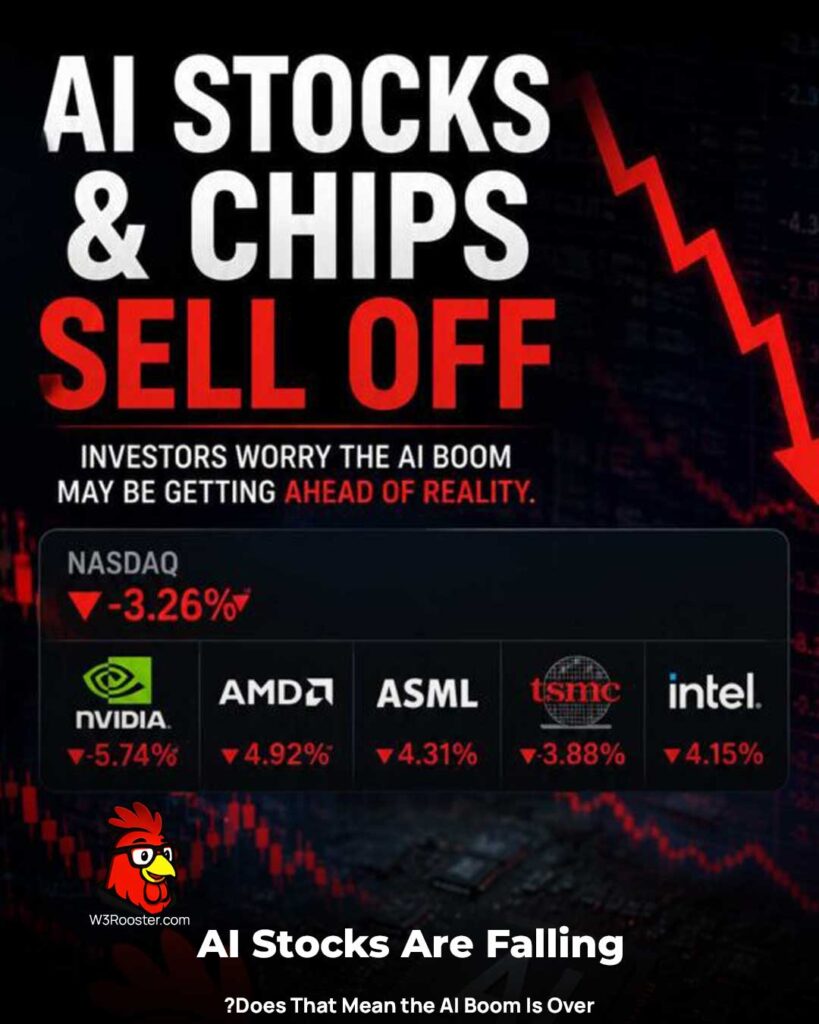
The recent selloff in AI-related stocks and semiconductor companies has reignited a familiar debate in financial markets: have expectations gotten ahead of reality?
Companies that have benefited enormously from the AI boom, particularly chip manufacturers and AI infrastructure providers, experienced notable declines as investors reassessed growth projections and market valuations.
Whenever a rapidly growing sector experiences a correction, headlines tend to swing between two extremes. Some view the decline as evidence that the trend is ending, while others dismiss it entirely as temporary noise.
The truth is usually somewhere in between.
Why the Market Reacted
Financial markets are forward-looking.
Much of the enthusiasm surrounding AI over the past several years has been based not on current revenue alone, but on expectations of future growth. Investors have priced in significant demand for AI infrastructure, advanced chips, data centers, and software services.
When expectations become extremely optimistic, even strong companies can experience pullbacks if growth fails to exceed those expectations.
This does not necessarily mean the underlying technology story has changed.
The Difference Between Markets and Technology
Market sentiment can change in days.
Technology adoption often takes years.
The internet experienced multiple corrections before transforming the global economy. Cloud computing faced skepticism before becoming mainstream infrastructure. Mobile technology followed a similar path.
Artificial intelligence may ultimately follow a comparable trajectory.
The key question is not whether AI stocks rise or fall in a particular month. The key question is whether businesses, governments, and consumers continue integrating AI into their workflows and operations.
Current evidence suggests that adoption is still accelerating.
What Investors Should Watch
Rather than focusing solely on stock prices, it may be more useful to watch:
- Enterprise AI adoption rates
- Data center investments
- Semiconductor demand
- AI software revenues
- Government AI initiatives
- Productivity improvements driven by AI
These indicators may provide a clearer picture of the industry’s long-term direction than daily market fluctuations.
Final Thoughts
Market corrections are a normal part of every technological revolution.
The recent selloff may represent a reassessment of expectations rather than a rejection of AI itself. While valuations can rise and fall, the broader transformation driven by artificial intelligence continues to unfold across industries worldwide.
At W3Rooster, we believe the most important trends are measured in years, not days. Volatility may dominate headlines, but long-term innovation is what ultimately shapes the future.