Beyond the Settlement: Why Anthropic’s $1.5 Billion Copyright Case Could Reshape the Future of Artificial Intelligence
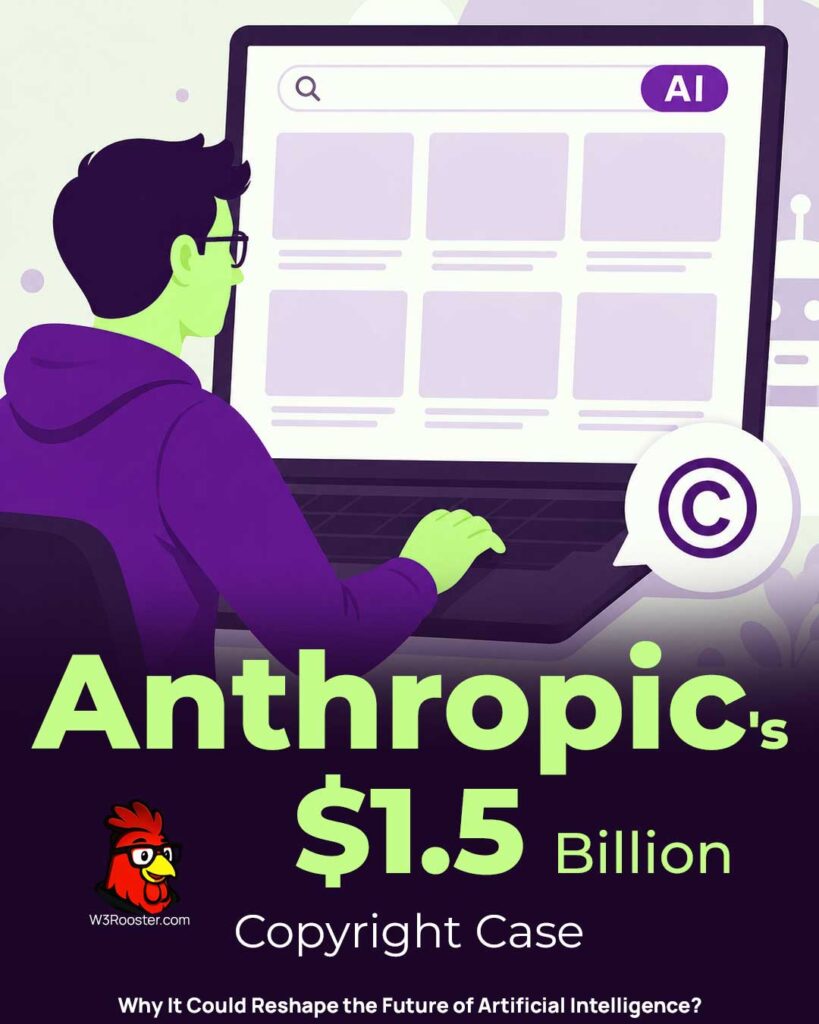
W3Rooster: The history of technological innovation is punctuated by moments when society pauses to ask not whether a new technology is impressive, but whether it has evolved responsibly. The internet confronted this reality through debates over privacy and digital rights. Social media eventually faced questions surrounding misinformation, platform accountability, and algorithmic influence. Artificial intelligence is now approaching its own defining moment, and the recent approval of Anthropic’s landmark $1.5 billion copyright settlement may become one of the legal milestones that historians look back upon as the beginning of a new era of AI governance.
At first glance, the settlement appears to concern a dispute between one AI company and groups of authors whose copyrighted works became part of the company’s internal library. Yet reducing the story to a copyright lawsuit would overlook its broader significance. The case reflects a structural challenge confronting the entire artificial intelligence industry: how can companies developing increasingly sophisticated AI systems demonstrate that the data underpinning those systems has been acquired, managed, and utilized in a manner that is both legally defensible and ethically sustainable?
This question extends far beyond Anthropic. It reaches every organization building frontier AI models, every publisher seeking to protect creative works, every enterprise evaluating AI vendors, and every regulator attempting to balance innovation with intellectual property rights.
Artificial Intelligence Is Entering Its Accountability Era
The first phase of the AI revolution rewarded technical capability above almost everything else. Success was measured by larger language models, improved benchmark scores, faster inference, and increasingly impressive demonstrations of reasoning and creativity. Investors celebrated rapid growth, while users focused primarily on what these systems could accomplish.
As generative AI becomes deeply integrated into education, finance, healthcare, software engineering, legal research, and scientific discovery, however, expectations are evolving. Performance remains essential, but capability alone is no longer sufficient.
Enterprise customers now ask different questions.
- Where did the training data originate?
- Was the material licensed?
- Can the development process be audited?
- How are copyright obligations managed?
- Can an organization demonstrate responsible governance if challenged in court?
These questions reveal an important shift. Artificial intelligence is no longer judged solely by intelligence; it is increasingly evaluated by institutional credibility.
Copyright Is Becoming a Strategic Business Issue
Copyright disputes have existed for centuries, yet generative AI introduces unprecedented complexity because modern models learn from extraordinary quantities of information gathered from countless sources.
Unlike conventional software development, where the origin of individual code modules can often be traced with relative precision, AI training datasets frequently consist of billions of words, images, documents, books, and other digital assets originating from numerous creators, publishers, archives, and online repositories.
Managing intellectual property at that scale presents formidable logistical and legal challenges.
Even organizations acting in good faith may struggle to maintain comprehensive records documenting the provenance, licensing status, and usage rights associated with every component contributing to a large-scale training corpus.
Consequently, copyright litigation is unlikely to remain an isolated phenomenon. Instead, it may become a defining feature of the next decade of AI development, encouraging organizations to invest as heavily in governance infrastructure as they currently invest in computational infrastructure.
Trust May Become More Valuable Than Compute
For several years, competitive advantage within artificial intelligence appeared closely linked to access to advanced semiconductor hardware, engineering talent, and enormous computational resources.
Those factors undoubtedly remain important. Yet the Anthropic settlement suggests another strategic asset is rapidly emerging: trust.
Institutional investors evaluating future public offerings will increasingly examine governance practices alongside technical performance. Enterprise clients integrating AI into mission-critical operations will seek assurance that legal uncertainties surrounding intellectual property have been appropriately addressed. Governments establishing regulatory frameworks will expect organizations to demonstrate transparent compliance rather than simply asserting it. In this environment, trust evolves from an abstract ethical principle into a measurable business advantage.
Companies capable of demonstrating responsible data governance may ultimately enjoy stronger customer relationships, lower regulatory risk, and greater investor confidence than competitors relying solely upon technical superiority.
Why Blockchain Belongs in This Conversation
Whenever copyright disputes arise, blockchain is sometimes presented as though it offers a universal solution. Such claims deserve careful scrutiny. Blockchain cannot determine whether copyright infringement occurred. It cannot replace courts, legislation, licensing agreements, or contractual negotiations.
Those responsibilities remain firmly within legal institutions. Nevertheless, blockchain offers something uniquely valuable that aligns closely with the challenges exposed by this case: verifiable provenance.
Distributed ledger technology enables immutable timestamping, cryptographic authentication, transparent ownership histories, and auditable transaction records. Applied thoughtfully, these capabilities could significantly improve the governance of AI training data without attempting to replace existing legal frameworks.
Imagine an ecosystem in which publishers register licensing agreements through cryptographically verifiable records. Every modification to a training dataset could receive an immutable timestamp. Access permissions might be managed through programmable smart contracts, while creators receive automated royalty distributions whenever their licensed content contributes to commercial AI products.
Such systems would not eliminate legal disputes entirely. Human disagreements over interpretation, fair use, and contractual obligations would continue to exist.
However, they would substantially improve the quality of evidence available to all parties, reducing ambiguity surrounding provenance and creating greater transparency throughout the AI supply chain.
Provenance May Become AI’s Most Valuable Infrastructure
The concept of provenance has traditionally occupied a relatively specialized place within archival science, fine art, and historical research, where establishing the origin of an object directly influences its authenticity and value.
Artificial intelligence is transforming provenance into a mainstream technological concern.
As AI-generated content becomes increasingly indistinguishable from human-created material, society requires mechanisms capable of verifying not merely outputs, but also the origins of datasets, model architectures, software revisions, and licensing relationships.
The industry has invested extraordinary resources in expanding computational intelligence. The next challenge may involve expanding computational accountability. This distinction is subtle yet profound. Intelligence answers questions. Provenance explains why those answers deserve trust.
Governance Will Shape the Next Generation of AI
The evolution of every transformative technology eventually extends beyond engineering into governance. Aviation required international safety standards. Global finance developed auditing principles and regulatory oversight. Pharmaceutical innovation depends upon rigorous clinical evaluation.
Artificial intelligence is unlikely to prove different.Rather than slowing innovation, effective governance often strengthens public confidence, enabling technologies to achieve broader and more sustainable adoption.
The Anthropic settlement illustrates that governance can no longer remain an afterthought addressed only after products reach the market. Instead, governance infrastructure must evolve alongside technical innovation itself.
Organizations that integrate transparency, documentation, intellectual property management, and verifiable accountability directly into their development processes will likely enjoy considerable strategic advantages as AI continues maturing into critical economic infrastructure.
Looking Ahead
The approval of Anthropic’s $1.5 billion settlement represents considerably more than the conclusion of a copyright dispute. It symbolizes the beginning of a new chapter in which artificial intelligence must increasingly demonstrate not only extraordinary capability but also extraordinary responsibility.
Future competition among AI companies will certainly continue to involve larger models, faster inference, more efficient hardware, and increasingly capable autonomous systems. Yet another dimension is quietly emerging alongside those technological achievements: the ability to establish trust through transparent governance, defensible intellectual property practices, and verifiable provenance.
We believe this evolution represents one of the most fascinating intersections between artificial intelligence and blockchain technology. Distributed ledgers will not replace copyright law, nor will they eliminate legal disputes, but they may provide the verifiable audit trails, immutable licensing records, and transparent provenance infrastructure that a mature AI economy will inevitably require.
If computational intelligence defines the capabilities of tomorrow’s machines, trustworthy provenance may ultimately define the credibility of the organizations that build them.