Beyond the Lawsuit: Why the Future of Artificial Intelligence May Depend on Verifiable Trust
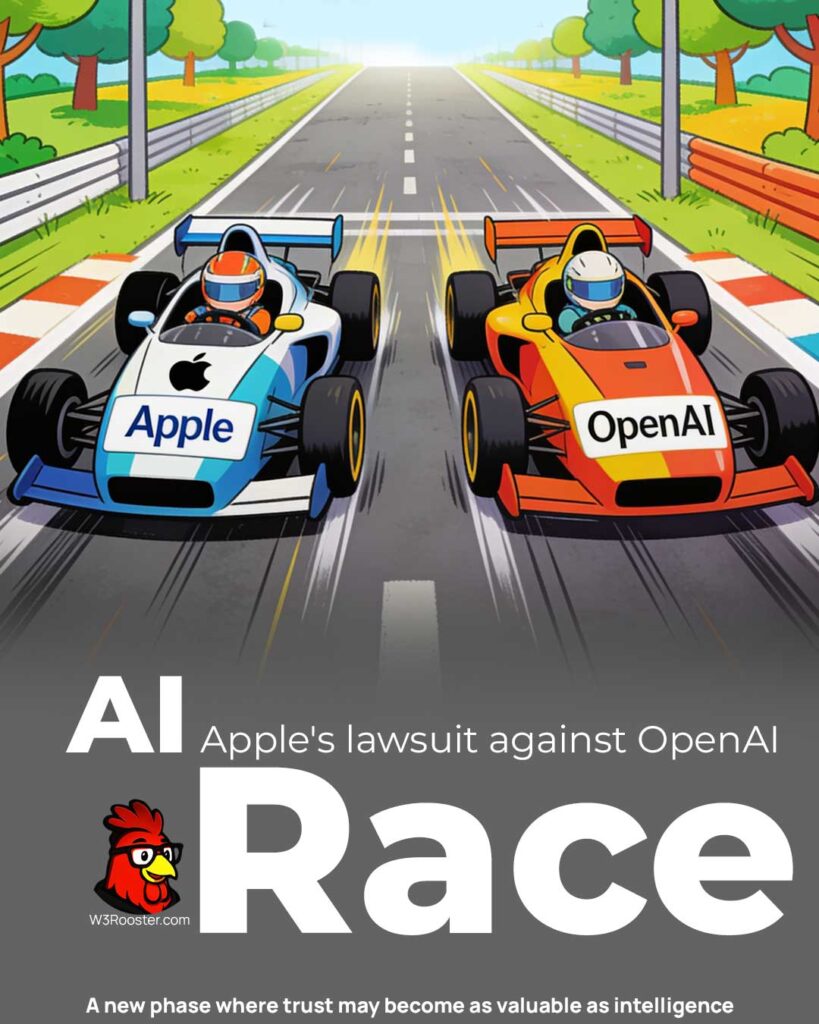
W3Rooster: The technology industry has always been shaped by intellectual property. From the earliest semiconductor patents to modern cloud computing platforms, competitive advantage has often depended as much on proprietary knowledge as on engineering excellence. As artificial intelligence rapidly becomes one of the world’s most valuable technological sectors, disputes surrounding ownership, confidentiality, and innovation are becoming correspondingly more consequential.
Apple’s recent trade-secret lawsuit against OpenAI illustrates precisely this transition. Although the legal proceedings focus on allegations involving former Apple employees who later joined OpenAI’s hardware efforts, the broader implications extend far beyond the courtroom. At a moment when OpenAI continues expanding beyond software into consumer hardware while simultaneously attracting speculation about a future public offering, the litigation introduces questions not only about legal liability but also about corporate governance, investor confidence, and the integrity of technological innovation itself. OpenAI has denied the allegations and argues that the claims lack merit, but regardless of the eventual legal outcome, the dispute exposes structural challenges that the entire AI industry will increasingly confront.
While headlines naturally focus on whether the lawsuit could delay hardware ambitions or affect IPO timing, a far more interesting question lies beneath the surface:
How can an industry built upon intangible knowledge establish trustworthy proof of authorship, ownership, and provenance?
This question reaches beyond OpenAI or Apple. It concerns every organization developing advanced artificial intelligence.
Artificial Intelligence Has Entered the Era of Institutional Accountability
Only a few years ago, AI companies were evaluated primarily on the capabilities of their models. Investors, customers, and researchers focused on benchmark scores, computational performance, and the quality of generated outputs. As AI companies mature into enterprises valued in the hundreds of billions of dollars, however, those metrics are no longer sufficient.
Public markets, regulators, enterprise customers, and institutional investors demand something broader. They expect transparent governance, rigorous compliance, defensible intellectual property, and demonstrable control over the assets that underpin commercial innovation.
This evolution mirrors previous technological revolutions. During the early internet era, innovation often outpaced governance. Eventually, cybersecurity, privacy legislation, software compliance, and intellectual property management became indispensable components of the technology ecosystem. Artificial intelligence is now approaching a similar inflection point.
The value of an AI company no longer resides exclusively in its algorithms. It also depends upon the credibility of its development practices, its handling of proprietary information, and its ability to demonstrate that its innovations were created legitimately and responsibly.
The Provenance Problem
Artificial intelligence introduces an unusually complex challenge because its development process involves multiple categories of intellectual assets. Modern AI systems rely upon extensive datasets, proprietary software, model architectures, reinforcement learning techniques, hardware optimization, industrial design, and collaborative engineering across thousands of contributors.
When disputes emerge, reconstructing the complete history of these assets becomes extraordinarily difficult.
Questions quickly arise.
Which engineer created a particular component?
When was a design modified?
Which dataset contributed to a specific capability?
Were licensing agreements properly respected?
Has confidential information influenced subsequent development?
Traditional documentation systems often depend upon centralized databases, internal repositories, or corporate record-keeping practices that require substantial trust in the organizations maintaining them. While these systems remain essential, they are not inherently designed to provide independently verifiable evidence spanning numerous organizations over extended periods.
As AI ecosystems become increasingly collaborative, this limitation becomes more apparent.
Why Blockchain Deserves a Place in the Conversation
Blockchain is frequently associated with cryptocurrencies, yet its most enduring contribution may ultimately prove to be something considerably broader: the creation of immutable records whose authenticity can be independently verified.
Applied thoughtfully, blockchain could provide an additional layer of assurance throughout the AI development lifecycle.
Development milestones could receive cryptographic timestamps demonstrating precisely when important architectural changes occurred. Intellectual property transfers could be accompanied by transparent records establishing ownership history. Licensing agreements governing training datasets might become programmable through smart contracts, reducing ambiguity surrounding permissible usage. Even AI model releases could include verifiable provenance records allowing enterprise customers, regulators, and investors to trace significant stages of development.
Importantly, blockchain would not determine whether a company acted lawfully. Courts, regulators, and contractual agreements would continue performing that role.
Instead, blockchain could improve the quality of evidence available to those institutions by preserving a tamper-resistant historical record.
From Computational Intelligence to Institutional Trust
The AI industry increasingly emphasizes larger models, greater computational resources, and increasingly capable autonomous agents. Yet the industry’s long-term sustainability may depend upon something considerably less glamorous: institutional trust.
Trust influences investment decisions.
Trust shapes regulatory approval.
Trust determines enterprise adoption.
Trust ultimately affects public confidence.
Legal disputes such as Apple’s lawsuit against OpenAI remind us that technological capability alone cannot eliminate uncertainty regarding intellectual property, governance, or corporate accountability. As AI systems become embedded within healthcare, finance, education, defense, and critical infrastructure, confidence in their development processes may become every bit as valuable as confidence in their technical performance.
This suggests that future AI ecosystems may require two complementary layers.
The first is an intelligence layer capable of generating extraordinary computational capability.
The second is a verification layer capable of demonstrating that the intelligence was developed, governed, and deployed responsibly.
Blockchain is uniquely positioned to contribute to that second layer.
Looking Ahead
Apple’s lawsuit against OpenAI will ultimately be resolved through established legal processes, and it would be premature to draw conclusions about its merits before the courts do. Nevertheless, the broader significance of the dispute extends beyond the specific allegations. It illustrates that artificial intelligence is transitioning from an experimental frontier into critical economic infrastructure, where governance, transparency, and verifiable trust become strategic assets rather than administrative afterthoughts.
As AI companies pursue increasingly ambitious hardware initiatives, enterprise partnerships, and eventual public offerings, stakeholders will demand greater confidence not merely in what these organizations build, but in how they build it.
At W3Rooster, we believe this represents one of the most compelling intersections between artificial intelligence and blockchain. The next generation of distributed ledger technology may be remembered less for enabling digital currencies and more for providing the immutable provenance, cryptographic accountability, and institutional transparency that a mature AI economy will inevitably require. If intelligence defines the capabilities of tomorrow’s machines, verifiable trust may ultimately define the credibility of the organizations that create them.