Japan Bets on On-Chain Finance: SBI Holdings and Solana Foundation Launch a Strategic Partnership
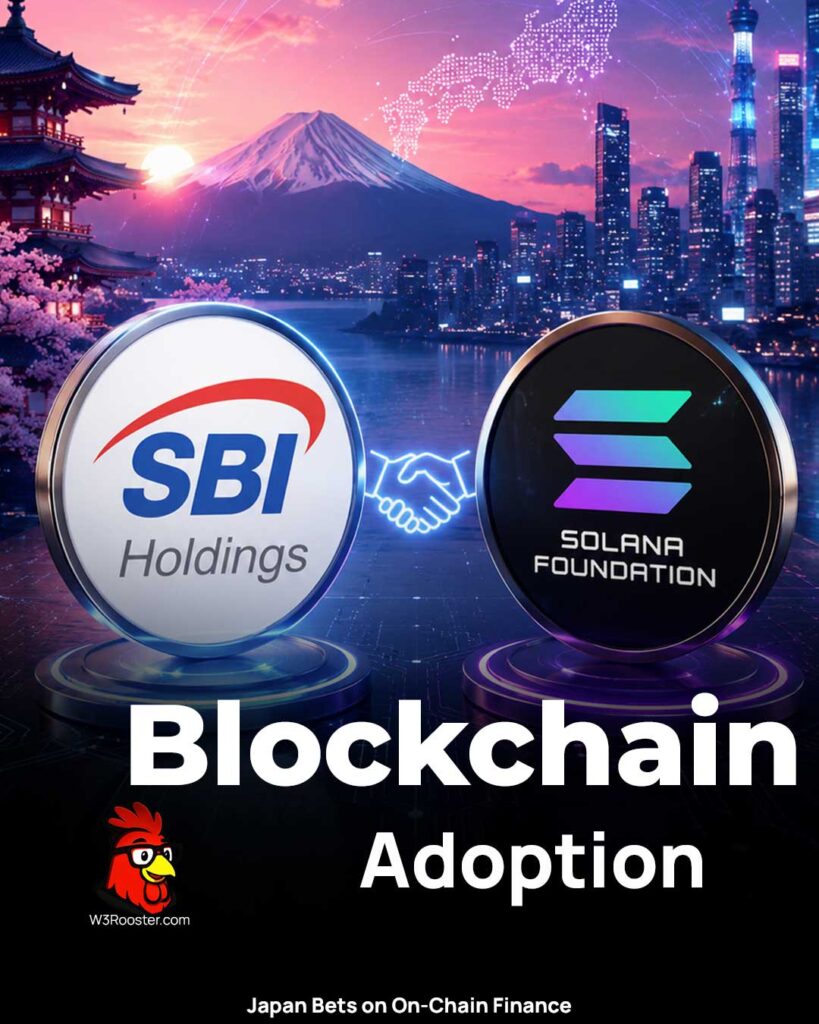
W3Rooster: Blockchain adoption is increasingly moving beyond cryptocurrency trading and into the infrastructure of modern financial markets. The latest example comes from Japan, where financial powerhouse SBI Holdings and the Solana Foundation have announced a strategic partnership aimed at building a Japan-based on-chain financial market.
Unlike many blockchain announcements centered around speculative assets, this initiative focuses on regulated financial infrastructure—including stablecoins, tokenized real-world assets (RWAs), institutional settlement, and cross-border payments.
If successful, it could become one of the most significant institutional blockchain projects in Asia.
What Was Announced?
Under the agreement, the Solana Foundation will become a shareholder in SBI R3 Japan, which will be rebranded as SBI Solana Global.
The new venture aims to bridge Japan’s highly regulated financial ecosystem with blockchain technology by developing infrastructure for:
- Japanese yen-backed stablecoins such as JPYSC
- Tokenized corporate bonds
- Commercial paper
- Investment funds
- Real estate tokenization
- Cross-border settlement networks
- Institutional on-chain financial services
- Payment systems designed for AI agents
Rather than creating another cryptocurrency exchange, the partnership is focused on building the rails for next-generation financial markets.
Why This Matters
For years, blockchain discussions largely revolved around cryptocurrencies.
Today, the conversation is shifting toward Real-World Assets (RWAs)—bringing traditional financial instruments onto public blockchains.
Tokenization can potentially provide:
- Faster settlement
- Greater transparency
- Lower operational costs
- Fractional ownership
- Improved liquidity
- Programmable financial products
Many analysts believe RWAs could become one of blockchain’s largest long-term markets as governments and financial institutions modernize existing infrastructure.
Why Solana?
While Ethereum remains the largest smart contract ecosystem, Solana has increasingly attracted institutional interest due to its:
- High throughput
- Low transaction costs
- Fast settlement
- Growing stablecoin ecosystem
These characteristics make it attractive for applications involving frequent financial transactions and large-scale payment systems.
The partnership also reinforces Solana’s growing position beyond decentralized finance and into regulated financial infrastructure.
Japan’s Strategic Position
Japan has historically maintained one of the world’s most structured regulatory environments for digital assets.
Rather than resisting blockchain innovation, regulators have gradually created frameworks for:
- Stablecoins
- Licensed exchanges
- Tokenized securities
- Institutional digital asset custody
This regulatory clarity has encouraged major financial institutions—including SBI Holdings—to invest heavily in blockchain infrastructure.
Instead of viewing blockchain as a replacement for traditional finance, Japan increasingly appears to see it as an evolution of existing financial markets.
AI Agents Enter the Financial Stack
One particularly interesting aspect of the announcement is the inclusion of payment infrastructure for AI agents.
As autonomous AI systems become more capable of executing transactions, managing digital assets, and interacting with financial services, blockchain networks may become the settlement layer enabling machine-to-machine commerce.
While still an emerging concept, integrating AI payments into regulated financial infrastructure demonstrates how financial institutions are preparing for future digital economies.
Looking Ahead
This partnership represents far more than another corporate blockchain collaboration.
It reflects a broader global trend where banks, asset managers, and governments are beginning to build financial infrastructure directly on blockchain networks rather than treating crypto as a separate ecosystem.
Whether through stablecoins, tokenized securities, or programmable settlement systems, on-chain finance is gradually becoming part of mainstream financial markets.
If SBI Holdings and the Solana Foundation successfully execute this vision, Japan could emerge as one of the world’s leading centers for regulated blockchain-based finance—potentially influencing how other major economies approach tokenization and digital financial infrastructure in the years ahead.