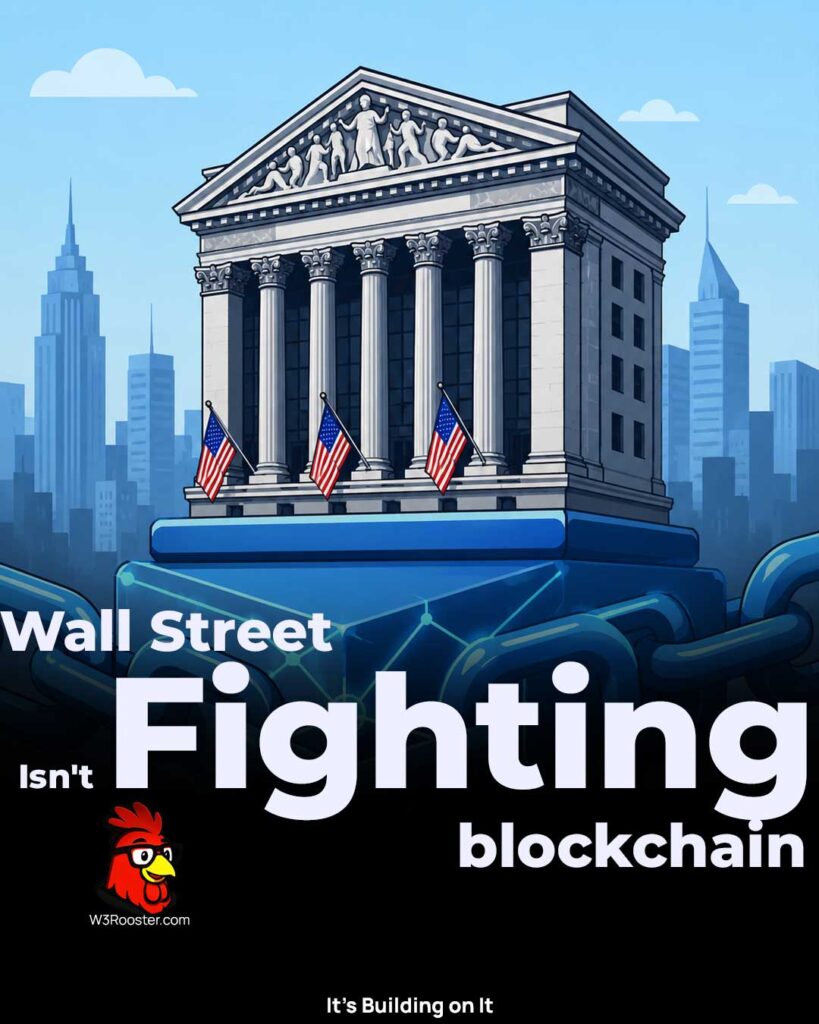
Wall Street Isn’t Fighting Blockchain Anymore—It’s Quietly Building Its Future on It
W3Rooster: For more than a decade, blockchain has been portrayed as a disruptive force determined to challenge the foundations of traditional finance. Supporters envisioned a future where decentralized networks would replace legacy institutions, while critics dismissed the technology as an experiment searching for a practical purpose beyond cryptocurrencies.
Today, however, the conversation has evolved into something far more significant. Rather than resisting blockchain, many of the world’s largest financial institutions are beginning to integrate it into the very infrastructure that powers global capital markets, suggesting that the future of finance may be less about competition between traditional finance and Web3 and more about their convergence.
Recent developments involving institutions such as JPMorgan, BlackRock, Goldman Sachs, Vanguard, the New York Stock Exchange, and the Depository Trust & Clearing Corporation (DTCC) demonstrate that tokenization has moved well beyond proof-of-concept experiments. Their focus is no longer on speculative digital assets but on transforming traditional financial instruments—including publicly traded equities and U.S. Treasury securities—into programmable, blockchain-native assets capable of operating within existing regulatory frameworks. At nearly the same time, the United Kingdom has brought together banks, exchanges, regulators, and infrastructure providers to accelerate tokenization initiatives across wholesale financial markets, reinforcing the idea that this is becoming an international race rather than a regional innovation.
Tokenization Represents Infrastructure, Not Speculation
One of the biggest misconceptions surrounding blockchain is that its value depends entirely on cryptocurrencies. While Bitcoin introduced decentralized money and Ethereum demonstrated how programmable smart contracts could support decentralized applications, the underlying technology has always been capable of much more. Tokenization represents perhaps the clearest example of that broader vision because it focuses not on creating entirely new financial assets, but on improving the infrastructure through which existing assets are issued, transferred, settled, and managed.
When a stock, bond, or Treasury security becomes tokenized, its legal ownership does not suddenly change into something fundamentally different. Instead, blockchain becomes the technological layer responsible for recording ownership, automating settlement, enforcing compliance rules, and reducing operational complexity. From an investor’s perspective, the financial product remains familiar, yet beneath the surface the processes supporting that asset become considerably more efficient.
This distinction is crucial because it illustrates that blockchain’s greatest opportunity may not be replacing financial markets but modernizing how those markets operate.
Why Financial Giants Are Paying Attention
Traditional financial markets have achieved extraordinary scale, but they continue to rely on operational structures that were designed decades ago. Behind every stock purchase lies an intricate network of brokers, custodians, clearing houses, settlement systems, reconciliation procedures, compliance checks, and reporting requirements. Although these mechanisms have proven reliable over many years, they also introduce significant complexity, operational costs, and delays that become increasingly difficult to justify in a digital economy.
Blockchain offers an alternative architecture in which many of these processes can be coordinated through shared, verifiable ledgers and programmable smart contracts. Rather than requiring multiple organizations to maintain separate records that must constantly be reconciled, participants can reference a common source of truth while automated rules execute transfers, collateral management, and settlement with greater efficiency.
For institutions managing trillions of dollars in assets, even modest improvements in settlement speed, liquidity management, collateral utilization, and operational expenses can translate into enormous economic value. This explains why tokenization is attracting attention from firms whose primary objective is not cryptocurrency speculation but financial infrastructure optimization.
The Next Evolution of Capital Markets
What makes the current wave of institutional adoption particularly interesting is that it does not seek to replace regulatory oversight or established financial systems. Instead, blockchain is increasingly being viewed as complementary infrastructure capable of enhancing existing markets while preserving investor protections, legal certainty, and compliance requirements.
This hybrid approach reflects a growing recognition that innovation does not necessarily require abandoning decades of financial regulation. Instead, blockchain can provide faster settlement, greater transparency, programmable ownership rights, and improved operational efficiency without fundamentally altering the legal framework governing securities. In many respects, this resembles previous technological transitions within finance, where digital trading platforms replaced physical trading floors without changing the underlying nature of financial markets themselves.
As a result, blockchain is gradually shifting from being perceived as an alternative financial ecosystem toward becoming an enabling technology that strengthens the one already in place.
A Global Competition Is Emerging
The United States is not the only jurisdiction recognizing this opportunity. The United Kingdom’s recent efforts to coordinate major financial institutions around tokenization highlight that governments increasingly view blockchain infrastructure as a strategic advantage capable of enhancing national competitiveness within global capital markets.
This trend is also visible across Europe, Asia, Singapore, Hong Kong, the United Arab Emirates, and several other financial centers where regulators have introduced frameworks supporting tokenized securities, digital bonds, and real-world asset initiatives. Rather than isolated pilot programs, these efforts collectively suggest that tokenization is becoming part of a broader modernization strategy designed to prepare financial markets for an increasingly digital economy.
As each jurisdiction seeks to attract investment, innovation, and institutional participation, blockchain infrastructure is gradually becoming a competitive differentiator rather than simply another emerging technology.
Blockchain’s Greatest Success May Be Invisible
Ironically, blockchain may achieve mainstream adoption without most investors ever realizing they are using it. Just as billions of people rely on internet protocols without understanding how data travels across networks, future investors may purchase stocks, government bonds, or exchange-traded funds without ever noticing that the underlying settlement process occurs on blockchain infrastructure.
Success, in this context, may not be measured by whether users consciously interact with blockchain, but by whether markets become faster, more transparent, less expensive, and operationally more resilient. The technology succeeds precisely because it becomes invisible, quietly performing its role beneath the applications and financial products people use every day.
History offers numerous examples of transformative technologies that eventually disappeared into the background, becoming so fundamental that users stopped thinking about them entirely. Blockchain may ultimately follow the same trajectory.
What This Means for Web3
For builders, developers, and long-term participants in the Web3 ecosystem, these developments represent an important shift in perspective. The next phase of blockchain adoption is unlikely to be driven solely by speculative cycles or the launch of new cryptocurrencies. Instead, much of the industry’s long-term value creation may come from providing the infrastructure that enables traditional finance to become more programmable, transparent, and efficient.
Rather than replacing Wall Street, blockchain appears increasingly likely to become one of its foundational technologies. Ethereum and other smart contract platforms spent years developing the programmable infrastructure necessary for tokenized assets, decentralized settlement, and digital ownership. Traditional financial institutions are now beginning to apply those innovations at institutional scale, suggesting that the distinction between “crypto” and “traditional finance” may gradually become less meaningful as both ecosystems converge.
At W3Rooster, we see this as one of the defining transitions of the coming decade. Tokenization is no longer simply another blockchain narrative; it is becoming the architectural layer upon which the next generation of global financial markets may be built. If this trajectory continues, the greatest victory for blockchain will not be replacing the financial system that already exists, but quietly becoming the technology that enables its next evolution.