AscendEX’s Shutdown Is a Reminder That Trust Is Web3’s Most Valuable Asset
The closure of a cryptocurrency exchange is never merely another corporate event. It is a stress test for one of the industry’s most persistent and unresolved questions: when technology promises trustlessness, how much of the ecosystem still depends on institutions that must simply be trusted?
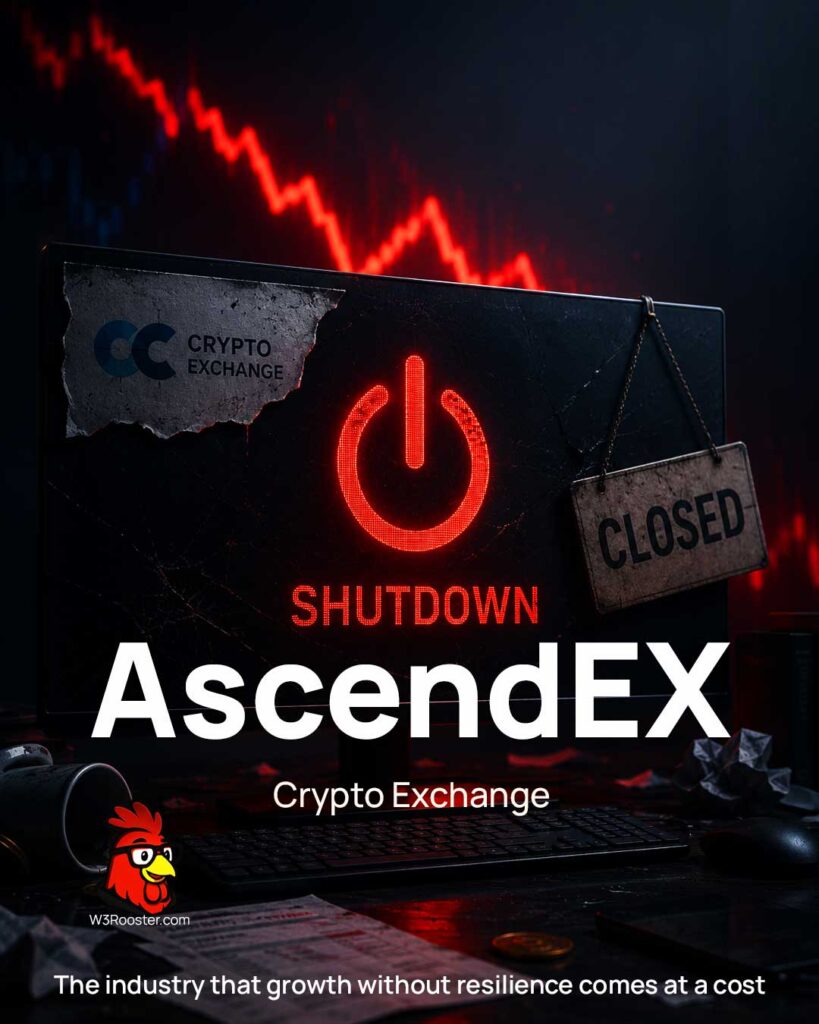
AscendEX has announced the cessation of its operations, citing a combination of regulatory developments, financial pressures, and operational challenges. The company also indicated that user withdrawals would be subject to manual review, creating uncertainty around both the timing and, potentially, the final amounts users may ultimately receive.
For customers, such announcements are naturally personal. An exchange account is not an abstract technological concept when access to funds suddenly becomes uncertain. Yet for the wider cryptocurrency industry, the significance extends well beyond the fate of a single company.
Exchange closures have become one of the recurring reminders of a structural contradiction embedded within the digital-asset economy. Blockchain was conceived partly as an alternative to systems dependent on centralized intermediaries. Bitcoin’s original architecture offered a way to transfer value without requiring users to place absolute faith in a bank, payment processor, or other institutional gatekeeper. But as cryptocurrency evolved from an experimental network into a global financial ecosystem, centralized exchanges became some of its most consequential institutions.
They simplified access, provided liquidity, converted fiat currencies into digital assets, and made crypto markets accessible to hundreds of millions of people who had little interest in managing private keys or interacting directly with decentralized protocols.
In doing so, however, they also reintroduced a familiar problem. Trust. For W3Rooster, the AscendEX story is therefore larger than the operational difficulties of one exchange. It illustrates a lesson the blockchain industry continues to rediscover, often at considerable expense: sophisticated technology can reduce certain forms of institutional risk, but technology alone cannot manufacture credibility. Trust remains an economic asset. In Web3, it may be the most valuable one.
Innovation Must Be Matched by Operational Strength
Blockchain technology is often discussed through the language of architecture. Decentralization, immutability, cryptographic verification, distributed consensus, and transparency have become central concepts in the industry’s vocabulary. These characteristics matter because they attempt to replace some traditional forms of institutional trust with mathematical verification.
A blockchain transaction does not require participants to know one another personally. The system is designed so that agreed rules, cryptographic signatures, and network consensus can provide assurance where personal familiarity cannot.
That technological achievement is significant. Yet the broader crypto economy is not composed exclusively of blockchains. Around every major blockchain ecosystem sits a substantial layer of infrastructure: exchanges, custodians, wallet providers, stablecoin issuers, lending platforms, market makers, payment processors, analytics companies, and increasingly, regulated financial institutions. Many of these organizations are centralized to varying degrees. They make decisions behind closed doors, maintain corporate treasuries, employ executives, negotiate with regulators, manage cybersecurity risks, and occasionally discover that the elegant theories of digital finance become considerably messier when confronted with payroll, liquidity shortages, lawsuits, or banking relationships.
Centralized exchanges occupy a particularly important position in this infrastructure.
For many users, an exchange is the practical front door to cryptocurrency. It is where they buy their first Bitcoin, trade tokens, convert assets back into national currencies, and often store substantial balances. The blockchain itself may be decentralized, but the customer’s experience can remain profoundly centralized.
That distinction is easy to overlook during periods of market optimism. When deposits and withdrawals function normally, liquidity appears abundant, and customer support responds quickly enough, users rarely spend much time contemplating the architecture of institutional risk.
The question becomes much more important when something stops working. A centralized exchange asks users to make several assumptions simultaneously. Customers must assume their assets are properly safeguarded, that internal accounting accurately reflects liabilities, that liquidity is sufficient to meet withdrawals, that cybersecurity systems are competent, and that management will communicate honestly when conditions deteriorate.
These assumptions cannot be replaced entirely by a polished interface or an impressive technology stack. Users expect platforms entrusted with their assets to protect customer funds, maintain sufficient liquidity, operate transparently, adapt to changing regulations, and communicate clearly during periods of institutional stress. When one of these foundations begins to weaken, confidence can deteriorate with surprising speed.
Finance has always understood this dynamic. Banks, for example, are not simply collections of vaults and spreadsheets. They are institutions sustained partly by confidence. A bank can appear healthy one week and face a liquidity crisis the next if enough customers simultaneously lose faith and attempt to withdraw funds. Cryptocurrency has introduced new technological mechanisms, but it has not repealed the psychology of financial confidence.
Indeed, the speed of digital markets can intensify it. Information travels instantly. Social media can amplify rumors within minutes. Blockchain data can be interpreted, misinterpreted, or selectively presented by analysts and anonymous accounts. A screenshot suggesting withdrawal problems can circulate globally before a company has formulated a response.
The result is an environment in which operational credibility must be maintained continuously. Trust is not a reserve that can be deposited once and forgotten. It must be replenished.
The Custody Paradox at the Heart of Crypto
One of the more interesting paradoxes in cryptocurrency is that an industry built around reducing reliance on trusted intermediaries has created some of the most influential financial intermediaries of the digital era.
The phrase “not your keys, not your coins” emerged precisely because of this tension. Self-custody gives users direct control over cryptographic keys and, by extension, their assets. It eliminates some forms of counterparty exposure associated with holding funds on an exchange.
But self-custody introduces its own responsibilities.
Managing private keys is unforgiving. Losing a password to an online banking account is inconvenient; losing access to a cryptographic private key can be irreversible. Sending a traditional bank transfer to the wrong recipient may sometimes be corrected. Sending digital assets to an incompatible or incorrect blockchain address can produce a very different outcome.
Centralized exchanges became successful partly because they solved these usability problems. They acted as custodians, recovery mechanisms, trading venues, and customer-service layers. They transformed an unfamiliar cryptographic system into something closer to conventional online finance.
Convenience, however, comes with institutional dependence. The user who deposits assets into a centralized platform is no longer dealing exclusively with blockchain code. That user is also dealing with corporate governance, internal controls, legal jurisdictions, treasury management, banking partners, cybersecurity teams, and executive decision-making.
This is not necessarily an argument against centralized exchanges. Modern financial systems depend on intermediaries for many legitimate reasons. Professional custody, compliance systems, consumer protection mechanisms, and deep liquidity cannot simply be dismissed as relics of an older financial order.
The more useful question is whether these institutions have developed operational standards proportionate to the responsibility they assume. That is where the industry still faces uneven progress. A cryptocurrency company can possess exceptional engineering talent while suffering from weak financial controls. It can develop sophisticated trading infrastructure while maintaining inadequate crisis communication. It can speak fluently about decentralization while operating internally through a highly concentrated management structure.
Technical innovation and institutional maturity are related, but they are not the same thing. W3Rooster’s perspective is that the next stage of Web3 development will increasingly depend on recognizing this distinction. The industry’s competitive advantage can no longer rest exclusively on launching faster products, adding new tokens, or attaching fashionable terminology to existing financial services. Infrastructure eventually has to behave like infrastructure. That means reliability must become less glamorous but more important.
Regulation Is Only Part of the Story
Regulatory developments are frequently invoked when cryptocurrency businesses encounter difficulty, and in many cases regulation genuinely is a significant factor.
The global digital-asset industry operates across a fragmented legal landscape. A platform may serve users in multiple jurisdictions, each with different rules concerning securities, derivatives, consumer protection, anti-money-laundering procedures, custody, taxation, and licensing. Requirements can evolve rapidly, while enforcement priorities may differ substantially between countries.
For exchanges, compliance is not a decorative administrative department attached to the engineering team. It has become a central component of corporate survival. Licenses must be obtained and maintained. Banking relationships must be protected. Customer-identification systems must satisfy regulatory expectations. Transactions may require monitoring. Certain products may become unavailable in particular jurisdictions. New legislation can change the economics of an entire business model.
All of this creates genuine pressure. Yet regulation can also become a convenient explanation for problems that have deeper origins. When a platform experiences difficulty, it is tempting to attribute the situation entirely to hostile regulators or an uncertain legal environment. Sometimes that narrative is accurate. More often, however, institutional failure is more complicated. Regulation may expose weaknesses that already existed rather than creating every weakness from nothing.
A healthy financial organization should be designed with the expectation that rules will change. This is hardly unique to cryptocurrency. Banks operate under evolving capital requirements. Technology companies navigate changing privacy legislation. Pharmaceutical companies face shifting regulatory standards. Energy companies adapt to environmental policy. Institutional resilience requires anticipating uncertainty rather than assuming that the operating environment will remain permanently favorable.
The cryptocurrency sector is gradually being forced to learn the same lesson. Regulatory ambiguity can be frustrating, inconsistent, and expensive. But uncertainty itself is now part of the industry’s strategic environment. Companies that treat compliance merely as an obstacle may find themselves structurally unprepared for the next phase of institutionalization.
Those that integrate regulatory intelligence into their operating model may discover that compliance eventually becomes a competitive advantage. This does not mean blindly celebrating every regulatory intervention. Poorly designed rules can suppress innovation, create unnecessary barriers to entry, and push activity into less transparent jurisdictions. The objective should be intelligent regulation rather than regulation for its own sake.
Nevertheless, blaming every institutional failure on regulators risks obscuring a more uncomfortable question. Was the organization built to survive adversity? That question is becoming increasingly important as Web3 moves beyond its experimental adolescence.
Resilience Is Becoming as Important as Innovation
The early years of cryptocurrency rewarded speed. New exchanges could emerge rapidly. Tokens could attract enormous attention in short periods. Entire categories of decentralized finance could develop within months. The pace of experimentation was extraordinary, and occasionally chaotic.
That velocity remains one of the industry’s strengths. It also encouraged a culture in which launching was often treated as more important than enduring. But the criteria for success are changing. As digital assets become increasingly connected to institutional finance, payment systems, corporate treasuries, investment products, and potentially national economic infrastructure, the tolerance for operational fragility is likely to decline.
A prototype can afford to fail differently from a financial institution. This distinction matters. An application with occasional downtime may frustrate users. A trading venue unable to process withdrawals can trigger an entirely different category of concern. When a company handles other people’s money, resilience stops being a technical aspiration and becomes an institutional obligation.
Resilience has several dimensions. There is financial resilience: sufficient liquidity, prudent treasury management, and an understanding of what happens under adverse market conditions. There is operational resilience: the ability to continue functioning when systems fail, employees leave, counterparties collapse, or external infrastructure becomes unavailable.
There is cybersecurity resilience, which has become particularly important in an industry where attacks are persistent and the assets involved can move globally at extraordinary speed. And there is reputational resilience: the ability to communicate credibly when circumstances become uncomfortable.
The last category is frequently underestimated.
Companies often communicate confidently during periods of growth because good news is comparatively easy to explain. The true test of institutional communication occurs when executives possess incomplete information, customers are anxious, and every public statement may be scrutinized for inconsistency.
Silence can create speculation. Overconfidence can destroy credibility. Excessive legal caution can sound evasive. The challenge is to communicate honestly without making promises that cannot be fulfilled.
That requires preparation long before a crisis begins. In this respect, the cryptocurrency industry has much to learn from sectors that have spent decades developing crisis-management disciplines. Aviation, banking, telecommunications, and critical infrastructure all understand that operational failure cannot be addressed solely after it occurs.
The objective is to build systems capable of absorbing shocks. Nassim Nicholas Taleb popularized the concept of antifragility: systems that do not merely resist disorder but can improve through exposure to stress. The idea is particularly relevant to Web3. A mature blockchain organization should not define success as never encountering difficulty. Complex systems inevitably encounter difficulty.
The more meaningful measure is what happens next. Does the institution have procedures? Does it have reserves? Does governance function under pressure? Can users understand what is happening? Can the organization recover credibility? These are less fashionable questions than discussions about token launches or technological roadmaps. They may also be more consequential.
The Cybersecurity Dimension of Institutional Trust
The conversation around trust in cryptocurrency cannot be separated from cybersecurity.
Digital assets have created a particularly unforgiving security environment because successful attacks can result in immediate and irreversible financial consequences. A compromised password, stolen private key, malicious smart contract approval, or vulnerability in an internal system can produce losses at a scale that traditional organizations might spend years attempting to recover.
For exchanges, security is therefore inseparable from reputation. Users do not generally distinguish between different categories of institutional failure with the nuance an internal risk committee might prefer. Whether funds become inaccessible because of a cyberattack, liquidity shortage, administrative breakdown, or operational shutdown, the customer’s fundamental concern is straightforward: can I access what I believed belonged to me?
This is why cybersecurity must be understood as part of financial governance rather than merely an engineering function. The strongest technical defenses can still be undermined by poor internal procedures. Multi-signature wallets, cold-storage systems, hardware security modules, access controls, transaction monitoring, and penetration testing all matter. But technology exists within organizations run by people.
Insider risk remains possible. Human error remains possible. Social engineering remains remarkably effective. A sophisticated system can be compromised by a remarkably unsophisticated mistake. This is one reason the industry’s fixation on technological novelty occasionally distracts from more mundane but essential disciplines. Good security often looks boring when it works. It involves redundant controls, documented procedures, audits, separation of responsibilities, and employees being required to follow processes that may appear inconvenient.
There is little glamour in a properly configured access-control policy. There is considerably less glamour in explaining to customers why one was necessary after a breach. The future of Web3 security may therefore involve a subtle cultural adjustment. The industry has historically celebrated builders who move quickly and challenge institutional conventions. That entrepreneurial instinct has produced remarkable innovation. Yet organizations responsible for substantial pools of customer assets must eventually balance experimentation with conservatism.
Some systems should be difficult to change. Some approvals should require more than one person. Some funds should be deliberately inaccessible to operational staff. In finance, friction is occasionally a feature.
Every Exchange Closure Becomes an Industry Case Study
When a major platform encounters serious difficulty, the immediate attention naturally focuses on customers, creditors, management, and the circumstances surrounding the event.
The longer-term significance is often broader. Every institutional failure becomes a case study for the industry. The cryptocurrency sector has already experienced several cycles of this kind. Each major collapse or security incident produces an initial period of shock, followed by investigations, explanations, recriminations, and eventually new proposals for preventing similar problems.
Sometimes the lessons are genuinely absorbed. Sometimes they are remembered only until the next bull market makes caution seem unfashionably pessimistic. This pattern is not unique to crypto. Financial history is crowded with institutions that convinced themselves they had discovered new ways to manage old forms of risk. Technology changes, but leverage, liquidity, concentration, fraud, and human overconfidence possess an extraordinary capacity for reinvention.
Blockchain has altered the mechanics of finance. It has not eliminated the psychology of it. The closure of an exchange should therefore encourage a broader examination of institutional architecture.
How are customer assets segregated? What happens when normal operations cease? Who has authority over emergency decisions? How transparent are financial conditions? How quickly can users withdraw assets? What information is available before a crisis rather than after one?
These questions are not glamorous marketing material, but they are increasingly likely to determine which companies survive multiple market cycles.
There is also an investor perspective worth considering. For years, crypto investors primarily evaluated projects through technological potential, token economics, adoption metrics, and market momentum. Those variables remain important, but institutional quality deserves greater attention. An impressive protocol can be damaged by incompetent governance. A profitable platform can be destabilized by poor treasury management.
A technically superior product can lose users if management communicates in a manner that appears opaque or evasive. The market is slowly learning to price credibility, although not always efficiently.
Reputation can take years to build and days to damage. Warren Buffett famously observed that it takes twenty years to build a reputation and five minutes to ruin it. The precise arithmetic is less important than the principle. In digital finance, where users can move capital with a few clicks, reputational deterioration can occur at network speed. That makes trust a strategic asset rather than a public-relations slogan.
Governance Is Moving From a Legal Formality to a Competitive Advantage
One of the most consequential developments in the evolution of Web3 may be the growing importance of governance. During the industry’s earlier years, governance often sounded abstract. It appeared in white papers, token-voting mechanisms, corporate structures, and discussions about decentralization. But institutional stress has a way of transforming governance from theory into something much more tangible.
Who makes decisions when conditions deteriorate? Who can authorize movement of funds? Who is accountable for risk? What information reaches stakeholders? How are conflicts managed? These questions determine whether governance is merely a diagram in a presentation or an operational system capable of functioning under pressure.
Transparent governance does not mean publishing every internal conversation. Businesses have legitimate confidentiality requirements, and indiscriminate disclosure can sometimes create additional risks. Transparency, rather, involves making the fundamental structure of accountability understandable.
Users and investors should be able to develop a reasonable picture of who controls what, how major risks are managed, and what protections exist when ordinary operations fail. Decentralized autonomous organizations have attempted to address some of these issues through on-chain voting and distributed decision-making. Their experiments have been intellectually valuable, though decentralized governance introduces complications of its own. Token holders may not participate. Voting power may become concentrated. Technical complexity can limit meaningful oversight.
Decentralization does not automatically produce good governance. Centralization does not automatically produce bad governance. The quality of governance depends on incentives, accountability, competence, and the ability to identify problems before they become existential.
This is another area where the industry’s vocabulary occasionally needs more precision. A system can be decentralized technologically while remaining concentrated economically. A company can market transparency while revealing little information of practical value. Governance should therefore be evaluated by how an institution behaves when incentives become misaligned, not by the terminology used in its marketing materials.
W3Rooster’s broader research perspective is that Web3 is entering a period in which institutional design may become almost as important as protocol design. The most successful organizations will need both.
Sustainable Business Models Matter More Than Market Narratives
Crypto has never lacked ambitious narratives. There is always another technological frontier approaching: decentralized finance, tokenization, digital identity, gaming economies, artificial intelligence agents, decentralized physical infrastructure, stablecoins, real-world assets, and countless variations on those themes.
Many of these developments have genuine potential. But narratives do not pay operating expenses. A company can attract attention while losing money. It can report substantial trading volumes while possessing fragile margins. It can expand internationally while accumulating regulatory obligations faster than sustainable revenue. It can raise capital and postpone difficult questions for several years.
Eventually, however, the arithmetic becomes difficult to negotiate with. Sustainable business models are particularly important for exchanges because their revenues can be cyclical. Trading activity frequently expands during periods of intense market enthusiasm and contracts when interest declines. An organization built for perpetual peak activity may find quieter markets considerably less forgiving.
Diversification can help, but diversification itself introduces complexity. Additional products require additional compliance, security, staffing, and operational oversight. Growth therefore creates its own category of risk. The assumption that bigger automatically means safer deserves scrutiny. Larger organizations may possess greater resources, but they also develop more complicated systems and potentially more points of failure.
The objective should not simply be growth. It should be durable growth. That distinction may sound obvious, but financial history demonstrates how frequently it is ignored. Expansion is visible. Resilience is harder to market. No conference audience is likely to applaud a presentation titled “Our Improved Internal Reconciliation Procedures.” Yet accurate reconciliation procedures may contribute more to institutional longevity than a dozen ambitious announcements. This is the peculiar economics of trust infrastructure. The most important systems are often the least exciting.
Communication During Stress Is Part of the Product
Technology companies tend to think of their products as software, interfaces, networks, or services. Financial institutions have another product, whether they acknowledge it or not: confidence. Confidence is shaped partly by performance and partly by communication.
During normal operations, a company can afford a degree of ambiguity because users assume they can access services tomorrow. During periods of uncertainty, ambiguity becomes much more expensive.
Customers want to know what happened. They want to understand what happens next. They want timelines, even if those timelines contain uncertainty. They want distinctions between confirmed facts and ongoing investigations.
Most importantly, they want to avoid discovering crucial information from third parties.
The history of corporate crises repeatedly demonstrates that communication failures can compound operational failures. A technical problem may be survivable. A technical problem followed by inconsistent statements, delayed disclosures, and visible confusion within management can become a crisis of institutional legitimacy.
This does not mean executives should speculate publicly or promise outcomes beyond their control. Responsible communication requires precision. Saying “we do not yet know” is often more credible than manufacturing certainty.
There is a useful parallel with cybersecurity incident response. The best organizations prepare communication protocols before an attack occurs. They know who is responsible for technical investigation, who communicates with customers, who speaks to regulators, and what information can be verified. Crypto companies should increasingly approach financial stress with similar discipline. Crisis communication should not be improvised on social media at midnight. The industry has grown beyond that stage, or at least it should.
What AscendEX’s Situation Means for Web3
The broader lesson from any exchange shutdown is not that centralized services are inherently doomed or that decentralized technology provides an automatic solution to institutional failure.
The lesson is more nuanced. Web3 remains a hybrid ecosystem. Its future will likely include decentralized protocols alongside centralized platforms, regulated institutions alongside experimental networks, self-custody alongside professional custody, and automated systems alongside human judgment.
The important challenge is determining where trust is necessary and how that trust should be verified. Projects, developers, investors, and users are increasingly recognizing that long-term adoption depends on more than exciting technology. Transparent governance, responsible treasury management, strong operational controls, sustainable business models, cybersecurity discipline, and clear communication all contribute to the credibility of the broader ecosystem.
These principles are not peripheral to blockchain’s future. They are part of its infrastructure. The industry’s most durable organizations may eventually be distinguished less by the boldness of their marketing than by the predictability of their operations. That represents a cultural shift for a sector accustomed to celebrating disruption.
Disruption is valuable when it improves broken systems. It is less impressive when the disruption consists of users discovering that basic institutional safeguards were absent. Web3’s long-term ambition has always been larger than speculative trading. The technology promises new mechanisms for ownership, coordination, settlement, identity, and digital economic organization.
Those ambitions require trust at a different scale. A blockchain application managing a small experimental community can tolerate a certain degree of institutional informality. A network intended to support global commerce cannot.
As blockchain becomes more integrated with conventional financial infrastructure, expectations will rise accordingly. Institutional investors will demand risk controls. Regulators will demand accountability. Businesses will demand reliability. Ordinary users will demand something even simpler: confidence that the system will work when they need it. The technology must meet those expectations without abandoning the principles that made blockchain valuable in the first place. That balancing act will define much of the industry’s next decade.
Looking Beyond the Headlines
There is a temptation to view every crypto crisis as evidence either that the entire industry is fundamentally broken or, conversely, that critics simply fail to understand the technology.
Both reactions are intellectually convenient. Neither is particularly useful. The cryptocurrency industry is capable of extraordinary technical innovation and extraordinary institutional mistakes, sometimes simultaneously. It has produced systems that allow strangers to settle value across borders without traditional intermediaries, while also producing companies that have rediscovered financial risks centuries older than the internet.
Progress does not move in a straight line. The more mature perspective is to recognize that technological innovation and institutional competence develop at different speeds. Software can be written rapidly. Trust infrastructure takes longer.
Artificial intelligence is now making digital systems increasingly autonomous. Blockchain is creating new mechanisms for transparency, verification, and programmable ownership. Together, these technologies could significantly alter how economic systems operate.
Yet neither artificial intelligence nor blockchain can replace responsible leadership. Algorithms can automate decisions, but they cannot eliminate the importance of deciding which risks should never be automated. Blockchains can create transparent records, but they cannot guarantee that every organization interacting with those records is competently governed.
Smart contracts can execute predetermined rules, but they cannot determine whether the rules themselves were wise. Technology changes the available tools. It does not absolve institutions of judgment.
For W3Rooster, this is the deeper significance of stories such as AscendEX’s shutdown. The industry’s future will not be determined solely by which protocol processes the most transactions or which platform grows fastest during the next market cycle. Those measurements capture activity, but activity and durability are different qualities.
The strongest blockchain ecosystems of the next decade may be those that understand this distinction early. They will innovate, certainly. But they will also maintain reserves when optimism is abundant, invest in security when nothing appears to be happening, develop governance before conflict emerges, and communicate clearly when circumstances become difficult.
In other words, they will treat trust as something that must be engineered institutionally as carefully as software is engineered technically. That may be Web3’s least glamorous challenge. It may also be its most important one. The closure of a cryptocurrency exchange is never just another industry headline. It is a reminder that behind every wallet interface, trading engine, blockchain explorer, and cryptographic protocol sits a more fundamental question about human institutions.
Who is responsible? What happens when systems fail? And why should anyone trust the answer?
Blockchain can verify transactions. Only institutions can demonstrate, over time, that they deserve confidence. That distinction will matter long after the headlines surrounding any individual exchange have disappeared.