Stablecoins Are Becoming Blockchain Infrastructure
Why the Next Phase of Digital Finance May Be Built Around Programmable Money?
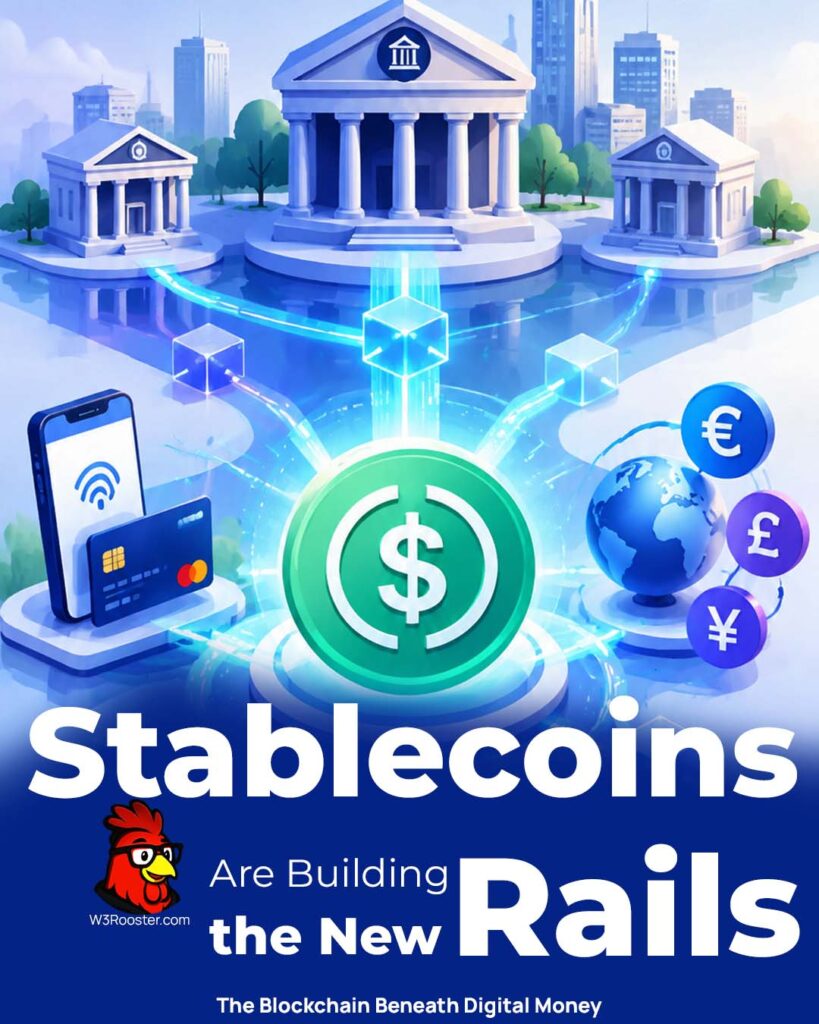
Stablecoins are evolving from digital dollars into infrastructure connecting payments, settlement, FX, and tokenized finance.
Stablecoins are moving beyond their role as dollar-pegged tokens. With purpose-built networks such as Circle’s Arc, the industry is beginning to experiment with blockchains designed specifically for payments, settlement, foreign exchange and tokenized financial assets.
For years, stablecoins were mostly described as the boring part of crypto: digital dollars designed to stay at $1 while everything around them moved at much greater speed.
That description is becoming increasingly inadequate. Stablecoins now sit at the intersection of payments, trading, treasury management and tokenized finance. The next stage of the industry is therefore less about creating another digital dollar and more about building infrastructure capable of moving those dollars efficiently at global scale.
Circle’s Arc is one of the clearest examples of this transition. Announced in August 2025 as an open Layer-1 blockchain purpose-built for stablecoin finance, Arc is designed around payments, foreign exchange, settlement and tokenized assets rather than trying to become another general-purpose blockchain competing for every possible crypto application.
That distinction matters. The question is no longer simply whether stablecoins will become important. It is whether stablecoins will influence how the underlying financial infrastructure itself is designed.
Why Existing Blockchains May Not Be Enough
Stablecoins already operate across numerous networks, including Ethereum and other high-throughput chains. That multichain model has helped digital dollars spread rapidly, but it also creates friction.
A financial institution does not necessarily want to manage a volatile cryptocurrency merely to pay transaction fees. A multinational business may not want sensitive payment information permanently exposed on public infrastructure. And a treasury department generally prefers predictable costs and settlement rules rather than having to account for fluctuating network fees.
These are mundane concerns, but they are precisely the kinds of concerns that determine whether technology becomes financial infrastructure. Circle’s rationale for Arc is built around those constraints. The company designed the network to use USDC for gas, provide deterministic sub-second finality, offer an embedded foreign-exchange mechanism and include optional privacy features intended to accommodate institutional requirements.
In other words, Arc is attempting to make blockchain infrastructure behave more like financial plumbing. And financial plumbing rarely wins attention because it is exciting. It wins because people eventually depend on it.
Arc Represents a Different Blockchain Philosophy
Ethereum was designed as a broad, programmable blockchain. Solana likewise pursues a wide range of applications while emphasizing performance. Arc takes a considerably narrower approach. Its premise is that stablecoin finance has sufficiently distinctive requirements to justify dedicated infrastructure.
That means the network is not merely another place where USDC happens to exist. Its architecture is being organized around activities such as cross-border payments, stablecoin foreign exchange, treasury operations, capital-markets settlement and tokenized collateral. Circle also says Arc can support tokenized equities, commodities, real estate and other forms of digital value.
Independent analysis of Arc similarly characterizes it as an open Layer-1 focused specifically on stablecoin-native financial activity, with EVM compatibility intended to reduce the learning curve for developers already familiar with Ethereum tooling.
That is an important strategic choice.
Instead of asking financial applications to adapt themselves to a general-purpose blockchain, Arc attempts to adapt the blockchain to financial applications.
USDC as Gas Changes More Than the Fee Model
One of Arc’s less glamorous features could prove to be one of its most consequential: USDC is used for transaction fees. On conventional blockchain networks, users generally pay gas in the network’s native asset. That creates an additional treasury requirement for businesses. If a company wants to transact on a chain, it needs to acquire and manage another cryptocurrency whose dollar value can fluctuate.
For a retail user, that may be an inconvenience. For an institution processing substantial volumes of payments, it can become an operational issue. Using USDC as the gas asset makes the cost structure dollar-denominated and easier to forecast. Circle argues that this can simplify accounting and treasury management while removing the need to maintain a separate volatile token merely to operate financial applications.
It is a subtle change, but it reflects a larger principle: institutional blockchain infrastructure may increasingly be designed around the asset being moved rather than around a speculative asset securing the network.
The Stablecoin Is Becoming More Than Money
Another reason this trend deserves attention is that the infrastructure being built around stablecoins is not necessarily limited to payments. Circle’s Arc architecture incorporates support for assets such as USDC, EURC and USYC, while its broader design contemplates tokenized financial instruments and capital-markets settlement.
This creates a potentially powerful combination.
A network can have dollar and euro stablecoins functioning as settlement money while tokenized securities and other financial instruments represent the assets being exchanged. That begins to resemble a complete financial environment rather than a cryptocurrency network with a payments feature attached.
W3Rooster’s broader perspective on this development is that the important story is therefore not simply “Circle is launching a blockchain.” The more consequential question is whether stablecoins can become the monetary layer connecting programmable assets, financial applications and global settlement.
The Data Suggests Stablecoin Activity Is Already Complex
There is also evidence that stablecoin activity is not simply a collection of straightforward person-to-person payments. A recent academic study examining approximately 370 million USDT and USDC transactions on Ethereum found distinct statistical patterns depending on whether transactions involved externally owned accounts or smart contracts. The research identified heavy-tailed transaction-value distributions and separate scaling regimes across transaction categories.
That finding is significant because smart-contract activity represents something different from an individual sending dollars to another individual. Stablecoins can be embedded inside automated financial systems, trading mechanisms, lending protocols and other applications. As these interactions become more sophisticated, the infrastructure supporting them has to accommodate not just money transfers but machine-executed financial activity.
This is one reason the stablecoin infrastructure debate deserves to be treated as a technology and financial-market story, not merely a crypto-token story.
Circle Is Moving Further Down the Stack
Arc also reveals something about Circle’s own evolution. The company’s original proposition was comparatively straightforward: issue a digital dollar that businesses and users can move on blockchain networks. But controlling only the asset can leave the issuer dependent on infrastructure designed by somebody else.
Arc changes that equation. Circle can potentially influence the settlement environment, fee model, interoperability, foreign-exchange mechanisms and developer tooling surrounding its stablecoin. Its existing infrastructure stack—including payments, wallets, cross-chain transfer and other services—is intended to integrate with Arc.
That does not guarantee that Arc will dominate stablecoin settlement. Far from it. But it demonstrates that the competition is moving downward through the stack. The next contest may not simply be which stablecoin has the most users, but which infrastructure captures the economic activity generated by those stablecoins.
This Does Not Mean Every Stablecoin Needs Its Own Blockchain
There is an important counterargument. Stablecoins have already demonstrated that they can flourish across multiple networks. USDT and USDC do not need to exist on only one blockchain to be useful. In fact, the multichain model can provide access to different liquidity pools, applications and user communities. A dedicated stablecoin-oriented blockchain therefore has to prove that its specialization creates enough value to justify another network.
This is where Arc’s strategy becomes particularly interesting. Circle explicitly describes Arc as multichain-aligned rather than as a replacement for every other blockchain. Its objective is to create specialized infrastructure while remaining connected to the wider ecosystem.
That distinction could become crucial.
The future may not be a single “stablecoin chain.” It could instead be a network of specialized settlement environments connected through interoperability infrastructure, with different chains optimized for different financial functions.
The Bigger Opportunity Is Tokenized Finance
Payments are only one piece of the equation. If stablecoins become reliable settlement assets and purpose-built networks become reliable settlement infrastructure, tokenized financial assets can potentially operate on the same rails. That creates a more intriguing architecture: stablecoins provide programmable money, tokenized assets provide programmable ownership, and blockchains provide the settlement environment connecting them.
Arc’s stated ambitions around capital markets and tokenized collateral point directly toward this possibility. Circle envisions applications ranging from cross-border payments and stablecoin FX to tokenized securities and automated financial workflows.
The implications extend beyond crypto markets. A tokenized money-market fund, for example, does not merely need a token. It needs a mechanism for transferring ownership, moving collateral, settling transactions and interacting with other financial instruments. That is where blockchain infrastructure becomes more interesting than blockchain speculation.
What This Means for the Crypto Industry
For investors and crypto businesses, this evolution changes the competitive landscape. Stablecoin issuers may increasingly resemble infrastructure companies. Blockchain networks may compete on settlement capabilities and institutional usability rather than simply transaction throughput. Financial institutions may evaluate chains based on operational characteristics that sound remarkably similar to conventional financial infrastructure: finality, privacy, liquidity, compliance and predictable costs.
The winners will not necessarily be the chains with the loudest communities. They may be the networks that quietly process enormous amounts of financial activity without users even noticing which blockchain sits underneath. That would represent a profound change from the first decade of crypto.
The Real Test Has Not Happened Yet
There is still a significant gap between infrastructure design and infrastructure adoption. Arc’s architecture is compelling on paper, but purpose-built functionality does not automatically translate into network effects. Ethereum has an enormous developer ecosystem, while other high-performance networks already have substantial liquidity and applications.
Arc therefore has to demonstrate that its specialized architecture solves problems important enough for institutions and developers to change their existing behavior. The same applies to the broader thesis that stablecoins are becoming blockchain infrastructure.
The direction is visible. The final outcome is not.
W3Rooster’s research perspective is that this uncertainty is precisely what makes the subject worth following. The most interesting stories in crypto are often not about what has already won, but about infrastructure being built today that could quietly determine how financial markets operate tomorrow.
A Simple Proposition
Stablecoins began as a relatively simple proposition: create digital representations of fiat currencies that can move across blockchain networks. They are becoming something considerably more ambitious.
The emergence of Arc suggests that the industry is experimenting with a new model in which the stablecoin is not merely an asset sitting on top of a blockchain. Instead, the stablecoin can become the organizing principle around which an entire settlement network is designed. Whether that model ultimately outperforms general-purpose blockchains remains unresolved. But the experiment itself is important.
If it succeeds, the defining blockchain infrastructure of the next financial era may not be built around speculative tokens at all. It may be built around programmable dollars, programmable euros, tokenized securities and the increasingly sophisticated rails that connect them. And that would make stablecoins far more than a crypto product.
They could become part of the architecture of finance itself.