The ECB Just Put Central-Bank Money Into Tokenized Finance. Who Controls the Money Behind the Blockchain?
Pontes Is More Than Another Blockchain Project
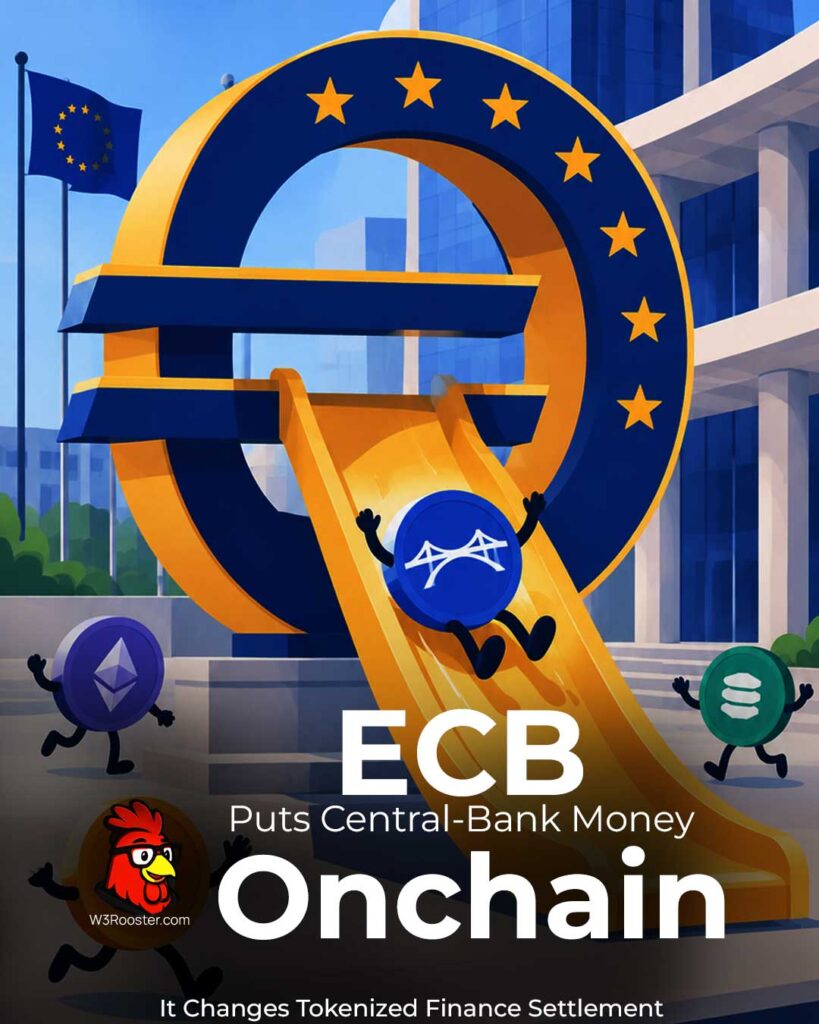
The European Central Bank has launched Pontes, a new settlement solution connecting distributed-ledger-based financial markets with central-bank money. The immediate event matters, but the deeper question is much larger: as securities move onto blockchains, what form of money will ultimately settle them? The answer could determine whether tokenized finance becomes an extension of traditional markets, a stablecoin-driven parallel system, or something structurally different.
On September 21, the Eurosystem launched Pontes to enable wholesale transactions involving tokenized assets to settle in central-bank money. Rather than creating a retail payment product, Pontes is aimed at banks and financial-market infrastructures, connecting distributed-ledger technology with the Eurosystem’s existing payment infrastructure. The ECB describes the launch as the first step in a broader strategy to make central-bank money suitable for a tokenized financial environment.
That distinction is important because the headline can easily be misunderstood. Pontes is not simply a new European blockchain, nor is it the retail digital euro. It is infrastructure designed to solve a particular problem: how can tokenized financial assets settle in central-bank money when the asset itself is recorded or traded on distributed-ledger infrastructure?
For years, the crypto industry approached this question from the opposite direction. It built blockchain-native forms of money first and then used them to settle increasingly sophisticated digital assets. Pontes represents a major institutional alternative: keep the advantages of distributed ledgers for financial assets while connecting their settlement to money issued by the central bank.
That makes Pontes less interesting as a standalone technology than as a sign of where the architecture of finance may be heading.
The Real Battle Is Over the Settlement Layer
Tokenization is often described as the process of putting stocks, bonds, funds or other assets on a blockchain. But an asset cannot exist in isolation. Every securities transaction also involves a payment leg, and the quality of that payment leg can determine how useful the tokenized market ultimately becomes.
This is where the ECB’s intervention becomes significant. Central-bank money is generally regarded within the financial system as the risk-free settlement asset because it represents a direct claim on the central bank. Pontes is intended to make that form of money available for transactions involving tokenized assets rather than forcing institutions to rely exclusively on commercial-bank money or privately issued digital currencies.
That creates a strategic contest that is broader than blockchain technology itself. One possible future relies heavily on stablecoins. Another could rely on tokenized commercial-bank deposits. A third could connect tokenized markets directly to central-bank settlement infrastructure. These systems do not necessarily have to eliminate one another, but their respective roles could determine where liquidity, risk and control accumulate.

W3Rooster has previously examined how stablecoins are evolving into financial infrastructure rather than merely digital representations of fiat currency. Pontes introduces the other side of that equation: if programmable assets become increasingly important, central banks may not be willing to leave the underlying settlement layer entirely to private issuers.
Pontes Is a Bridge, Not the Destination
There is another detail that deserves more attention than it has received. Pontes does not represent the complete replacement of conventional financial infrastructure with blockchain. Its initial architecture connects DLT-based market platforms with existing Eurosystem payment services. The ECB plans to expand Pontes gradually, including enhanced functionality and longer operating hours, with further implementation expected by 2028.
That makes the name “Pontes” unusually appropriate. A bridge is useful precisely because two systems still exist on either side of it. The longer-term project is the ECB’s Appia initiative, which is intended to produce a blueprint for a tokenized European financial ecosystem. Pontes therefore should be viewed as an important piece of a developing architecture rather than evidence that Europe’s financial system has suddenly migrated onto a blockchain.
This distinction matters when evaluating the technology. A bridge can prove that two systems can communicate without proving that one system will eventually replace the other. The more interesting question for the next several years is whether Pontes remains primarily a connection between conventional and tokenized markets, or becomes one component of a much more integrated digital financial infrastructure.
The ECB Is Not Just Building the Infrastructure. It Plans to Use It
Perhaps the most revealing part of the September 21 announcement was not Pontes itself. The ECB also began preparatory work to invest a small portion of its own funds in tokenized securities. The initial focus is expected to include euro-denominated securities issued by euro-area public-sector entities and European supranational institutions, with the purchases intended to settle through Pontes.
That decision changes the character of the experiment. A regulator can study a technology from the outside. A financial institution using that technology has to confront its imperfections. Trade execution, settlement, systems integration, portfolio management and operational procedures become real problems rather than theoretical ones.
The ECB says that direct investment will allow it to gain practical experience across the investment lifecycle. That may prove more consequential than any single technical feature of Pontes because institutional infrastructure tends to evolve through operational lessons rather than architectural diagrams alone.
There is a certain irony here. Crypto spent years arguing that financial institutions would eventually have to experience blockchain from the inside. The central bank is now preparing to do precisely that—but on its own institutional terms.
The Hard Problem Is Not Putting Assets Onchain
Tokenization becomes much more complicated once the entire lifecycle of an asset is considered. Issuing a token is relatively straightforward compared with managing everything that happens afterward. A tokenized bond still needs settlement. A tokenized fund still needs administration. A tokenized security may require custody, corporate actions, compliance and redemption. If those functions remain disconnected across different systems, putting the asset on a blockchain does not automatically create a more efficient market.
This is why the ECB emphasizes the possibility of bringing multiple stages of an asset’s lifecycle closer together through DLT, including issuance, trading, settlement, custody and servicing. Smart contracts could also automate parts of these processes.
The real technological proposition is therefore not simply “blockchain is faster.” It is that the asset and the financial processes surrounding it could become more tightly integrated. That is a much more consequential proposition. It suggests that tokenization could eventually alter the structure of post-trade finance, rather than merely provide a new format in which securities are recorded.
Tokenization Could Solve One Problem and Create Another
There is a danger, however, in assuming that moving finance onto distributed ledgers automatically eliminates fragmentation. Traditional markets already contain multiple exchanges, custodians, clearing systems, payment networks and jurisdictions. Tokenization could simplify some relationships while creating a new layer of fragmentation if different financial institutions issue assets on incompatible networks.
A European tokenized bond on one DLT platform may not automatically interact with a tokenized fund on another. A stablecoin operating on one network may not provide seamless settlement on another. Different regulatory jurisdictions may also impose different requirements on the same type of digital asset.
This is one reason the ECB’s longer-term Appia project matters. The institution has been examining whether Europe’s future tokenized financial infrastructure should rely on a single shared ledger, multiple interconnected networks, or some combination of architectures.
In other words, blockchain does not eliminate the infrastructure problem. It changes its location. The question becomes whether interoperability can develop quickly enough to prevent tokenized finance from becoming a collection of isolated digital markets.
The Stablecoin Question Has Become More Complicated
Pontes also changes the context in which stablecoins should be evaluated. Stablecoins have become one of crypto’s most important forms of financial infrastructure because they combine blockchain transferability with relatively stable fiat-denominated value. W3Rooster’s earlier analysis highlighted how stablecoin networks are increasingly being designed around payments, settlement, foreign exchange and tokenized financial assets rather than simple transfers.
Pontes introduces a different model. Instead of placing a private digital currency at the center of the settlement process, the asset can remain on DLT infrastructure while the payment side connects to central-bank money. That does not make stablecoins obsolete. They have advantages in environments where direct access to central-bank settlement is unavailable, particularly across borders and within open blockchain ecosystems. But Pontes demonstrates that institutional tokenization does not necessarily require private stablecoins to become the ultimate settlement asset.
The emerging financial system could therefore become hybrid: central-bank money for some regulated wholesale transactions, commercial-bank money and tokenized deposits for others, and stablecoins for markets where their flexibility and portability provide an advantage.
The competition may ultimately be less about which technology “wins” and more about which form of money becomes appropriate for which financial activity.
Europe’s Strategy Is Also About Monetary and Technological Sovereignty
There is a broader strategic dimension to the ECB’s approach.
If tokenized finance becomes an important part of global capital markets, the infrastructure supporting it could become economically significant in much the same way that payment networks and securities settlement systems are significant today. That means Europe has an interest not only in whether its financial institutions adopt tokenization, but also in whether European financial activity depends on infrastructure controlled elsewhere.
This helps explain why the ECB’s strategy combines central-bank settlement, tokenized financial markets and the broader Appia initiative. The objective is not merely to make an existing payment system compatible with a new technology. It is also to ensure that the euro remains a credible monetary anchor as financial assets become increasingly digital.
For W3Rooster, this is perhaps the most interesting transformation in the story. The blockchain debate is gradually moving away from whether decentralized networks can challenge banks and toward a more complicated question: how will banks and central banks adapt the architecture of finance when financial assets themselves become programmable?
The 2028 Test Will Matter More Than the 2026 Launch
The launch of Pontes is significant, but the more revealing evidence will arrive later. The ECB expects Pontes to evolve progressively through 2028, while Appia is intended to provide a broader blueprint for Europe’s tokenized financial ecosystem.
That gives the industry a useful benchmark. By then, observers will be able to ask whether institutions are actually using tokenized markets at meaningful scale, whether liquidity has developed, whether interoperability works across platforms, and whether DLT has produced operational improvements large enough to justify the investment required to rebuild parts of financial infrastructure.
The difficult part will not be demonstrating that a token can move. It will be demonstrating that an entire financial market can operate more effectively because the token exists. That is a much higher standard.
The Money Behind the Blockchain May Matter More Than the Blockchain
The most consequential question raised by Pontes is therefore not whether the ECB has embraced blockchain. It is whether the rise of tokenized assets is forcing the financial system to reconsider the monetary foundation underneath them.
For years, much of the crypto industry focused on creating programmable assets and programmable money outside the traditional financial system. The institutional phase of tokenization is producing a different experiment: programmable assets connected to regulated financial infrastructure and, potentially, central-bank settlement.
That does not mean the old system has been defeated, nor does it mean blockchain has suddenly solved the inefficiencies of financial markets. Pontes is still an evolving bridge, and many of the economic, regulatory and interoperability questions surrounding tokenized finance remain unresolved.
But the direction is becoming clearer. The future of tokenized finance may not be defined by a single blockchain, stablecoin or financial institution. It may instead be defined by the settlement architecture connecting programmable assets with credible forms of money.
That is why the September 21 launch deserves to be remembered as more than a central-bank technology announcement. Pontes puts a much older question into a new environment: when ownership becomes digital and markets become programmable, who provides the money that makes those markets trustworthy?
The answer to that question could shape the financial infrastructure of the next decade. W3Rooster’s perspective is that this is where the tokenization story becomes genuinely interesting. The blockchain itself may eventually become almost invisible to the end user. The settlement system underneath it will not.