Nasdaq Just Bet $100 Million on Kraken. Who Will Control the Tokenized Stock Market?
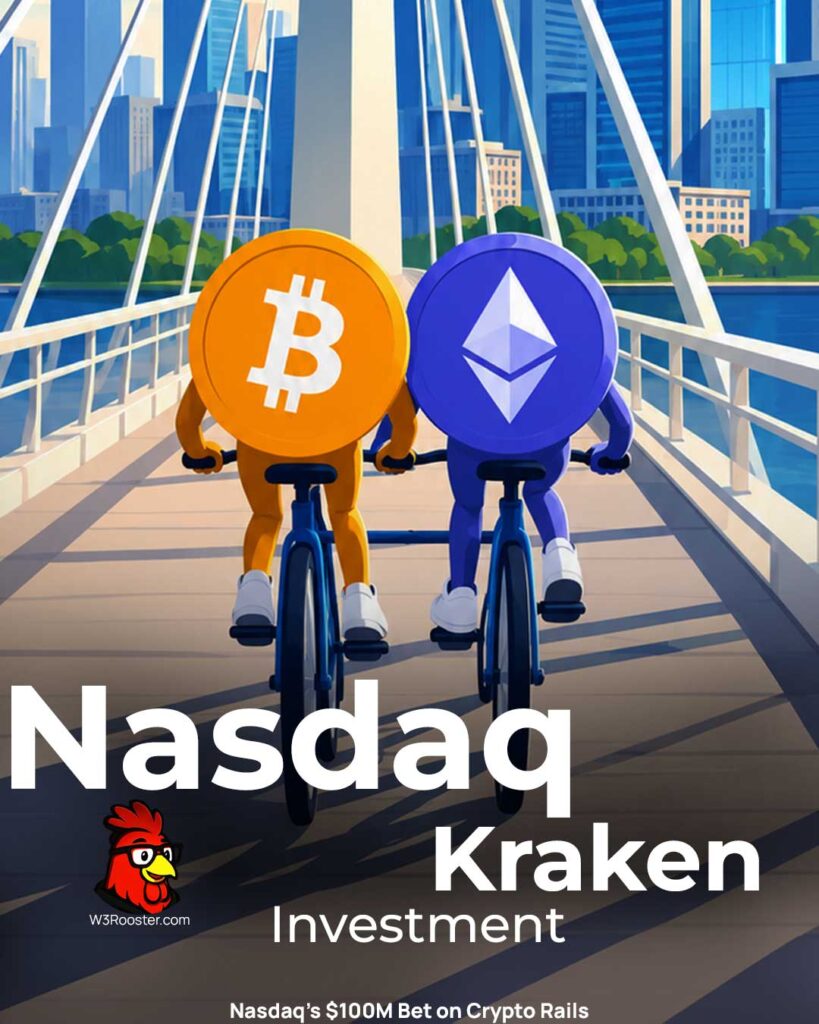
Nasdaq’s $100 million investment in Payward, the parent company of Kraken, is not simply a bet on tokenized equities. It signals a deeper convergence between traditional exchanges and crypto-native infrastructure—and raises a more consequential question about who will control the rails of tomorrow’s capital markets.
Nasdaq’s $100 Million Bet Is Bigger Than a Crypto Partnership
Nasdaq’s decision to invest $100 million in Payward is significant because the two companies are not approaching tokenization from the same starting point. Nasdaq brings decades of experience in regulated securities markets, exchange infrastructure, market surveillance and institutional trading. Payward brings a crypto-native network, digital-asset infrastructure and experience operating markets designed around continuous digital access.
The partnership therefore represents something more important than another traditional financial institution experimenting with blockchain. It brings two previously separate financial architectures closer together. Nasdaq is extending its role into tokenized equities and always-on markets, while Kraken is moving further toward infrastructure that can connect digital assets with regulated capital markets.
That convergence could ultimately matter more than the size of the investment itself. The central question is no longer whether established exchanges will participate in tokenization. They increasingly will. The more important question is which institutions will control issuance, trading, settlement, surveillance, custody and distribution once tokenized securities become part of mainstream financial infrastructure.
Nasdaq’s planned Equity Tokens are expected to launch in the second quarter of 2027. Payward will also adopt Nasdaq’s market-surveillance technology across its trading venues. That combination is revealing: the future being constructed here is not simply a blockchain version of the stock market. It is an attempt to combine the operating characteristics of digital markets with the institutional controls of traditional finance.
Tokenized Stocks Are No Longer a Technology Demonstration
For years, tokenized securities were largely discussed as a technological possibility. The basic proposition was straightforward: represent an existing financial asset on a blockchain and make it easier to transfer, access or integrate with programmable applications.
That phase is ending. Major exchanges, financial institutions and crypto companies are now exploring how tokenized securities could operate as actual market infrastructure. The question has therefore shifted from whether stocks can be represented on-chain to whether the financial rights and institutional processes surrounding those stocks can move into a digital environment as well.
That distinction is crucial because a token representing a stock is not automatically the same thing as owning the stock. A token can provide economic exposure without providing voting rights, dividends or direct legal ownership. Another structure may preserve the rights of the underlying security but rely on custodians or traditional registries behind the scenes.
This is why the Nasdaq-Kraken relationship deserves to be viewed through the architecture of ownership rather than simply through the language of blockchain adoption. If tokenized equities are going to become a serious part of capital markets, investors will eventually need to know exactly what a token represents, who recognizes it, which rights accompany it and what happens when something goes wrong.
What Does a Tokenized Stock Actually Represent?
The most important issue in tokenized equities may be the least visible one: the relationship between the blockchain record and the legal ownership record. Traditional securities markets distribute trust across multiple institutions. Registries establish ownership records. Custodians hold securities. Exchanges provide trading venues. Clearing systems manage obligations. Settlement systems establish finality. Corporate infrastructure handles dividends, voting and other shareholder rights.
Blockchain can compress or automate parts of this architecture, but it does not automatically replace the legal institutions surrounding it. A token can move between wallets in seconds while the underlying legal claim remains dependent on a custodian, issuer, transfer agent or securities registry.
That creates a fundamental distinction between tokenization as a new interface and tokenization as a new ownership architecture. The first can make traditional financial assets more accessible and programmable without changing the foundations underneath them. The second would require a much deeper transformation of how ownership itself is recorded, transferred and legally recognized.
Nasdaq’s issuer-centric approach is therefore particularly important. Its framework attempts to keep issuers and shareholder rights at the center of the tokenization process rather than treating the blockchain representation as an independent substitute for the security. That suggests the emerging institutional model may be less about removing existing financial structures and more about connecting them to programmable infrastructure.
The Real Prize May Be Settlement, Not Trading
Trading is the most visible part of financial markets, but settlement may be where tokenization creates its most consequential structural change. A tokenized equity can theoretically trade continuously, transfer between digital platforms and settle much faster than a conventional security. Yet every transaction still raises fundamental questions about delivery, payment, finality and the authoritative ownership record.
These questions matter because the existing settlement system is not simply an outdated technical process. It performs important functions involving liquidity, reconciliation, risk management and the coordination of multiple institutions. Removing settlement delays can eliminate some risks while creating new requirements for continuous liquidity and real-time collateral management.
This is where the Nasdaq investment becomes strategically interesting. The long-term value of tokenized equities may not come from allowing investors to trade a stock on a blockchain. It may come from rebuilding the plumbing underneath the transaction: issuance, transfer, settlement, collateral movement, corporate actions and the synchronization of multiple financial systems. In that sense, the real promise of tokenization is not necessarily faster trading. It is programmable financial infrastructure.
The 24/7 Market Is More Than an Extended Trading Session
Always-on markets are another major component of the Nasdaq-Kraken strategy. Crypto markets have demonstrated that digital assets can trade continuously, while traditional securities markets remain constrained by exchange schedules, settlement windows and institutional operating hours.
But making an equity market available 24 hours a day does not automatically make it better. A functioning market requires liquidity, reliable price discovery, risk controls and mechanisms capable of handling corporate announcements and sudden changes in information. If a tokenized representation continues trading while the underlying conventional market is closed, the relationship between the two prices becomes an important structural problem.
Imagine a major corporate announcement arriving overnight. A tokenized security could immediately begin repricing while the primary market remains closed. Which price becomes authoritative? How should arbitrage operate? What happens when liquidity is thin? Continuous access may improve global participation, but it can also create new periods of fragmented price discovery and heightened volatility.
The broader financial system is already beginning to confront this question. Tokenized deposits, digital securities and blockchain-based settlement systems are gradually challenging the assumption that financial infrastructure must operate according to the same calendar as traditional institutions. The important shift is therefore not simply that markets could remain open on weekends. It is that financial assets, money and settlement could increasingly be designed to operate continuously together.
Nasdaq and Kraken Are Building a Bridge Between Two Financial Worlds
The partnership also reveals how quickly the boundary between traditional finance and crypto infrastructure is changing. Nasdaq represents a market architecture built around regulation, institutional trust and established securities processes. Kraken emerged from an ecosystem designed around digital assets, continuous markets and blockchain-native settlement.
Those models once appeared fundamentally opposed. Today, each side increasingly needs capabilities associated with the other. Traditional financial institutions want the programmability, accessibility and continuous operation of digital markets. Crypto companies need regulatory credibility, institutional infrastructure and mechanisms for connecting blockchain markets to legally recognized financial assets.
The resulting system is unlikely to belong exclusively to either side. It may instead become a hybrid architecture in which regulated exchanges, crypto platforms, custodians, banks, blockchain networks and issuers all occupy different layers of the same market.
The Real Competition May Be Over Financial Infrastructure
This is where the $100 million investment becomes more revealing. Capital is only one part of the relationship. Nasdaq brings surveillance and market infrastructure. Payward brings crypto-native distribution and trading capabilities. Together, they create a potential bridge between regulated capital markets and blockchain-based financial networks.
That bridge could become strategically valuable if tokenized equities scale. The institutions that control the interfaces between issuance, trading, custody, settlement and blockchain networks could possess more influence than the platforms that merely offer the largest selection of tokenized assets.
The competition may therefore develop around standards and infrastructure rather than individual tokens. Who determines how tokenized securities are issued? Who controls the authoritative record? Who provides surveillance? Who manages corporate actions? Which blockchain networks are permitted to connect to regulated markets? And who decides how assets move between permissioned and permissionless environments? These are infrastructure questions. They are also questions about power.
Blockchain Does Not Eliminate Trust. It Changes Where Trust Lives
One of crypto’s earliest promises was disintermediation. Blockchain would reduce dependence on centralized institutions by allowing code and decentralized networks to coordinate financial activity.
The institutional tokenization movement is producing a more complicated outcome. Intermediaries may not disappear; their functions may simply move. A smart contract can automate a transfer, but institutions still have to determine which assets are eligible, who can participate, how identities are verified and what happens when an automated transaction conflicts with legal obligations.
The central issue is therefore not whether blockchain eliminates trust. It is where trust resides after financial infrastructure becomes programmable. That distinction may prove decisive. A blockchain can provide transparency and deterministic execution, but capital markets also depend on legal recognition, institutional governance and mechanisms for resolving disputes. The strongest tokenization architectures will probably be those that combine these forms of trust rather than assuming technology can replace all of them.
The Hardest Problem Is the Border Between Blockchain and Law
Blockchain networks operate across borders almost by design. Securities law does not. A token can theoretically move between countries within seconds, while the legal rights attached to the underlying security may depend on the issuer’s jurisdiction, the investor’s jurisdiction, the location of the custodian and the rules governing the relevant market.
This creates one of the deepest structural challenges for tokenized equities. The technology can make distribution global much faster than legal systems can make ownership rules interoperable.
Voting rights, dividends, corporate actions, bankruptcy treatment, investor protection and regulatory enforcement all remain legal questions. Tokenization can change how those processes are executed, but it cannot simply remove the jurisdictional systems that make them enforceable.
The institutions capable of connecting blockchain-based infrastructure with these legal frameworks may therefore gain an advantage over companies focused only on creating new digital representations of existing assets.
The Next Stock Market May Not Look Like a Blockchain Market
There is a temptation to imagine the future of tokenized equities as a visibly different version of today’s market: stocks represented by tokens, wallets replacing brokerage accounts and blockchain networks replacing exchanges.
The actual transition may be much less dramatic on the surface. Investors may still interact with familiar financial institutions. Exchanges may still enforce market rules. Custodians and banks may remain important. What changes could be the infrastructure underneath those familiar interfaces.
Settlement could become more continuous. Ownership records could become more programmable. Corporate actions could increasingly interact with software. Tokenized securities could move between regulated venues and blockchain-based applications without requiring every layer of the financial system to be rebuilt from scratch.
That would be a quieter transformation than the most enthusiastic blockchain narratives suggest. But it could also be more consequential because it would alter the plumbing of financial markets rather than simply create another category of digital assets.
What Nasdaq’s Kraken Investment Really Tells Us
The significance of Nasdaq’s $100 million investment in Payward is not that a traditional exchange has suddenly discovered blockchain. Institutional finance has been exploring tokenization for years.
The more important development is that the boundary between traditional and crypto-native financial infrastructure is becoming harder to maintain. Nasdaq needs capabilities associated with digital markets, while Kraken increasingly needs the institutional infrastructure and regulatory credibility associated with traditional finance.
That convergence could define the next phase of tokenization. The winning architecture may not be the one that removes traditional finance or the one that simply puts traditional assets on a blockchain. It may be the one capable of connecting regulated ownership, digital settlement, continuous markets and programmable financial applications without sacrificing legal certainty.
Who Will Control the Tokenized Stock Market?
The most important question raised by Nasdaq’s investment is therefore not whether tokenized equities will arrive. They are already moving closer to mainstream financial infrastructure.
The deeper question is who will control the system in which those equities live.
Control could sit with exchanges that establish market standards. It could sit with crypto platforms that provide global digital distribution. It could sit with custodians and banks that maintain the connection between blockchain records and legally recognized assets. It could also shift toward blockchain networks that become sufficiently important to serve as settlement infrastructure for regulated markets.
That makes the Nasdaq-Kraken relationship more than a corporate investment. It is an early indication of a larger contest over the architecture of tokenized capital markets. The first generation of tokenization asked whether financial assets could be put on-chain. The next generation will ask something harder: who controls the rails, rules and rights once those assets are there?
For W3Rooster, that is the more durable story. Tokenization will ultimately be judged not by how many securities receive blockchain representations, but by whether those representations can support a financial system that is faster, more continuous and more programmable without losing the institutional trust on which ownership depends.
Nasdaq may have just invested $100 million in Kraken. The larger investment is in a future where the distinction between Wall Street infrastructure and crypto infrastructure becomes increasingly difficult to draw.