Tokenization Is Becoming Financial Infrastructure — And Collateral May Be Its Most Important Use Case
The Tokenization Story Is Entering Its More Consequential Phase
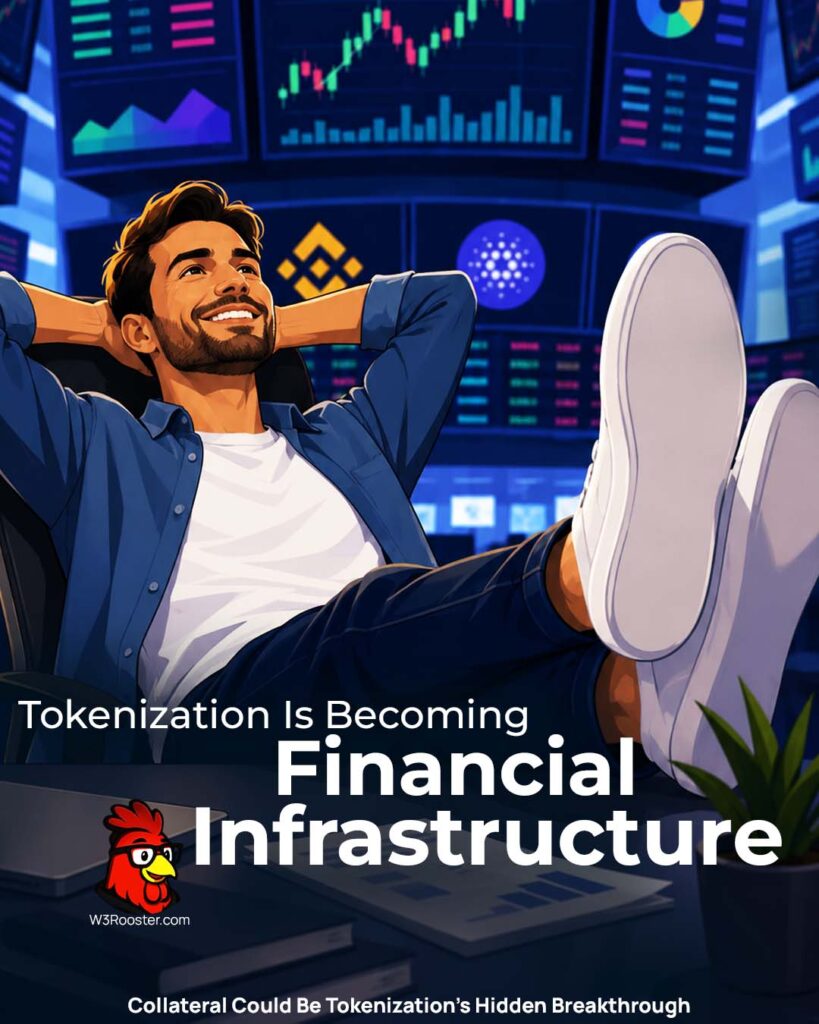
The next phase of blockchain adoption may not be about putting more assets on-chain. It may be about making those assets productive inside the machinery of global finance.
For several years, tokenization has been presented as a relatively straightforward proposition: take an asset that already exists in traditional finance and represent its ownership digitally on a blockchain. Treasuries, funds, equities and other real-world assets can then be transferred with greater speed, potentially traded around the clock and integrated with programmable financial applications.
That description is increasingly incomplete. The more consequential development emerging now is that tokenized assets are beginning to move from the perimeter of financial markets toward their underlying infrastructure. Recent discussions among institutional participants have placed particular emphasis on tokenized fixed-income instruments as collateral, while blockchain companies are moving into regulated functions traditionally performed by financial intermediaries. At the same time, the rapid expansion of tokenized products is forcing the industry to consider whether blockchain is merely creating another distribution channel or quietly reconstructing the architecture through which financial assets move.
For W3Rooster, this distinction is central to understanding where the tokenization thesis goes next. The question is no longer simply how many assets can be represented on-chain. It is whether those assets can become functional components of the financial system itself.
From Tokenized Assets to Tokenized Financial Plumbing
The significance of recent developments becomes clearer when tokenization is viewed through the lens of market infrastructure.
A financial asset does not become economically transformative merely because its ownership is recorded on a blockchain. The deeper value emerges when the asset can be issued, transferred, pledged, settled, financed and reused within a connected system. In traditional markets, these functions are distributed across custodians, transfer agents, brokers, clearing houses, settlement systems, banks and other intermediaries.
Blockchain technology potentially compresses some of those functions into programmable infrastructure. That possibility is visible in Injective’s move into regulated transfer-agent activity. Its affiliate, Injective Institutional Services, became an SEC-registered transfer agent on August 19, allowing it to participate in functions involving official ownership records, ownership transfers, distributions and corporate actions for securities. The significance is therefore not simply that another blockchain company has entered tokenization; it is that blockchain infrastructure is beginning to occupy a role traditionally associated with the legal and administrative machinery surrounding securities ownership.
This is a subtle but important transition. Issuing a tokenized security is one layer. Establishing the infrastructure through which the legal ownership of that security is maintained and transferred is another. The second is considerably more important.
Why Collateral Could Become Tokenization’s Hidden Breakthrough
The most revealing recent institutional argument may be the least glamorous one. GSR managing director Andy Baehr recently identified short-term fixed-income products as a particularly practical application for tokenization because institutions could potentially use them as collateral for futures and over-the-counter transactions. Rather than treating tokenization primarily as a new way for investors to trade assets, this model treats tokenized securities as working capital within financial markets.
That distinction matters. Collateral is one of the less visible foundations of modern finance. It supports derivatives, secured lending, repo markets and numerous forms of institutional risk management. A high-quality asset that can be pledged efficiently is not merely an investment; it is a financial instrument capable of supporting another transaction.
Tokenization could therefore create value through a second-order mechanism. A Treasury or other high-quality fixed-income asset does not have to become more valuable simply because it is tokenized. Instead, its usefulness could increase if it becomes easier to transfer, verify, pledge and mobilize across financial venues.
The important question becomes one of capital velocity.
If an eligible asset can move between counterparties more rapidly, remain transparently represented throughout its lifecycle and potentially interact with automated financial contracts, the same underlying pool of capital could support more efficient financial activity. That is a fundamentally different proposition from fractional ownership or 24/7 trading.
It is also why collateral may ultimately prove to be a more consequential tokenization use case than retail access to tokenized stocks.
The ETF Analogy Is Useful — But It Has Limits
Ondo executive John Hoffman recently compared the development of tokenized assets with the early evolution of exchange-traded funds. The analogy is instructive because ETFs were initially met with skepticism before becoming a major component of modern investment markets. Ondo’s tokenized-stock platform reportedly reached $1 billion in total value locked within eight months, while its broader Treasury products have accumulated roughly $2 billion, according to Hoffman.
The comparison, however, should not be accepted too literally. ETFs were primarily a new structure for packaging and distributing existing financial exposure. Tokenization potentially changes something deeper: the technological environment in which assets are issued, transferred and used after issuance.
An ETF can improve access to an asset without fundamentally changing the settlement architecture underneath it. A tokenized security, by contrast, can potentially become interoperable with programmable lending, automated settlement and blockchain-based financial applications.
This means tokenization has a chance to become less like another financial product and more like a new financial substrate. That is also where the analogy with earlier technological transitions becomes intellectually useful. Railways did not merely create faster transportation; they changed the geography of commerce. The internet did not merely create another publishing channel; it changed the economics of distribution. If tokenization succeeds at scale, its ultimate consequence may similarly lie beyond the individual products that first attract attention.
The Institutional Market Is Moving Toward a 24/7 Financial Architecture
The attraction of tokenized equities and funds is obvious: continuous trading, fractional access and potentially faster settlement. Recent industry discussions have emphasized these possibilities, with major financial institutions and market infrastructure providers exploring blockchain-based approaches to securities trading and settlement.
But continuous trading alone does not constitute a financial revolution. Markets operate as interconnected systems. Extending trading hours without transforming custody, settlement, collateral, liquidity and risk management could simply create a faster front end attached to an older back end.
The more ambitious vision is different. Imagine an institutional environment in which a tokenized Treasury can serve simultaneously as an investment, a collateral asset and a programmable settlement instrument. Its ownership could be verified digitally; its transfer could be automated; its eligibility as collateral could be encoded into financial agreements; and its movement between applications could occur without the same sequence of manual processes that characterize fragmented financial infrastructure today.
That would not merely make finance faster. It would make finance more composable. This is where the tokenization narrative begins to intersect with decentralized finance, institutional custody and traditional capital markets. The boundaries between those categories become less distinct when the same tokenized asset can move between regulated financial platforms and programmable blockchain environments.
The Missing Piece Is Not Technology. It Is Institutional Trust.
The strongest argument against excessive enthusiasm is that financial markets are not held together by technology alone.
They depend on legal finality, investor protections, identity, custody, settlement certainty, liquidity and confidence in counterparties. A blockchain can make an ownership record transparent, but transparency does not automatically establish legal enforceability. Faster settlement does not eliminate counterparty risk. Programmability does not remove the need for governance.
The BIS has approached the broader transformation from precisely this institutional perspective. Its 2026 economic report argues that the future monetary and financial architecture must preserve the trust properties of the existing two-tier system while incorporating technological innovation. Its discussion of distributed-ledger systems and tokenized private money points toward a model in which technological infrastructure evolves without abandoning the institutional foundations that make financial claims credible.
That perspective is important because tokenization’s greatest challenge may eventually be coordination rather than scalability. If every institution creates its own token standard, settlement environment and eligibility framework, tokenized markets could become another fragmented financial ecosystem. The promise of composability would then collide with the reality of incompatible systems. The financial system does not need merely more tokens. It needs interoperable claims.
Tokenized Collateral Could Connect TradFi and DeFi
This is perhaps the most strategically interesting consequence. Traditional finance possesses enormous quantities of high-quality collateral but operates through highly segmented infrastructure. DeFi possesses programmable markets and transparent settlement environments but has historically relied heavily on crypto-native collateral and has struggled with institutional-grade assets.
Tokenized real-world assets could provide a bridge. A tokenized Treasury, for example, could potentially retain the legal and economic characteristics expected by institutional investors while becoming usable inside programmable financial environments. That does not mean every traditional security will migrate into DeFi. It means the distinction between “traditional asset” and “on-chain asset” could gradually become less meaningful.
W3Rooster’s perspective here is that the real milestone in tokenization should not be measured exclusively by the amount of assets represented on-chain. A more revealing metric may eventually be how many financial functions those assets perform once they are there.
A tokenized asset that merely sits in a wallet is digitally represented capital. A tokenized asset that can be traded, pledged, settled, financed and incorporated into automated financial agreements is infrastructure. That difference could define the next stage of the market.
The Risks Become Larger as Tokenization Becomes More Important
There is an inherent paradox in this evolution. The more useful tokenized collateral becomes, the more systemic its infrastructure could become. If tokenized assets begin supporting lending, derivatives and institutional settlement at meaningful scale, failures in custody, smart contracts, oracle systems, interoperability or legal arrangements could propagate beyond the crypto ecosystem.
There is also the question of liquidity. A tokenized representation of an asset does not automatically create deep liquidity for the underlying instrument. Nor does 24/7 availability guarantee continuous two-sided markets. Counterparty risk remains another unresolved issue. GSR’s Baehr has emphasized that institutional lending will require increasingly sophisticated assessment of counterparties, while crypto lending still suffers from fragmented liquidity and underdeveloped interest-rate structures.
In other words, tokenization can remove some frictions while exposing others. That is precisely why the most durable analysis should resist both extremes: the assumption that blockchain will inevitably rebuild finance, and the assumption that tokenization is simply another speculative narrative. The more plausible outcome lies somewhere between them.
The Real Tokenization Revolution May Be Invisible
The most important phase of tokenization may not produce the most spectacular headlines. Retail investors will notice tokenized stocks. Crypto users will notice new real-world-asset markets. Institutions may notice something much less visible: collateral that can move with greater programmability, settlement systems that operate beyond traditional market hours, and financial claims that can interact directly with software.
That is where the historical significance could emerge. The first generation of tokenization asks: What assets can we put on-chain? The second asks: What can those assets do once they are there?
The answer increasingly appears to involve collateral, settlement, liquidity and financial coordination. For W3Rooster, that is the more consequential interpretation of the current wave of institutional activity. Tokenization should not be judged merely by whether blockchain can reproduce existing financial products. Its deeper test is whether it can make the financial system more modular, programmable and continuously connected without weakening the legal and institutional foundations upon which that system depends.
The industry has spent years trying to put the world’s assets on-chain. The more consequential ambition now is to put financial activity itself on-chain. If that transition succeeds, the token may ultimately matter less than the infrastructure it enables.
Read More
- GSR’s Baehr says tokenized fixed income could play key role in institutional collateral — The Block — Aug. 20, 2026
- Ondo executive says tokenization is following the same path as early ETFs — The Block — Aug. 20, 2026
- Injective becomes SEC-registered transfer agent as it expands tokenization push — The Block — Aug. 19, 2026
- Tokenization Promises To Break Trading Barriers. What Investors Need To Know. — Investors.com — Aug. 2026
- Piero Cipollone: Building the rails for Europe’s tokenised financial markets — BIS