Tether’s First Big Four Audit Is a Turning Point for USDT — But It Doesn’t End the Transparency Debate
Why Tether’s First Full Audit Matters Now
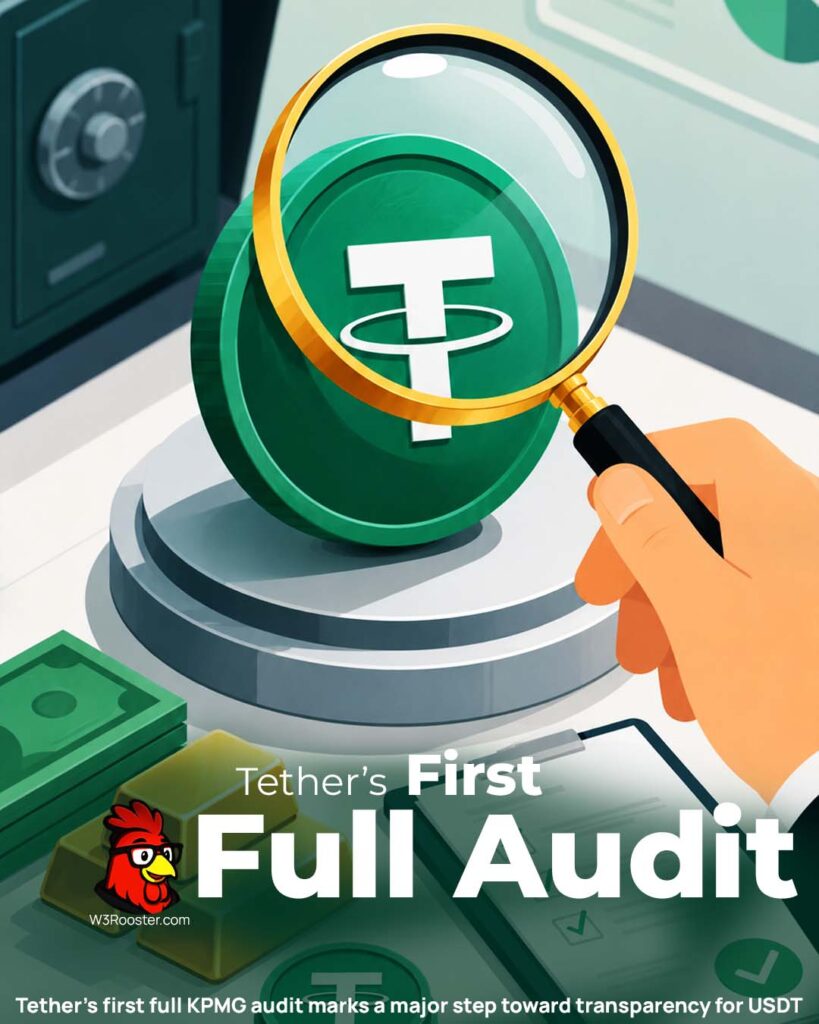
Tether has completed its first full independent financial statement audit with KPMG, a milestone years in the making. The result strengthens the credibility of the world’s largest stablecoin, but the more important question is what this audit actually proves—and what it still leaves unanswered.
For years, one question has followed Tether almost everywhere: Where is the money?
That question became particularly consequential because USDT is not merely another crypto token. It is a foundational piece of the digital-asset economy, used for trading, settlements, payments, liquidity and access to dollar-denominated value across blockchain networks. When confidence in Tether rises or falls, the consequences can extend well beyond Tether itself.
On August 13, Tether announced that KPMG U.S. had completed its first full independent financial statement audit of the company’s 2025 accounts. The audit represents a significant departure from the periodic reserve attestations Tether had relied on for years. Reuters described the development as a major step toward greater transparency, while Tether presented it as a new benchmark for digital-asset financial reporting.
That distinction matters. An attestation is useful, but it is not the same thing as a full financial statement audit. The former generally provides assurance around specified information at a particular point in time; the latter examines financial statements and the underlying accounting processes across a reporting period. For Tether, that difference is the heart of the story.
From Reserve Attestations to a Full Financial Audit
Tether spent years publishing reserve reports rather than submitting its financial statements to a Big Four accounting firm. BDO Italia had provided assurance over Tether’s reserve reporting, giving the market periodic snapshots of assets and liabilities.
Those reports served a purpose, but they left a larger question intact: how does the entire financial machinery behind the stablecoin operate?
A full audit is designed to examine much more than a single reserve balance. It can involve financial statements, transactions, accounting policies, internal controls, asset ownership, valuations and supporting documentation. In Tether’s case, the sheer complexity of its balance sheet makes the assignment unusual: the company combines traditional financial assets with digital assets, gold and token liabilities. Tether had announced in March that it had formally engaged a Big Four firm for the work, and subsequent reporting identified KPMG as the auditor.
This is why describing the development merely as “Tether finally got audited” undersells it. The significance is that a company at the center of crypto’s financial plumbing has subjected its financial reporting to a conventional form of institutional scrutiny.
What KPMG’s Opinion Actually Means
Tether said KPMG issued an unqualified opinion on the 2025 financial statements of Tether International. In accounting terminology, that is generally the most favorable standard audit opinion: the auditor is saying the statements are fairly presented, in all material respects, under the applicable accounting framework.
That is meaningful. But it is not a magic wand. An unqualified opinion does not mean an auditor is guaranteeing that a company will never encounter financial stress. Nor does it mean every future transaction has been pre-approved, every possible risk has disappeared, or that an asset can never lose value.
The distinction is important because crypto audiences often compress complicated financial language into a much simpler conclusion: “The auditor says everything is fine.”
That is not what an audit opinion means. It means the audited financial statements meet the auditor’s reporting criteria, subject to the scope and standards of the engagement. The details of that scope are therefore just as important as the headline. And this is where the Tether story becomes more interesting than a simple victory lap.
The $6.8 Billion Cushion and What It Tells Us
According to figures reported following the audit, Tether’s reserves exceeded its liabilities by approximately $6.814 billion at the end of 2025. The company also reported more than $10 billion in profit for the year. A reserve cushion is important for a stablecoin issuer because USDT’s credibility depends heavily on the ability of the issuer to meet its obligations.
But a surplus should not be interpreted as an indestructible fortress. The composition of reserves matters. So does liquidity. So does the behavior of assets during periods of market stress. A balance sheet can look robust at one reporting date while still containing assets whose value or liquidity could behave differently during a crisis.
This is one reason Tether’s historical move away from commercial paper toward U.S. Treasury exposure has been important. The company’s reserve disclosures have increasingly emphasized short-duration government securities and other liquid assets, while Tether has also maintained exposure to assets such as gold and Bitcoin.
For W3Rooster’s perspective on the development, the more useful question is therefore not whether Tether has “enough money.” It is whether the structure of those reserves can withstand the kind of redemption pressure a global stablecoin might encounter during a severe liquidity event. That is a much harder question—and a much more interesting one.
Why Tether’s History Still Matters
The audit does not erase Tether’s history. The company spent years under regulatory and market scrutiny over the composition and adequacy of USDT’s reserves. In 2021, Tether and Bitfinex reached an $18.5 million settlement with New York’s attorney general over allegations concerning disclosures and the backing of USDT. The same year, the Commodity Futures Trading Commission imposed a roughly $41 million penalty over statements concerning the token’s backing during earlier years.
Those episodes belong to an earlier period of Tether’s development, and it would be misleading to treat historical findings as a description of the company’s current balance sheet.
But history explains why the audit carries so much weight. Trust is cumulative. So is skepticism. A company cannot spend years telling the market that its reserves are sound, operate one of the world’s most important financial tokens, and then expect every historical concern to disappear because an auditor has issued one favorable opinion. At the same time, refusing to acknowledge the significance of an independent audit would be equally unreasonable. The intellectually honest position sits somewhere between those extremes.
Tether Is Bigger Than a Stablecoin Company
The real importance of this audit becomes clearer when USDT is viewed as infrastructure rather than simply a cryptocurrency. Stablecoins now function as settlement assets across exchanges, DeFi applications, payment networks and cross-border financial systems. USDT in particular has become deeply embedded in the global crypto market.
That creates a peculiar situation.
Tether is a private company, but the economic infrastructure surrounding USDT is enormous. Its token liabilities interact with exchanges, traders, market makers, blockchain protocols and businesses around the world. That means Tether’s financial transparency has systemic implications within crypto.
If confidence in USDT is strong, the token can serve as a highly liquid dollar-denominated bridge between different parts of the digital economy. If confidence deteriorates sharply, the consequences could propagate through liquidity pools, trading pairs, lending markets and exchanges.
The audit therefore isn’t just an accounting exercise. It is part of the infrastructure supporting confidence in a large portion of the crypto ecosystem.
The Audit Arrives at a Convenient Moment for Tether
Timing is another important part of the story. Tether began preparing for its Big Four audit while the company was attempting to professionalize its financial systems and position itself for a deeper relationship with mainstream financial markets. Earlier reporting said Tether brought in PwC to help prepare internal systems for the audit, while the company also signaled ambitions around U.S. expansion and potential fundraising.
That makes the audit useful not only as a transparency mechanism but also as institutional infrastructure. The crypto industry is entering an era in which stablecoin issuers increasingly have to speak the language of traditional finance: audited statements, controls, regulatory capital, custody arrangements and documented risk management.
Tether has little choice but to adapt. For a company that once operated largely outside the traditional financial establishment, having a Big Four auditor examine its books is a notable sign of how far the stablecoin sector has traveled.
What the Audit Does Not Settle
There are still questions worth asking. First, investors and users should distinguish between the audited financial statements and the broader universe of entities, investments and activities connected to the Tether group. The scope of an audit matters enormously, and an audit of a particular reporting entity should not automatically be interpreted as an audit of every affiliated operation.
Second, the market needs to understand the underlying disclosures, not merely the conclusion. A clean opinion is valuable, but readers learn more from the statements, accounting policies, reserve composition and accompanying notes.
Third, an audit is historical by definition. Tether’s audit covers the 2025 reporting period. Financial conditions can change after the balance-sheet date, which is why ongoing reporting remains important. This last point is particularly relevant to stablecoins. A token can have adequate reserves today and face a radically different environment tomorrow.
The Next Standard for Stablecoins
Tether’s audit could ultimately matter less because it answers every question and more because it changes the questions the industry is expected to answer.
For years, stablecoin transparency largely revolved around reserve attestations. Increasingly, the standard is moving toward broader financial reporting, stronger controls and institutional verification.
That creates pressure on every major stablecoin issuer.
If Tether can undergo a Big Four audit, competitors will face a straightforward question: Why shouldn’t they? The same logic extends beyond issuers. Exchanges, custodians, DeFi protocols and corporate treasury managers all have an incentive to understand precisely what stands behind the stablecoins they use.
In that sense, the audit could become a reference point for the maturation of the entire sector. W3Rooster’s broader takeaway is that the crypto industry is gradually discovering something traditional finance learned long ago: transparency is not merely a public-relations feature. It is infrastructure.
A Milestone, Not a Verdict
Tether’s first full Big Four audit is unquestionably a milestone. KPMG’s involvement, the reported unqualified opinion and the disclosed reserve surplus represent a significant evolution from the limited assurance regime that characterized Tether’s transparency efforts for much of its history.
But the most credible interpretation is neither “Tether has been completely vindicated” nor “the audit means nothing.”
It is more nuanced. Tether has taken a meaningful step toward institutional-grade financial scrutiny. The next step is for the market to examine the accounting details, understand the scope of the engagement and continue monitoring the company’s reserves and liabilities over time.
That is how trust actually works. One audit can change the conversation. Only sustained transparency can settle it. For the stablecoin industry, that may be the most important legacy of Tether’s 2026 audit.