21 Banks Are Building a Stablecoin: Who Will Control the Future of Programmable Money?
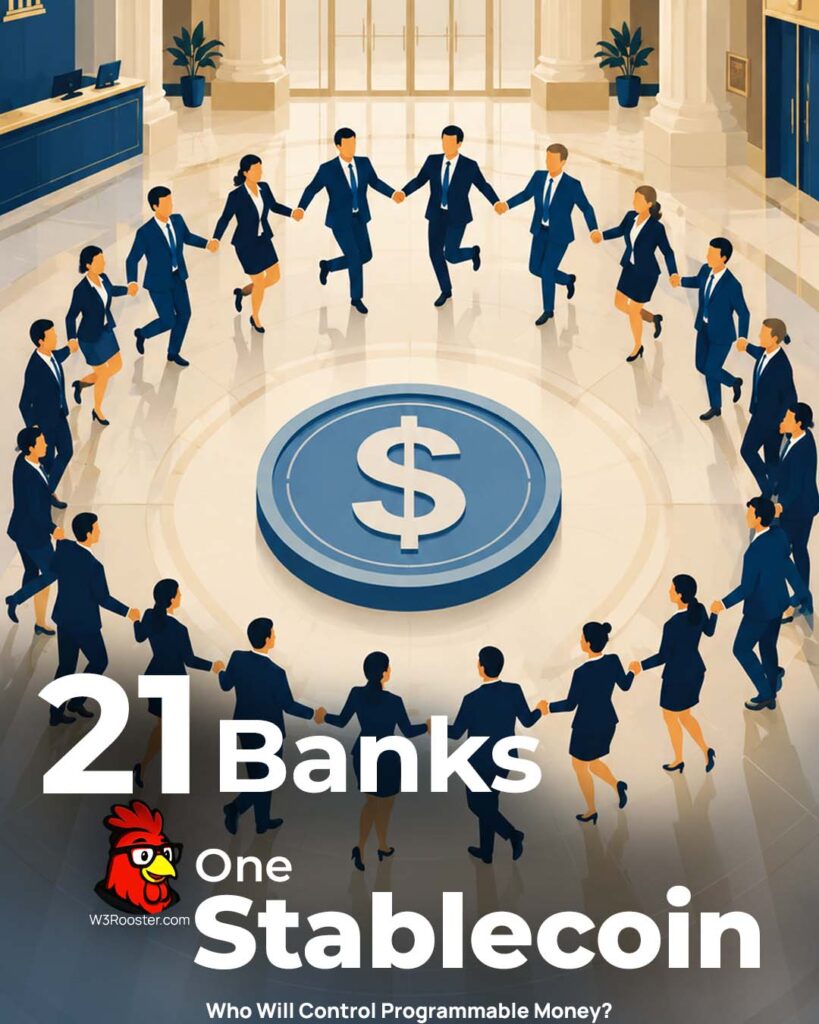
A 21-bank consortium is preparing a new dollar stablecoin for 2027, bringing traditional finance deeper into blockchain. But the larger question is not who will issue the token—it is who will control the infrastructure of digital money.
The most consequential development in stablecoins may no longer be coming from the crypto companies that created the market. It is coming from the banks that once regarded stablecoins primarily as a competitive threat.
On September 1, 2026, 21 major financial institutions announced plans to establish a company that will issue a U.S.-dollar stablecoin, with a launch targeted for the first half of 2027. The group includes Goldman Sachs, Bank of America, Citigroup, Deutsche Bank, Wells Fargo and other major institutions. The consortium was initially formed with 10 members in 2025 and has now more than doubled in size.
At first glance, this looks like another institutional crypto announcement. It is more significant than that. The development suggests that banks are no longer debating whether blockchain-based money belongs in the financial system. They are increasingly debating which form of blockchain-based money will dominate it. For W3Rooster, that distinction is where the real story begins.
Why 21 Banks Are Suddenly Interested in Stablecoins
Banks did not arrive at stablecoins because the technology suddenly became fashionable. They arrived because the economics of digital money are becoming harder to ignore.
Crypto-native issuers demonstrated that a privately issued digital dollar could move across borders, operate continuously and interact directly with blockchain applications. Stablecoins also created a new settlement layer for digital-asset markets, where conventional banking infrastructure can be cumbersome by comparison.
That success created an uncomfortable possibility for commercial banks. If customers increasingly use stablecoins instead of conventional deposits for payments and settlement, banks could lose part of their traditional role in moving and storing money.
Recent Federal Reserve research has examined precisely this concern, finding that stablecoins can affect bank deposits, liquidity and lending rather than simply creating a separate financial ecosystem. The strategic response is therefore logical: if blockchain-based money is becoming important, banks have an incentive to participate in its creation rather than watch another industry establish the dominant infrastructure. The 21-bank consortium is best understood as that transition from defense to offense.
Stablecoins and Tokenized Deposits Are Not the Same Thing
One of the easiest mistakes in this debate is to treat a stablecoin and a tokenized deposit as interchangeable. They are not. A stablecoin is generally a digital token issued against reserves designed to maintain a fixed value against a currency. A tokenized deposit, by contrast, represents a commercial bank deposit on a blockchain. The underlying economic relationship remains with the bank and its balance sheet.
JPMorgan’s existing JPM Coin illustrates the distinction particularly well. The bank describes it as a deposit token rather than a cryptocurrency or stablecoin, allowing institutional customers to move dollar-denominated bank money on a public blockchain while retaining the characteristics of a bank deposit.
This distinction matters because the banking industry may ultimately use both models. A February 2026 Federal Reserve Bank of New York study reached an interesting conclusion: depending on regulation, risk incentives and the structure of the banking system, stablecoins and tokenized deposits can each have advantages, and there are circumstances in which allowing them to compete is preferable.
That makes the 21-bank initiative more intriguing. The future may not be a simple contest in which stablecoins defeat deposits. It may instead involve several forms of digital money serving different functions.
The Real Battle Is Over the Infrastructure of Money
The token itself may eventually become the least interesting part of this story. The deeper transformation concerns the infrastructure underneath it. Traditional payments often involve multiple institutions, messaging systems, reconciliation procedures, settlement windows and intermediaries. Blockchain can potentially combine some of those functions into a shared digital record where payment, settlement and reconciliation occur much closer together.
That is why institutional blockchain projects have increasingly focused on programmable payments rather than speculative assets. JPMorgan, for example, says its blockchain infrastructure is being used for programmable payments, on-chain foreign exchange and institutional settlement.
The 21-bank stablecoin could therefore be viewed as an attempt to construct a common digital-money rail for commercial finance. If successful, its significance would extend beyond cryptocurrency. Corporate treasury operations, cross-border payments, collateral management and securities settlement could all become candidates for continuous, programmable settlement. The important question is no longer whether blockchain makes payments faster. It is whether blockchain changes which intermediaries are necessary in the first place.
The Deposit Problem Could Become the Banking Industry’s Biggest Test
There is, however, a serious economic tension underneath the enthusiasm. Commercial banks do not merely hold deposits for convenience. Deposits form an important part of the funding structure through which banks make loans and perform maturity transformation.
If consumers and businesses move substantial amounts of conventional deposits into stablecoins, the consequences could reach far beyond payments. Research from the New York Fed has found evidence that stablecoin activity can transmit liquidity pressures into banks and potentially affect bank lending and monetary-policy transmission.
Tokenized deposits do not eliminate this problem either. Dallas Fed researchers have warned that widespread adoption of tokenized deposits could affect bank liquidity management and maturity transformation, potentially influencing the availability of credit.
This is why the industry’s transition to programmable money cannot be evaluated solely by asking whether transactions become more efficient. The more important question is: what happens to the financial system that exists behind those transactions? A payment can become instantaneous while the consequences for bank funding become considerably more complicated.
Why Banks May Want Both Stablecoins and Tokenized Deposits
At first, issuing both may seem redundant. In reality, the two instruments could occupy different layers of the emerging financial architecture. Tokenized deposits are naturally suited to relationships between regulated banks and their customers. They preserve the familiar banking relationship while adding blockchain-based settlement and programmability.
Stablecoins can potentially travel more broadly across digital ecosystems. They may be easier to integrate into public blockchain markets, digital-asset platforms and cross-border networks where participants do not share the same banking relationship.
That creates a possible division of labor. A bank could use tokenized deposits internally and with institutional customers while a stablecoin provides a more portable digital-dollar instrument for external networks.
Recent institutional research increasingly treats these instruments not simply as competitors but as alternative components of a future monetary system. The BIS, however, has warned that stablecoins face unresolved challenges involving interoperability, redemption, financial integrity and the preservation of monetary “singleness,” while viewing tokenized deposits as a potentially stronger foundation for the existing two-tier monetary system. That disagreement is important. The future is not settled.
The Dollar Could Become Even More Powerful on Blockchain
There is also a geopolitical dimension that deserves more attention than it usually receives in crypto coverage. The consortium plans to begin with a U.S.-dollar stablecoin and has indicated that other G7 currencies, particularly the euro, could follow.
That raises an unexpected possibility. Blockchain was originally associated with reducing dependence on centralized financial institutions, yet the most successful form of blockchain money may strengthen the world’s existing monetary hierarchy.
If digital dollars become easier to access, transfer and integrate into global financial applications, the technology could reinforce rather than weaken the dollar’s international position. This is not merely theoretical. Recent economic analysis has argued that stablecoins could expand global access to dollar-denominated financial instruments and potentially reinforce existing dollar dominance.
For W3Rooster, this is one of the most interesting contradictions in the entire story: a technology born from financial decentralization could help extend the reach of the world’s most powerful centralized currency.
Regulation May Be Turning From Obstacle Into Accelerator
Another major change is the regulatory environment. For years, banks had strong reasons to approach crypto cautiously. Regulatory uncertainty made it difficult to determine which blockchain activities could become commercially viable without creating unacceptable legal and compliance risks.
That environment is changing. The U.S. regulatory framework for payment stablecoins now establishes requirements around permitted issuers and reserve assets, while regulators are also addressing customer identification and other operational questions. The Federal Reserve has continued developing rules and guidance for bank participation in digital-asset markets.
The consequence is subtle but important. Regulation can restrict innovation, but regulatory clarity can also create the conditions under which large institutions finally feel comfortable investing billions of dollars into new infrastructure. In that sense, regulation may become less of a wall surrounding crypto and more of a bridge connecting crypto technology with traditional finance.
The Consortium’s Biggest Challenge May Be Coordination
Creating a stablecoin is one challenge. Creating a stablecoin jointly controlled by 21 major financial institutions is another. The participants are competitors. They have different technology platforms, customer bases, risk models and strategic priorities. A shared stablecoin therefore requires decisions about governance, reserve management, transaction standards, interoperability, redemption and compliance.
There is also a fundamental question of neutrality. If one institution becomes too influential within the consortium, the system could resemble a private banking network rather than an open financial protocol. If governance becomes too fragmented, the network could become slow and difficult to operate.
The irony is striking: blockchain is often presented as a technology for removing intermediaries, yet the institutional version of blockchain may require an unusually sophisticated layer of governance to coordinate those intermediaries. The success of this project will therefore depend not only on the token’s technical design but on whether competing banks can agree on a common financial language.
Will Bank Stablecoins Actually Be Web3?
This may ultimately be the most revealing question. A bank-issued stablecoin could run on blockchain infrastructure while remaining highly permissioned. Transactions could require identification, access could be restricted, and issuers could retain significant authority over the movement of funds.
None of those characteristics necessarily make the system ineffective. In fact, they may make it more compatible with regulated finance. But they do raise a philosophical question about what is being adopted. Is traditional finance genuinely entering Web3, or is traditional finance taking the most useful components of blockchain and incorporating them into an existing centralized architecture?
The answer could determine whether this movement represents a transformation of banking or simply its technological modernization. The distinction matters because blockchain does not automatically produce decentralization. It provides a different mechanism for recording and transferring value. Institutions still decide who can access that system, who governs it and under what rules it operates.
The Future of Programmable Money May Not Belong to One System
The 21-bank stablecoin consortium arrives at a moment when several financial architectures are developing simultaneously. Crypto-native stablecoins have already demonstrated global demand for digital dollars. Commercial banks are building tokenized deposits. Central banks are exploring tokenized forms of central-bank money. Exchanges and asset managers are experimenting with tokenized securities and blockchain-based settlement.
These systems do not necessarily have to eliminate one another.
They could instead form layers of a more complicated monetary ecosystem in which different forms of digital money compete, interoperate and occasionally converge. That possibility makes the September 1 announcement more significant than the creation of another stablecoin. The banks are effectively acknowledging that programmable money is becoming part of the future of finance. What remains uncertain is who will define its rules.
Who Will Control the Future of Programmable Money?
The financial system has always been shaped by competition over infrastructure. Railways, telecommunications networks, payment cards and electronic exchanges became powerful not simply because they moved information or value faster, but because whoever controlled the network could influence how economic activity flowed through it.
Stablecoins introduce the same question in digital form. If crypto-native companies dominate, programmable money could develop around open blockchain ecosystems. If banks dominate, blockchain may become a new settlement layer for an increasingly regulated financial system. If central banks assert greater control, digital money could evolve around public monetary infrastructure instead.
The most plausible outcome may be a hybrid system rather than a single winner. The 21-bank consortium is therefore not the conclusion of the stablecoin story. It is evidence that the next phase has begun. The original crypto vision imagined blockchain as an alternative to traditional financial institutions. The emerging reality is more complicated: traditional institutions are learning to use the same infrastructure, and they have considerably more capital, regulatory access and institutional reach than the industry that pioneered it.
For W3Rooster, that is the deeper question worth following beyond the headlines. The future of programmable money may not be determined by which stablecoin has the largest circulation, but by which architecture becomes trusted enough to carry the world’s economic activity.
And if banks succeed in building that architecture, the irony may be impossible to ignore: the technology designed to challenge the old financial system could become one of the foundations on which the next version of it is built.