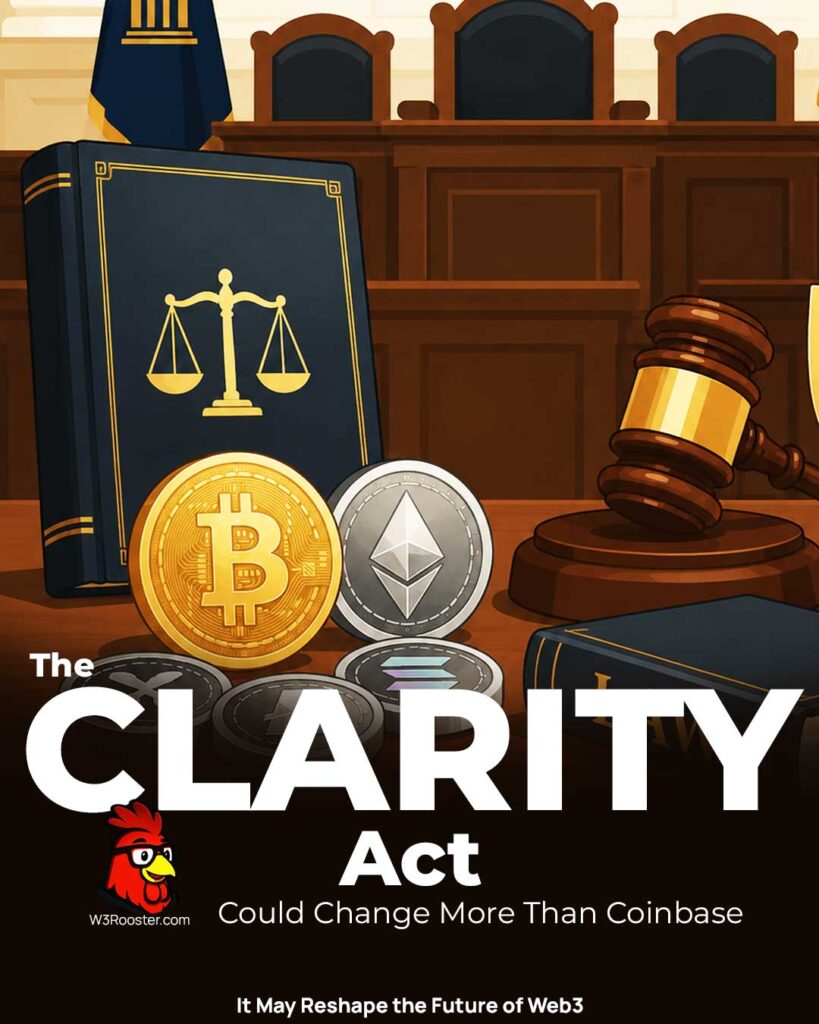
The CLARITY Act Could Change More Than Coinbase
It May Reshape the Future of Web3
W3Rooster: For many years, one of the biggest challenges facing the cryptocurrency industry in the United States has not been a lack of innovation, investment, or user interest. Blockchain developers, entrepreneurs, financial institutions, and technology companies have continued building new products and exploring new business models. However, one major obstacle has remained: regulatory uncertainty.
The lack of clear rules has created challenges across the entire digital asset ecosystem. Companies often struggled to understand how existing financial regulations applied to cryptocurrencies, decentralized applications, stablecoins, and blockchain-based financial services. This uncertainty increased compliance costs, slowed institutional adoption, and caused some blockchain companies to consider building their businesses in countries with clearer regulatory environments.
Now, discussions surrounding the CLARITY Act have brought renewed attention to a fundamental question:
Could clearer cryptocurrency regulation become the turning point that transforms blockchain from a high-risk emerging technology into a mature component of the global financial system?
The immediate attention has focused heavily on companies such as Coinbase, one of the largest cryptocurrency exchanges in the United States. A clearer regulatory framework could significantly influence how exchanges operate, how digital assets are classified, and how companies design blockchain-based financial products.
However, the impact of this discussion goes far beyond a single company.
The larger issue is whether the United States can create a balanced environment where innovation, consumer protection, financial stability, and institutional participation can grow together.
Coinbase Represents a Larger Industry Transition
Coinbase has become one of the most recognizable names in the cryptocurrency industry because it represents the connection between traditional finance and blockchain technology.
Unlike many crypto-native platforms that primarily focus on decentralized applications, experimental financial products, or community-driven ecosystems, Coinbase has positioned itself as a regulated bridge between traditional investors and digital assets. Millions of users and many institutions interact with blockchain technology through platforms like Coinbase, making its regulatory environment especially important.
For companies operating within financial markets, uncertainty creates significant operational difficulties. Businesses need to understand how laws apply to their products, what compliance requirements they must follow, and how they can develop new services without creating unexpected legal risks.
A clearer framework could provide companies with more confidence when building products related to digital assets, including cryptocurrency exchanges, stablecoins, custody services, tokenized assets, and institutional investment solutions. However, regulatory clarity is not only beneficial for large companies.
It can also influence the broader innovation ecosystem by giving startups, developers, and investors a clearer understanding of how blockchain technology can evolve within legal boundaries.
A young blockchain company developing a new financial application needs more than technical innovation. It also needs confidence that its product can operate legally, attract investment, and gain user trust. Clearer regulations could reduce some of the uncertainty that currently slows down these decisions.
Why Regulation Matters for Blockchain Innovation
Blockchain technology has always existed at the intersection of technological innovation and financial regulation. Unlike traditional software applications, blockchain networks often directly involve ownership, payments, financial transactions, and the movement of digital value. This creates unique challenges because governments must balance two important goals: encouraging technological progress while protecting consumers and maintaining financial stability.
If regulation is too limited, users and markets may face unnecessary risks.
However, if regulations remain unclear for too long, innovation can slow because companies are uncertain about what products they can build and how they should operate.
The challenge is not simply creating more rules. The challenge is creating clear, predictable rules that recognize blockchain as a long-term technological development rather than treating it only as a short-term financial trend.
A well-designed regulatory framework could encourage more responsible innovation because entrepreneurs and investors would have a better understanding of:
- Which activities are permitted.
- Which services require additional compliance.
- What standards companies must follow.
- How consumers can be protected.
This becomes increasingly important because the future of blockchain may not be defined only by cryptocurrency trading. The next stage of blockchain adoption could be focused on infrastructure.
The Next Blockchain Wave May Come From Tokenization
One of the strongest arguments for blockchain adoption is the growth of tokenization. Tokenization refers to the process of representing real-world assets digitally on blockchain networks. Instead of ownership records being stored only through traditional financial systems, assets can potentially be represented as digital tokens that exist on blockchain infrastructure.
These assets could include:
-
- Real estate.
- Bonds.
- Financial securities.
- Commodities.
- Investment funds.
- Other forms of ownership.
Many major financial institutions have explored tokenization because blockchain technology could provide several potential advantages, including faster settlement, increased transparency, programmable financial agreements, and automated compliance systems.
For example, traditional financial transactions often require multiple intermediaries, paperwork, and reconciliation processes. Blockchain-based systems could potentially simplify some of these processes by allowing different parties to interact through shared digital infrastructure.
However, large-scale tokenization requires regulatory certainty. A bank, investment firm, or asset manager cannot confidently build billion-dollar blockchain products if there is uncertainty around important questions such as:
-
- Who legally owns a tokenized asset?
- How should custody responsibilities be managed?
- What regulations apply to digital ownership?
- How should transactions be monitored?
This is why regulatory discussions such as the CLARITY Act could have implications far beyond cryptocurrency exchanges. Clearer rules could influence how traditional financial institutions approach blockchain technology over the next decade.
Ethereum, DeFi, and the Broader Web3 Ecosystem
Although Coinbase may receive much of the immediate attention when discussing regulatory changes, the potential impact of clearer rules would extend across the wider blockchain ecosystem.
Ethereum is one example of a network that could be significantly influenced by a more predictable regulatory environment. Over the past several years, Ethereum has developed into much more than a cryptocurrency network. It has become a major foundation for decentralized finance (DeFi), stablecoins, non-fungible applications, tokenized assets, and many other blockchain-based systems.
A clearer regulatory framework could affect many areas of blockchain development, including:
-
- Decentralized application development.
- Institutional blockchain participation.
- Stablecoin adoption.
- Real-world asset tokenization.
- Layer-2 scaling solutions.
- Enterprise blockchain infrastructure.
For developers, regulatory uncertainty creates additional friction. A startup building a blockchain-based financial application must consider not only whether the technology works but also whether the business model can operate within existing laws.
Developers and investors need answers to important questions:
Can this application legally serve users? Will financial institutions be willing to integrate with this technology? Will investors provide funding if the regulatory environment remains uncertain? Clearer regulations could reduce some of these barriers and create a more stable foundation for blockchain innovation.
However, regulation alone will not determine the success of blockchain technology. The technology itself must continue proving its usefulness. Blockchain projects will need to demonstrate that they can provide real value beyond speculation, price movements, and short-term market trends.
The future of Web3 will likely depend on whether blockchain can solve real-world problems in areas such as finance, identity, data management, and digital ownership.
The Institutional Money Question
One of the most significant potential effects of regulatory clarity is the possibility of greater institutional participation. Large financial institutions have already shown increasing interest in digital assets through several areas, including:
-
- Bitcoin and Ethereum exchange-traded funds (ETFs).
- Tokenization experiments.
- Blockchain-based settlement systems.
- Digital asset custody services.
- Stablecoin infrastructure.
These developments show that traditional finance is not ignoring blockchain technology. Instead, many institutions are exploring how blockchain could improve existing financial systems.
However, institutional investors usually require a predictable regulatory environment before committing significant capital. Pension funds, asset managers, banks, and multinational corporations operate under strict risk management frameworks. They cannot easily participate in markets where the legal status of assets, services, or transactions remains uncertain.
This is why regulatory clarity could become an important bridge between Wall Street and Web3. The next major wave of blockchain adoption may not come only from individual cryptocurrency users buying and selling digital assets.
It may come from financial institutions integrating blockchain technology into existing infrastructure. Imagine a future where blockchain networks quietly support financial operations behind the scenes:
-
- Faster settlement between institutions.
- Automated compliance processes.
- Digital representations of traditional assets.
- More efficient international transactions.
In this scenario, blockchain does not replace traditional finance overnight. Instead, it becomes part of the foundation that supports the next generation of financial services.
Regulation Is Not the Final Solution
Although clearer regulation could provide significant benefits for the blockchain industry, regulation alone cannot solve every challenge.
Blockchain companies will still need to address several important issues, including:
-
- Security vulnerabilities.
- Difficult user experiences.
- Scalability limitations.
- Privacy concerns.
- Market volatility.
Security remains one of the biggest challenges because blockchain applications often manage valuable digital assets. Smart contract vulnerabilities, infrastructure weaknesses, and poor security practices can damage user confidence and slow adoption.
User experience is another important factor. For blockchain technology to reach mainstream adoption, users should not need advanced technical knowledge to interact with decentralized applications. The future of Web3 will require simpler, more intuitive experiences that feel as accessible as traditional internet services.
Scalability also remains a major consideration.
As blockchain networks support more users and more complex applications, they must handle increasing transaction volumes while maintaining efficiency and reasonable costs.
However, privacy may become one of the most important discussions as blockchain moves deeper into mainstream financial systems.
Public blockchains provide transparency, which is one of their strongest advantages. However, businesses, institutions, and individuals often require confidentiality when dealing with sensitive financial information. The future may depend on technologies that allow blockchain systems to verify information without exposing unnecessary private data. This is where innovations such as zero-knowledge proofs and privacy-preserving infrastructure could become increasingly important.
The next generation of blockchain development will likely require both: Regulatory compliance and technological advancement. Neither one alone will be enough.
Conclusion
The discussion surrounding Coinbase and the CLARITY Act represents a much larger transformation taking place across the blockchain industry.
The first era of cryptocurrency was largely defined by experimentation, speculation, and the creation of decentralized networks. It was a period where developers explored new possibilities and challenged traditional ideas about money, ownership, and financial systems.
The next era may be defined by integration.
Blockchain technology is increasingly moving into areas traditionally controlled by banks, governments, and large enterprises. Tokenization, digital settlement systems, decentralized infrastructure, and blockchain-based financial services are gradually becoming part of broader technology discussions.
For this transition to succeed, innovation needs a strong foundation:
-
- Clear legal frameworks.
- Mature technology.
- Responsible development.
- Strong security standards.
- User trust.
At W3Rooster, we believe the most important blockchain stories are not only about cryptocurrency prices or market cycles. The deeper story is how blockchain technology gradually becomes part of everyday digital infrastructure.
The CLARITY Act may not determine the future of crypto by itself. Regulation cannot create innovation, and laws alone cannot guarantee adoption. However, if it helps create a clearer environment where developers, companies, investors, and users can participate with greater confidence, it could become an important step in blockchain’s evolution.
The future of Web3 may not be built only by cryptocurrency companies. It may be created through collaboration between developers, financial institutions, regulators, and users who recognize blockchain as a long-term technological shift. The biggest transformation may happen when blockchain stops being viewed only as a financial experiment and starts becoming an invisible layer powering the global digital economy.