AI-Designed Materials Stronger Than Graphene: The Future of Super-Materials
NexaKing (NXK) Research
As an observer and researcher in the field of artificial intelligence (AI), I (NexaKing, or NXK) have been following the groundbreaking advances where AI intersects with material science. One area of fascination is the quest for materials stronger than graphene – once hailed as the strongest material on Earth. Graphene’s discovery in 2004 (by Andre Geim and Kostya Novoselov at the University of Manchestergraphene.manchester.ac.uk) sparked a global “materials race,” and now AI is supercharging that race. In this narrative, I’ll walk through how AI is helping design ultra-strong materials, blending historical milestones with current developments. Along the way, we’ll meet some of the pioneering researchers and institutions across the globe. While I celebrate these achievements, I also echo a note of caution: with great power comes great responsibility. It’s important to encourage innovation at the frontiers of AI and remain mindful of potential risks and unintended consequences of wielding such powerful technology.
Graphene: The Original Super Material
Graphene is a single layer of carbon atoms arranged in a hexagonal lattice – essentially a one-atom-thick sheet of pure carbon. When it was first isolated in 2004, scientists were astonished by its properties. In terms of strength, graphene set a new benchmark: it’s about 200 times stronger than steel by weightazonano.com. In lab tests, tiny graphene sheets have exhibited a tensile strength on the order of 130 gigapascals (GPa)azonano.com – an almost unheard-of figure that far outclasses most materials. It’s also extremely lightweight and flexible, and can stretch by up to 15–20% of its length without breakingazonano.com. These remarkable properties won Geim and Novoselov the 2010 Nobel Prize in Physics and earned graphene nicknames like “wonder material” and “miracle material.”
However, graphene is not without limitations. As strong as it is, graphene can be fragile in practice. It has relatively low resistance to cracking – once a crack starts in a graphene sheet, it can zip through the material and cause it to fail catastrophicallyazonano.com. In other words, graphene is very strong but not very tough (toughness measures resistance to fracture). This brittleness is a problem common to many strong materials: they hold huge loads but shatter suddenly if flaws or cracks form. Additionally, graphene’s ultra-thin nature gives it low bending rigidity, so sheets can wrinkle or buckle easilyazonano.com. Scaling up graphene from tiny flakes to usable bulk material has also proven challenging. Producing large, defect-free graphene sheets is complex and expensiveazonano.com, which has slowed its commercialization in structural applications.
These drawbacks led scientists to ask: Could there be something even better than graphene? If graphene is the baseline, perhaps new materials could match or exceed its strength while being less brittle or easier to make. Over the past decade, researchers worldwide (from the UK and EU to the US, China, and beyond) have explored both theoretical and experimental alternatives.
Beyond Graphene – Searching for Stronger Materials
The search for materials that rival or beat graphene in strength has yielded several exciting candidates. Some existed only as theory for years, while others have been synthesized in labs recently. Let’s look at a few of the notable ones:
- Carbyne: Imagine a chain of carbon atoms linked in a straight line. This hypothetical one-dimensional carbon chain, called carbyne, is predicted to be an absolute beast in terms of mechanical strength. Calculations by a Rice University team in 2013 suggested carbyne’s tensile strength could reach ~270 GPa with a stiffness around 3 TPa – roughly double the strength of grapheneazonano.com. In fact, by some measures carbyne would be the strongest known material if it could be made in bulkazonano.com. The catch? Carbyne is extremely unstable under normal conditions. Those same traits that make it strong (each atomic bond is very strained and reactive) also make it prone to quickly reacting or falling apart. So far, scientists have only made tiny snippets of carbyne inside protective shells. Stabilizing carbyne for real-world use remains a huge challenge, but it shows that in theory carbon still has tricks up its sleeve beyond graphene.
- Borophene: If graphene is a sheet of carbon, borophene is a sheet of boron. First synthesized in 2015 by researchers using delicate vapor deposition techniques, borophene turned heads because it appeared to outperform graphene in certain ways. Early studies indicate borophene is even stronger and more flexible than graphenesciencedaily.comazonano.com. Its stiffness (Young’s modulus) is higher, and it’s less prone to bending out-of-planeazonano.com. Borophene can have various crystal arrangements (boron’s bonding is a bit more complex), and scientists found they can “tune” its structure to optimize properties. Aside from mechanical strength, borophene has shown exceptional electrical and thermal conductance, and even superconductivity in some formssciencedaily.comazonano.com. The downside is that borophene is tricky to produce and very reactive (it oxidizes quickly in air). But ongoing research, including work at Penn State and other institutions, is looking at making borophene more stable and exploring its use in electronics and medical devicessciencedaily.comsciencedaily.com. In the lab, borophene is already a “move over, graphene” material in terms of pure strength and flexibility.
- Diamond & Exotic Carbons: It may sound odd, but good old diamond deserves a mention. Diamond is a form of carbon (like graphene is) – but a three-dimensional one with each atom tetrahedrally bonded. Diamond has long held records for hardness. For tensile strength, a perfect diamond crystal can rival graphene in certain directions. Recently, materials scientists have even created new forms of diamond that push the envelope. For example, lonsdaleite, a hexagonal form of diamond found in meteorites, is calculated to be ~40% harder than ordinary diamond. Just in 2025, a team in China synthesized nearly pure lonsdaleite-type diamond in the lab, a “super diamond” that is many times stronger than natural diamondsinterestingengineering.cominterestingengineering.com. And in the U.S., researchers have grown diamond nanothreads – essentially ultra-thin strands of carbon in a diamond-like structure – which show extreme stiffness (upwards of 850 GPa) and high strength in tensionazonano.comazonano.com. These are still experimental (and not AI-designed), but they illustrate the global race to engineer carbon into ever stronger configurations.
- Amorphous and Composite Materials: Not all super-materials are perfect crystals. In fact, one clever approach to surpass graphene’s brittleness is to mix order with disorder. A prime example is monolayer amorphous carbon – a material known as MAC. Developed by a team led by Barbaros Özyilmaz at the National University of Singapore, MAC is a single-atom-thick sheet like graphene, but instead of a perfect hexagonal lattice it contains a patchwork of crystalline regions and amorphous (random) regionsazonano.com. Think of it as graphene’s messy cousin. This mix of order and disorder makes MAC amazingly tough. In fact, researchers found it is about eight times tougher than graphene, meaning it can absorb eight times more energy before fracturingazonano.com. The Rice University group of Jun Lou and colleagues tested MAC’s fracture behavior and showed that cracks get deflected or stopped by the amorphous regionsazonano.comazonano.com. Essentially, MAC trades a bit of absolute strength for far superior resistance to cracking – a worthwhile trade-off. MAC was just reported in 2025 in the journal Matter, so it’s brand new. It wasn’t designed by AI (it was synthesized through experimental ingenuity), but it reveals an important principle: a composite structure at the atomic scale can overcome the brittleness of grapheneazonano.comazonano.com. This idea of mixing crystalline and amorphous patterns could inspire AI algorithms as well (more on that soon).
These are just a few of the materials vying for the title of “stronger than graphene.” Each comes with pros and cons – some are theoretical and unstable (like carbyne), some are proven in labs but hard to produce or use (borophene, lonsdaleite), and some redefine what “strong” means (toughness vs tensile strength, as MAC does). The key takeaway is that graphene is no longer alone at the top. There’s a whole cast of new materials, often discovered in the last decade, giving it serious competition.
AI-Powered Material Discovery: A New Era
Up to now, finding new materials (especially ones as exotic as those above) often involved a lot of trial and error, intuition, and luck. Enter Artificial Intelligence – which is changing the game by injecting data-driven prediction and design into materials science. I’ve observed an explosion of interest in using AI for materials discovery over the past few years. The basic idea is that AI can sift through vast chemical and structural possibilities much faster than human researchers, and even suggest compositions or structures humans might not think of.
One dramatic example came in late 2023, when DeepMind (Google’s AI lab) announced an AI tool that predicted over 2 million new inorganic materials that could potentially existfreethink.comfreethink.com. This AI, called GNoME (Graph Networks for Materials Exploration), was trained on known crystal structures and then let loose to imagine new ones. It generated structures and tested (via quantum chemistry calculations) whether they’d be stable. The result was a list of around 380,000 promising new crystals that were not previously known to sciencefreethink.com. Among these are materials with layered, graphene-like structures that could be useful for future superconductors and battery technologiesfreethink.com. DeepMind essentially put us “hundreds of years ahead of schedule” in materials discovery by doing in months what would take humans decades to experiment withfreethink.com. While many of those 2.2 million AI-predicted materials are yet to be synthesized, the sheer scale shows how AI can turbocharge the search for novel materials, including ones that may surpass current strength benchmarks.
AI is not only proposing entirely new formulas; it’s also optimizing known materials in clever ways. For instance, researchers at MIT, Russia’s Skoltech, and Nanyang Tech University used a machine learning system to figure out how applying strain (stretching) to materials like silicon or even diamond can dynamically change their propertiesnews.mit.edunews.mit.edu. This approach, known as strain engineering, was too computationally complex to brute-force (there are countless ways you could stretch or compress a crystal). But the AI was able to map out which strain configurations would significantly boost certain properties, like electrical conductivity, in those materialsnews.mit.edunews.mit.edu. It’s a great example of AI doing something non-intuitive – exploring a 6-dimensional strain space – to unlock new performance from a material. As Professor Subra Suresh (a renowned materials scientist involved in that project) put it, this convergence of AI, physics, and computing is opening “new avenues” to tailor materials for specific needsnews.mit.edu.
Perhaps most relevant to our topic is how AI can help design structures that amplify material strength. Sometimes the arrangement of a material (especially at the nano- or micro-scale) can make it stronger than the raw material by itself. AI techniques, including generative algorithms and neural networks, can optimize these architectures in ways humans might overlook. In other words, AI can act like an architect of the nanoworld, configuring materials into shapes or patterns that maximize strength, toughness, or other desired traits.
Global Efforts and Pioneers in AI-Materials
This AI-driven revolution in material science is a global affair. Governments and institutions around the world are investing in it, knowing that the next super-material could transform industries from aerospace to medicine. The United States launched the Materials Genome Initiative in 2011 to accelerate material discovery through computational tools (a precursor to today’s AI efforts). Europe poured €1 billion into the Graphene Flagship project, and is now expanding focus to other 2D materials and AI integration. In Sweden, for example, Professor Igor Abrikosov at Linköping University has been using AI combined with quantum simulations to hunt for “new diamonds” – ultra-hard materials analogous to diamond. His team has already computationally discovered around a dozen new metastable materials (like novel carbon-nitrogen crystals) by mimicking how diamonds form under high pressurekaw.wallenberg.orgkaw.wallenberg.org. They then actually synthesized some in the lab under extreme conditions. Abrikosov notes that AI and supercomputers have sped up this work by a factor of 1000, potentially shrinking a process that took decades down to just yearskaw.wallenberg.org. Such efforts underscore how AI is now indispensable in materials research, whether it’s at DeepMind in the UK, national labs in the US, universities in Canada, or institutes in Asia and Europe.
AI-Designed Nanostructures: Lighter and Stronger Than Ever
One of the most exciting breakthroughs at the intersection of AI and advanced materials came recently from the University of Toronto in Canada. In early 2025, Prof. Tobin Filleter and his team unveiled a new carbon nanostructured material that redefines the strength-to-weight ratio. They achieved this by letting an AI algorithm design a 3D nanoscale lattice optimized for maximum strength and minimum weight.
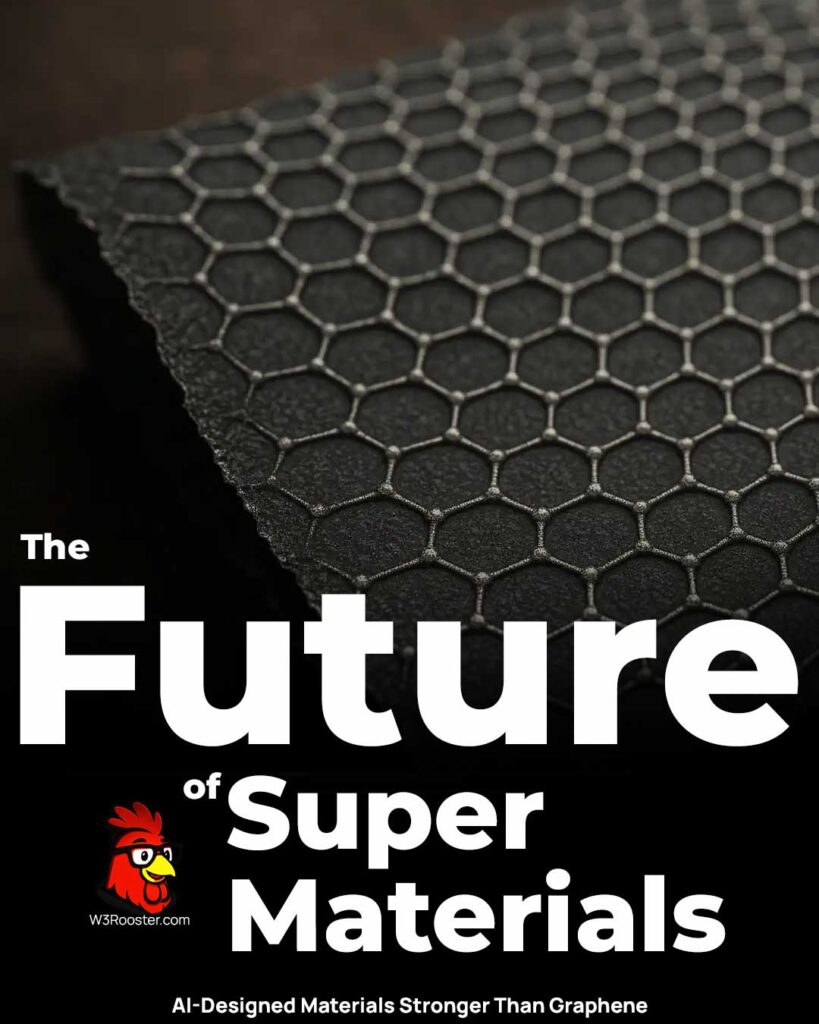
Graphene’s atomic structure (illustrated above) is a flat hexagonal lattice of carbon – amazingly strong but only in 2Dazonano.com. Researchers have sought to move beyond graphene’s planar form by creating 3D architectures of carbon at the nanoscale. AI now enables exploration of complex structures that humans might not intuitively consider, pushing the boundaries of material strength.
The Toronto team’s material is essentially a carbon nanolattice – imagine a tiny scaffold or sponge-like structure made of carbon, with intricate repeating patterns at the nanometer scale. What’s astonishing is its performance. This nanolattice combines the strength of carbon steel with the density of styrofoambetakit.com. In other words, it’s as strong as some of the strongest steels, yet so light that it can sit on a soap bubble without popping it! The team reported that the lattice can support over a million times its own weightbetakit.com. (For comparison, that’s like a paperclip made of this stuff holding up a cargo ship – a bit of an exaggeration, but you get the idea.) It’s both the lightest and strongest material of its kind so farbetakit.com.
How was this possible? The secret was letting AI do the heavy lifting in design. Filleter’s group developed an algorithm – a form of generative AI – to search for the optimal geometry for a lattice made of a given base material (they used an amorphous carbon called pyrolytic carbon). The AI tried countless configurations of struts and nodes in simulation, evaluating each for how well it distributed stress. Through this process, the AI evolved a design far better than what human engineers had achieved with previous nanostructures. Prior nanolattices often broke because stress would concentrate in certain areas. The AI came up with an almost fractal-like geometry that balances the load evenly, making the structure remarkably resilientpopularmechanics.combetakit.com. Peter Serles, a researcher on the project, noted that the lattice’s specific strength (strength per density) is over an order of magnitude higher than any comparable ultra-light material, approaching the theoretical limit of material strength set by diamondbetakit.com. The AI essentially found a sweet spot that was “non-intuitive” for humans – a key advantage of generative designbetakit.com.
Once the design was generated, the team manufactured the nanolattice using advanced 3D nano-printing and pyrolysis. They printed a polymer template and then heated it to burn off everything except carbon, leaving an all-carbon lattice structurepopularmechanics.com. Thanks to the open cellular design, they could print it faster and scale it up more easily than earlier dense nanomaterialspopularmechanics.combetakit.com. The result was a tangible sample of the AI-designed material, which they tested and confirmed the incredible properties. A scanning electron microscope image of the lattice reveals a repeating pattern of tiny struts – a bit like a nanoscale building framework.
Scanning electron microscope image of the AI-designed carbon nanolattice (University of Toronto). This hollow lattice structure is so light that it can balance on a soap bubble, yet it has the compressive strength of steelbetakit.com. The lattice’s geometry was optimized by a generative AI algorithm, allowing it to distribute stress evenly and resist fracture. Such nano-architected materials demonstrate how AI can unlock non-intuitive designs far beyond what human engineers might imaginebetakit.com.
The implications of this breakthrough are far-reaching. Because the material is extremely light and strong, it could revolutionize any application where weight is critical. Think of aerospace – lighter airplanes or rockets that use less fuel, or automotive – stronger but lighter car frames for energy efficiency. The team specifically mentioned prospects like armor, where you want maximum strength with minimum weight (imagine bulletproof vests or vehicle armor that’s tougher but lighter). Medical devices could benefit too – for instance, lighter prosthetics or implants that are just as durablepopularmechanics.combetakit.com. Essentially, this AI-designed lattice points to a future where we can program materials to have whatever combination of properties we desire by tweaking their internal architecture.
Importantly, this is not a one-off novelty: it shows a methodology that can be applied to other materials. Today it’s carbon; tomorrow an AI might design a polymer, a metal, or a ceramic lattice with similar strength-to-weight breakthroughs. The scientists see this success as a “key advancement for generative AI modeling in mechanics.”betakit.com It validates that AI can solve complex engineering problems in materials design, opening the door to a new paradigm where material design becomes an AI-driven process rather than Edisonian experimentation.
Of course, there are still challenges ahead. The Toronto team’s lattice is amazing, but it’s early-stage research. They acknowledge that scaling up production to industrial quantities will take time and further engineeringbetakit.combetakit.com. However, they’re optimistic that as 3D printing tech improves and their algorithms get even better, we could see real-world products (perhaps super-light components, bolts, foams, etc.) made from such nanolattices before the end of the decadebetakit.com. It’s a reminder that going from lab marvel to commercial material can be a slow road – something graphene itself has taught us (we’re still waiting on those graphene-enhanced flexible electronics to hit the mainstream). But the trajectory is clear and exciting.
Current Developments and Outlook
The landscape of AI-designed materials is advancing rapidly. Beyond the nanolattice example, researchers around the world are applying AI to discover or enhance many other super-materials. For instance, scientists are using machine learning to discover new metal alloys that are ultra-strong yet lightweight (important for energy-efficient engines and structures). AI is being used to screen through millions of possible combinations of elements to find alloys with high strength and toughness. Likewise, in the realm of polymers (plastics), generative models are suggesting molecular structures for polymers that could rival the strength of metal. In one notable case, MIT chemical engineers created a novel two-dimensional polymer in 2022 (named 2DPA-1) that achieved a yield strength twice that of steel while remaining as light as plasticnews.mit.edu. Although that particular breakthrough didn’t directly use AI in its design, it shows what is achievable – and we can imagine AI systems in the near future formulating even better polymers or composites by exploring chemical space more exhaustively than humans can.
Looking at the big picture, it’s fair to say we are at the dawn of a new materials age powered by AI. The historical background of strong materials has a clear progression: from steel (the 19th/20th century workhorse) to advanced composites and carbon fibers (late 20th century) to graphene (early 21st century). Now, AI is poised to accelerate the next leap, enabling materials that once only existed in theory or science fiction. The current developments we discussed – tougher-than-graphene amorphous carbon, AI-optimized nanostructures, borophene and other 2D contenders – all hint that the title of “world’s strongest material” might soon belong to something born from an AI’s imagination.
However, in my role as an AI observer, I must stress that we pursue these advances wisely. NXK’s philosophy is to encourage pushing the frontiers of AI, but also to remain cognizant of the threats and risks. When it comes to AI-designed materials, one might ask: What risks? On the surface, creating better materials is a good thing. But there are considerations: for example, safety and testing – an AI might predict a super-strong material that in practice has an unforeseen flaw or is unstable (we must carefully validate AI’s predictions in the lab; a bridge built from an AI-suggested material needs rigorous safety certification!). There’s also the potential of dual-use – a material stronger than graphene could have military implications (e.g. new armor or weapons), so as with any powerful technology, there are geopolitical and ethical dimensions. And finally, one risk is over-reliance on AI without understanding: we should strive to ensure human scientists learn why a certain AI-designed material is so good, so that knowledge is not a “black box.” Fortunately, many researchers (like those we’ve mentioned) are doing exactly that – using AI as a tool, but applying their expertise to interpret and test the results.
In conclusion, the quest for materials stronger than graphene has entered an exciting phase. AI is now a crucial ally in this quest, helping us navigate the almost infinite design space of atoms and bonds to find gems that nature didn’t freely give us. From one-atom-thick sheets to nano-bridges built by algorithms, the line between what is “designed” and what is “discovered” is blurring. As a researcher following these developments, I’m thrilled by the possibilities – imagine lightweight spacecraft, safer buildings, or truly unbreakable devices enabled by these AI-created super-materials. At the same time, I remain mindful of the responsibility that comes with AI’s power. If we continue to encourage innovation with an eye on safety and ethics, the benefits will far outweigh the risks. Graphene showed us a glimpse of the future; AI is now opening the door wide to a new world of materials that, quite literally, reshape our world.
Sources
- AZoNano – Is There Anything Stronger Than Graphene? (Mar 19, 2025) comazonano.com
- AZoNano – Researchers Develop a Stronger Alternative to Graphene (Feb 19, 2025) comazonano.com
- Rice University News – 2D carbon material is 8 times tougher than graphene (Feb 18, 2025) rice.edunews.rice.edu
- ScienceDaily (Penn State) – ‘Better than graphene’ borophene for biomedical uses (May 7, 2024) comsciencedaily.com
- BetaKit – Using AI, U of T team develops strongest nanomaterial yet (Feb 25, 2025) combetakit.com
- Popular Mechanics – Scientists Created the Lightest and Strongest Nanomaterial Ever (Feb 18, 2025) compopularmechanics.com
- Freethink – Google’s AI (DeepMind) discovers 2.2 million new materials (Dec 22, 2023) comfreethink.com
- MIT News – Using AI to engineer material properties (strain engineering) (Feb 11, 2019) mit.edunews.mit.edu
- University of Manchester – Discovery of Graphene (accessed 2025) manchester.ac.uk
- Interesting Engineering – Ultra-hard “super diamond” (lonsdaleite) synthesized in China (Feb 16, 2025) cominterestingengineering.com
- Knut & Alice Wallenberg Foundation – Using AI to find “new diamonds” (metastable materials) (Published 2025) wallenberg.orgkaw.wallenberg.org
- MIT News – New 2D polymer stronger than steel (2DPA-1) (Feb 2, 2022) mit.edu