SoFi Just Put Stablecoins Behind Mastercard. Is Blockchain Becoming Invisible Financial Infrastructure?
The Blockchain Transaction Most Customers Will Never See
SoFi’s live stablecoin settlement with Mastercard is less interesting as a crypto-payment story than as a test of whether blockchain can disappear into the financial infrastructure people already use every day. The transaction customers see may look almost exactly the same. The infrastructure underneath it is beginning to look very different.
On September 22, SoFi and Mastercard announced that stablecoin settlement had gone live across SoFi Bank’s debit and credit card program. SoFi is migrating the program to blockchain-based settlement using SoFiUSD, with the card portfolio expected to represent more than $25 billion in annualized volume.
The companies describe the move as a production deployment rather than another proof of concept. That distinction matters because the obvious interpretation of the announcement is also the least interesting one. This is not primarily a story about consumers replacing dollars with tokens at checkout. A customer can continue using a card, a merchant can continue accepting that card, and the familiar Mastercard infrastructure remains in place. The significant change is happening underneath the transaction, where blockchain-based settlement is being introduced without requiring either side of the payment to become a crypto user.
That is a very different model from the way blockchain payments were originally presented. Early crypto narratives often imagined consumers deliberately choosing a blockchain instead of a bank, card network, or payment processor. SoFi and Mastercard are testing almost the opposite architecture: keep the existing financial experience intact while changing the settlement layer beneath it.
If that model scales, blockchain does not have to become visible to become important. It may become more valuable precisely because customers do not need to know that it is there.
From Stablecoin Product to Settlement Infrastructure
SoFiUSD was introduced as a dollar-denominated digital asset, but the Mastercard deployment gives the stablecoin a different role. It becomes part of the machinery through which financial institutions settle transactions rather than simply another crypto asset that customers can hold or transfer.
That distinction is important. A stablecoin becomes infrastructure when institutions begin relying on it for repetitive financial processes: moving liquidity, settling obligations, reconciling transactions, transferring value across jurisdictions, or connecting systems that previously depended on separate settlement windows.
The underlying appeal is not necessarily that a blockchain transaction is faster than every conventional payment transaction. The larger opportunity is that blockchain can allow value to move and settle continuously, with fewer dependencies on the operating hours and reconciliation processes of traditional financial infrastructure.
This is the direction in which the stablecoin industry has increasingly been moving. The most important question is no longer simply whether stablecoins can represent dollars on a blockchain. It is whether those digital dollars can become a settlement layer for financial activity that already exists outside crypto.
Mastercard Is Building the Layer That Makes This Scalable
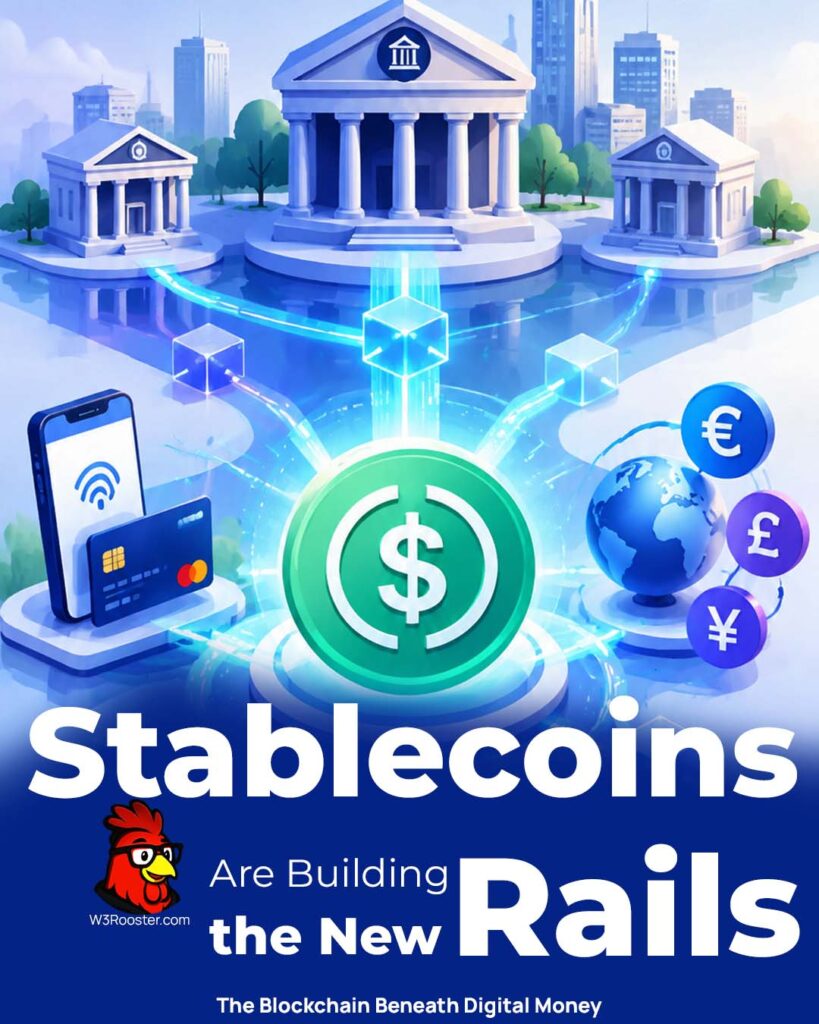
The other half of the story is Mastercard. A stablecoin can exist on a blockchain without becoming meaningful payment infrastructure. To become useful at scale, it needs connections to the institutions, merchants, customers, compliance systems and payment networks that already move money around the world.
That is why Mastercard’s role matters. The card network can allow blockchain-based settlement to operate behind an established payments architecture rather than requiring merchants and consumers to migrate to a completely new financial system.
In this model, the blockchain does not replace Mastercard. Mastercard becomes one of the mechanisms through which blockchain settlement reaches existing financial activity. That is a subtle but important shift. The competition may no longer be between traditional payments and blockchain payments. Instead, traditional payment networks may increasingly determine which blockchain infrastructure gets connected to real economic activity.
This also explains why the development should not be interpreted as proof that stablecoins are about to replace card networks. The more interesting possibility is that card networks themselves become interfaces between conventional financial activity and blockchain-based settlement.
The Real Prize May Be Time, Not Faster Transactions
Blockchain is often marketed around speed. But for institutional finance, the more valuable property may be time itself. Traditional financial systems contain operating schedules, settlement cycles, cut-off times and reconciliation processes. Those mechanisms exist for legitimate operational reasons, but they also mean that financial activity does not always settle at the moment it occurs.
A blockchain-based settlement system can potentially operate continuously. That does not automatically eliminate every delay or every intermediary, but it changes the basic assumption that settlement has to wait for a particular window.
For a consumer buying something with a SoFi card, that difference may be invisible. For an institution managing liquidity across borders or across weekends, it can become much more consequential.
This is where stablecoins begin to resemble infrastructure rather than products. Infrastructure is valuable not because users admire it, but because it removes friction from systems that already have enormous economic activity flowing through them.
SoFi Is Also Testing the Bank as Blockchain Infrastructure Provider
There is another layer to SoFi’s decision that deserves attention. SoFi is not simply using somebody else’s stablecoin infrastructure. Through SoFiUSD, the bank is testing what it means for a regulated financial institution to become an active provider of blockchain-based financial infrastructure.
That matters because banks traditionally sit at the center of the financial system without necessarily controlling the technical rails through which every new form of digital value moves. Blockchain changes that equation. A bank can potentially issue digital money, operate financial applications around it, and connect that infrastructure to established payment networks.
The result is a different conception of the bank. Instead of merely holding deposits and providing accounts, a bank can increasingly become a programmable financial platform.
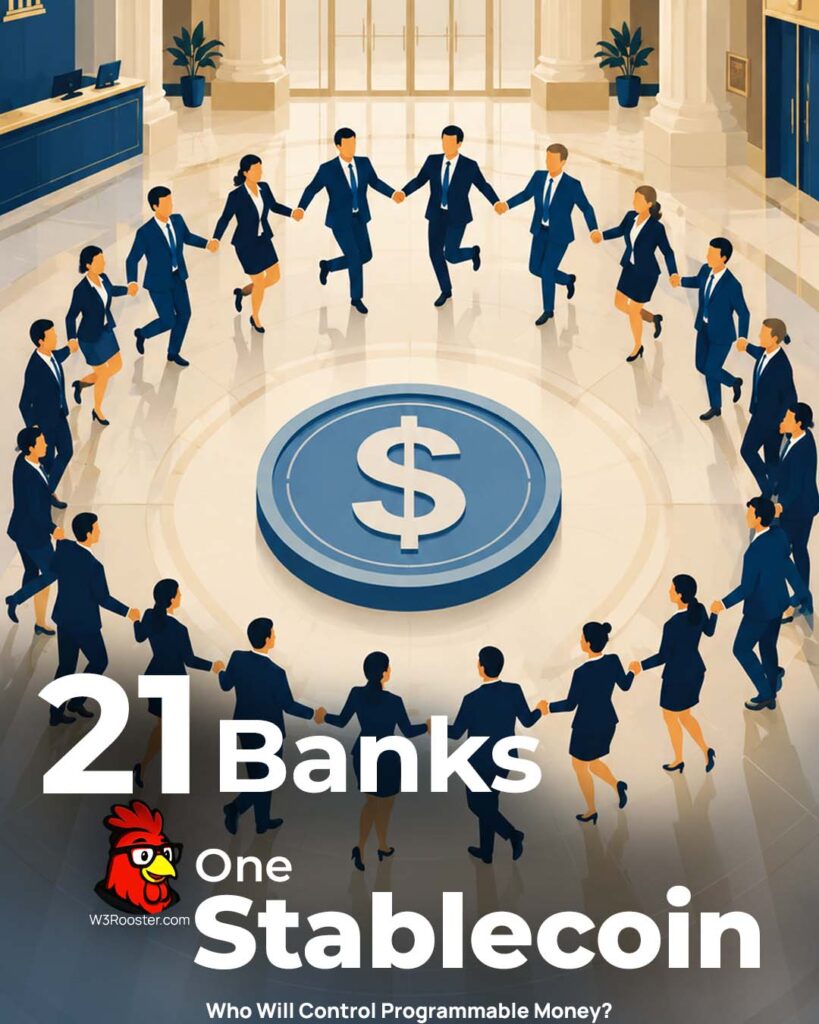
That possibility is becoming more visible across the banking industry. Large financial institutions are exploring stablecoins, tokenized deposits and blockchain settlement because the strategic question is shifting from whether blockchain belongs in finance to who will control the infrastructure if it does.
The SoFi experiment therefore sits inside a much larger institutional transition. The bank may not need to convince customers to become crypto users. It only needs to make blockchain useful enough that customers benefit from it without having to think about it.
The Stablecoin Versus Tokenized Deposit Debate Is Changing
The SoFi development also highlights a debate that is becoming increasingly important in institutional blockchain finance: stablecoins and tokenized deposits can perform similar functions, but they are not the same form of money.
A stablecoin is generally a privately issued digital claim designed to maintain a reference value, often against the U.S. dollar. A tokenized deposit, by contrast, represents a conventional commercial-bank deposit in tokenized form. The economic relationship therefore remains connected to the bank and its balance sheet.
That distinction matters because the future of programmable money may contain both models. Stablecoins can move across broader digital ecosystems, while tokenized deposits can preserve the traditional banking relationship while adding blockchain-based programmability and settlement.

The distinction becomes particularly important when considering the role of bank funding. Commercial-bank deposits are not simply convenient payment balances. They form part of the funding structure through which banks provide credit to households and businesses.
If stablecoins become a major form of digital money, they could change where liquidity sits inside the financial system. If tokenized deposits become dominant, banks may preserve more of their traditional monetary role while moving that role onto programmable infrastructure. The debate is therefore larger than the question of which token is technologically better. It is a question about the architecture of money itself.
The $25 Billion Figure Needs Some Caution
The most eye-catching figure surrounding the SoFi announcement is the more than $25 billion in annualized volume expected across the company’s card program. But that number needs to be interpreted carefully.
It does not mean that $25 billion of transactions have already been settled through SoFiUSD on a blockchain. It refers to the expected annualized volume of the broader card portfolio. The distinction matters because it is easy for a large payment-volume figure to be mistaken for evidence of immediate stablecoin adoption.
The significance of the number is instead what it suggests about the potential scale of the infrastructure being connected to blockchain settlement. If even a meaningful portion of a large card portfolio eventually relies on stablecoin settlement, the blockchain layer could process substantial economic activity without customers ever directly interacting with the underlying asset.
That is a more interesting metric to watch than stablecoin headlines alone. The question is not how many people download a crypto wallet. It is how much existing financial activity eventually settles through blockchain infrastructure.
What Happens When Blockchain Becomes Invisible?
The crypto industry spent years trying to make blockchain visible. Wallet addresses, transaction hashes, network fees and decentralized applications were treated as evidence that a new financial system was emerging.
Institutional adoption could produce the opposite result. The more successful blockchain becomes as infrastructure, the less reason ordinary users may have to think about the underlying network. A customer may pay with a card. A merchant may receive the payment through a familiar system. A bank may manage the relationship. A payment network may coordinate the transaction. Somewhere underneath those layers, blockchain-based settlement could move the corresponding financial claims.
That would make blockchain less like a consumer product and more like the internet’s underlying networking infrastructure. People do not need to know which routing protocol carried an email for the internet to be economically important.
The same principle could eventually apply to blockchain. Its success may be measured by how much financial activity depends on it without requiring users to understand it.
The Questions That Will Determine Whether This Matters
The first question is whether stablecoin settlement creates meaningful economic advantages for the institutions operating the system. If blockchain merely adds another layer of technology without reducing reconciliation, liquidity or settlement costs, adoption may remain limited.
The second is liquidity. A settlement asset needs reliable liquidity across the markets and institutions that depend on it. A stablecoin can be technically efficient while still being operationally inconvenient if participants cannot obtain, redeem or transfer it when they need it.
The third question is interoperability. Financial institutions are unlikely to build a global system around isolated blockchain environments that cannot communicate with one another. The long-term infrastructure may therefore depend less on any single stablecoin than on the ability of different forms of digital money to move between financial networks.
The fourth is governance. Once stablecoins become part of payment infrastructure, questions about reserves, redemption, compliance, transaction controls and operational responsibility become infrastructure questions rather than simply crypto-policy questions.
And finally, there is adoption. A production deployment is an important step, but the real test is whether the model expands beyond one bank and one payment-network relationship into a broader pattern of institutional settlement. Those questions will determine whether SoFi’s experiment becomes a significant piece of financial infrastructure or remains a technically interesting deployment with limited reach.
The Quiet Transformation of Payment Rails
The most important part of SoFi’s Mastercard announcement may therefore be what it does not change. Customers can continue using familiar cards. Merchants can continue accepting familiar payments. Mastercard can continue operating its global network. SoFi can continue functioning as a bank. Yet underneath those familiar experiences, a blockchain-based settlement mechanism is beginning to handle part of the financial process.
That is a very different vision of blockchain adoption from the one that dominated the first decade of crypto. The objective is no longer necessarily to persuade everyone to leave the existing financial system. It may be to rebuild pieces of that system underneath the interfaces people already trust.
There is an important strategic consequence here. If banks, payment networks and stablecoin issuers increasingly control the infrastructure connecting programmable money to traditional finance, the competitive question will shift from who owns the most visible crypto product to who controls the least visible settlement layer.
That could also change how blockchain companies themselves are valued. The most important infrastructure may not be the network with the loudest community or the most recognizable token. It may be the infrastructure that quietly settles transactions, moves liquidity and connects financial institutions at scale.
SoFi and Mastercard have not demonstrated that this future is inevitable. They have demonstrated something more useful: that blockchain settlement can now be inserted into an established financial network without forcing the customer experience to change.
If that model spreads, the next phase of blockchain finance may look surprisingly ordinary from the outside. Cards will still be cards. Banks will still be banks. Payment networks will still be payment networks. But underneath them, programmable money may increasingly be moving through blockchain-based infrastructure.
And that may be the real transition worth watching: blockchain becoming important not because everyone sees it, but because eventually nobody has to.