DTCC Just Opened Wall Street’s Plumbing to Tokenized Funds
Ondo Finance’s entry into DTCC’s Fund/SERV network may look like another tokenization milestone. The deeper story is about something more consequential: how blockchain-native financial products could enter the institutional system through the same infrastructure that already processes conventional funds.
On September 16, 2026, Ondo Finance’s regulated subsidiary, Oasis Pro Markets, became the first tokenization platform to join the Depository Trust & Clearing Corporation’s Fund/SERV network. DTCC says Fund/SERV currently supports more than 85% of U.S. mutual-fund transaction activity, connecting fund companies with distributors, wealth platforms and other service providers.
At first glance, this sounds like an infrastructure-access story. A tokenization company has gained membership in a major financial network, and therefore tokenized funds have another route toward traditional distribution. But that interpretation misses the more interesting development.
The real significance is that a blockchain-native financial product is beginning to connect with the operational machinery that makes conventional financial products usable at scale. Issuing an asset on a blockchain may demonstrate that tokenization works technically. Getting that asset into established financial workflows is a different problem entirely. The Ondo-DTCC development is important because it moves the discussion from whether assets can be tokenized to whether tokenized assets can actually participate in the institutional economy. That distinction is likely to matter long after the announcement itself disappears from the daily crypto news cycle.
Tokenization Has Had an Issuance Problem — But Distribution May Be Harder
The first generation of tokenization concentrated heavily on the asset itself. A Treasury, fund, stock or other financial instrument could be represented as a blockchain-based token, with promises of faster settlement, programmable ownership and continuous availability. Yet financial markets do not operate merely by creating securities.
A conventional fund also requires account records, order transmission, confirmations, reconciliations, distributions, tax information, reporting and connections between numerous institutions. Fund/SERV exists partly to coordinate these operational processes. According to DTCC, Oasis Pro Markets can now interact through a standardized connection with fund companies, wealth platforms and service providers instead of constructing separate connections for individual counterparties.
That seemingly mundane detail may be one of the most important aspects of the announcement. Imagine that a tokenized fund is technically flawless but requires every wealth platform that wants to distribute it to build a custom integration. The blockchain may have solved the problem of representing the asset, but the financial system has not solved the problem of distributing it efficiently. Technology has created a new product without eliminating the friction surrounding the product. Fund/SERV potentially changes that equation by giving tokenized funds a route into an existing standardized ecosystem.
This is why the story is less about blockchain replacing Wall Street than many early crypto narratives might suggest.
Wall Street’s “Plumbing” May Become Part of the Blockchain Revolution
For years, blockchain advocates have described distributed ledgers as an alternative to centralized financial infrastructure. There is another possibility: the most successful blockchain systems may become deeply integrated with the institutions they were originally expected to disrupt.
DTCC’s role makes that possibility particularly visible. The organization has been expanding its own work on tokenization and interoperability, rather than treating blockchain as a separate financial universe. In July 2026, DTCC processed production trades using tokenized representations of securities held at DTC, involving more than 30 firms and multiple use cases including collateral, securities lending, Treasury and repo delivery-versus-payment, equity transactions and margin workflows.
The organization has also been developing a tokenization service scheduled for launch in October 2026. That service is intended to allow DTC-held securities to be represented in tokenized form while remaining connected to traditional custody and market infrastructure.
Taken together, those developments suggest that institutional tokenization is evolving in a direction that is more hybrid than revolutionary. The future financial system may not have a clean boundary between “traditional finance” and “onchain finance.” Instead, securities could originate, trade or settle through blockchain networks while still depending on established institutions for legal records, custody, processing, compliance and distribution.
The irony is striking. Blockchain may eventually become more important to Wall Street not when it destroys the old plumbing, but when the old plumbing learns how to carry blockchain-based assets.
DTCC and Ondo Are Solving Different Sides of the Same Problem
The architecture becomes easier to understand when the two companies are viewed separately. Ondo has been building the blockchain-native side of the equation. Its acquisition of Oasis Pro gave the company access to a regulated broker-dealer, alternative trading system and transfer-agent structure, creating a foundation for regulated tokenized securities markets in the United States.
In July 2026, Oasis Pro Markets also received FINRA authorizations covering a range of tokenized equities and fund interests for U.S. institutions and retail investors, including the ability to operate within established broker and advisory channels.
DTCC occupies a different layer. Its infrastructure sits inside the established post-trade ecosystem, where standardization and connectivity between financial institutions are often more consequential than the underlying trading interface.
The September 16 development therefore connects two forms of infrastructure that have historically evolved separately. One side makes financial products programmable and blockchain-compatible. The other provides established institutional connectivity. That is why the word “distribution” deserves more attention than it initially receives.
The Next Competitive Advantage May Be Interoperability
There is a tendency in crypto to judge infrastructure by asking which blockchain is faster, cheaper or more scalable. Those questions remain relevant, but institutional finance introduces another variable: interoperability with systems that already have enormous network effects.
A wealth platform does not necessarily care which blockchain a tokenized fund uses. It cares whether the fund can be processed within existing operational, regulatory and accounting workflows.
This creates an unusual competitive environment. A blockchain can offer impressive technical capabilities and still struggle to obtain institutional adoption if every participant must build custom infrastructure around it. Conversely, an asset with less radical technical architecture may gain traction if it can connect to the systems that institutions already understand.
This is where the DTCC development becomes particularly significant for the broader real-world-asset sector. The challenge for tokenization may gradually shift away from creating tokens toward creating standardized interfaces between tokenized assets and financial institutions.
W3Rooster’s recent research into tokenized securities and capital-market architecture has repeatedly pointed toward this distinction: the asset is only one component of a much larger financial system. The Ondo-DTCC connection provides a concrete example of what that missing middle layer can look like.
The “Boring” Functions Could Decide Whether Tokenization Scales
There is another lesson hidden inside Fund/SERV. Blockchain discussions often emphasize the visible functions of a token: ownership, transferability, programmability and potentially 24/7 settlement. Institutional finance depends on many less glamorous processes that exist around those functions.
Account-level information matters. Reconciliation matters. Corporate and fund distributions matter. Tax reporting matters. Regulatory reporting matters. Transaction confirmations matter. None of these disappear because a financial asset becomes a token. In some respects, tokenization makes those requirements more complicated because two infrastructures must communicate: the blockchain environment and the existing financial system.
That is why the long-term value of developments like Fund/SERV membership should not be measured purely by how many tokenized assets are issued immediately afterward. The more interesting metric may eventually be how much friction disappears between digital assets and established financial workflows.
If a tokenized fund can be created onchain but cannot be administered through a familiar institutional process, it remains an isolated innovation. If it can move through established operational channels while preserving blockchain-native capabilities, its potential market is considerably broader.
From Tokenized Assets to Tokenized Markets
This may ultimately be the most important transition. The early tokenization narrative was largely about individual assets: tokenize a Treasury, tokenize a fund, tokenize an equity, tokenize private credit. The emerging narrative is broader. It concerns whether entire financial processes can operate across interconnected digital and traditional infrastructure.
That distinction echoes developments elsewhere in the financial system. South Korea’s tokenization roadmap, for example, has been exploring the interaction between securities, digital settlement and financial infrastructure rather than treating tokenization as a simple exercise in converting securities into tokens. India’s Demat 2.0 experiment similarly combines tokenized corporate bonds with wholesale digital currency, putting the asset and settlement-money layers into a shared digital architecture.
The broader direction is becoming harder to ignore. Tokenization is gradually moving from the question “Can this asset exist onchain?” toward “Can this asset operate inside a complete financial system?”
That is a much more demanding test. And it is precisely why the DTCC-Ondo connection deserves attention.
The Announcement Has Limits — and They Matter
There is also a reason to remain cautious about interpreting the development as proof that tokenized funds have already entered mainstream distribution.
The announcement establishes that Oasis Pro Markets has joined Fund/SERV and can use its standardized infrastructure. It does not establish that every Ondo fund is already being distributed through the network, nor does it provide a specific product launch or transaction timetable for Fund/SERV activity.
That gap between infrastructure access and actual utilization is important. Financial history is filled with infrastructure projects that appeared strategically important but took years to generate meaningful adoption. Network connectivity can reduce barriers, but it cannot by itself guarantee investor demand, regulatory acceptance, institutional integration or economic efficiency.
So the September 16 announcement should be viewed as an architectural development rather than proof that tokenized funds have already become a mainstream asset class. The infrastructure door has opened. What walks through it remains the more important question.
The New Architecture of Wall Street May Be Hybrid
W3Rooster’s perspective is that the most consequential blockchain developments may increasingly occur beneath the surface of crypto markets. They may appear in fund-processing networks, custody systems, settlement infrastructure, broker-dealer technology and institutional distribution rather than in the places traditionally associated with crypto speculation.
That would represent a significant change in the history of the industry. Bitcoin introduced the idea that value could be transferred without relying on conventional financial intermediaries. Ethereum expanded that idea into programmable assets and applications. Tokenization is now confronting a different problem: how to make those programmable representations function inside a financial system that already has decades of institutional standards and enormous networks of participants.
The answer may not be decentralization versus centralization. It may be interoperability. DTCC’s strategy increasingly points toward a financial infrastructure in which traditional and tokenized representations can coexist, move between systems and maintain institutional protections while gaining some of the programmability of blockchain networks.
That model is less dramatic than the promise of replacing Wall Street. It may also be more realistic. The deeper transformation of finance rarely happens by deleting every previous layer. More often, a new layer is introduced, connected to what already exists, and gradually changes what the older system can do.
The DTCC-Ondo relationship may be an early example of exactly that process. For tokenization, the decisive breakthrough may therefore not be the moment a financial asset becomes a token. It may be the moment the token becomes legible to the financial system around it.
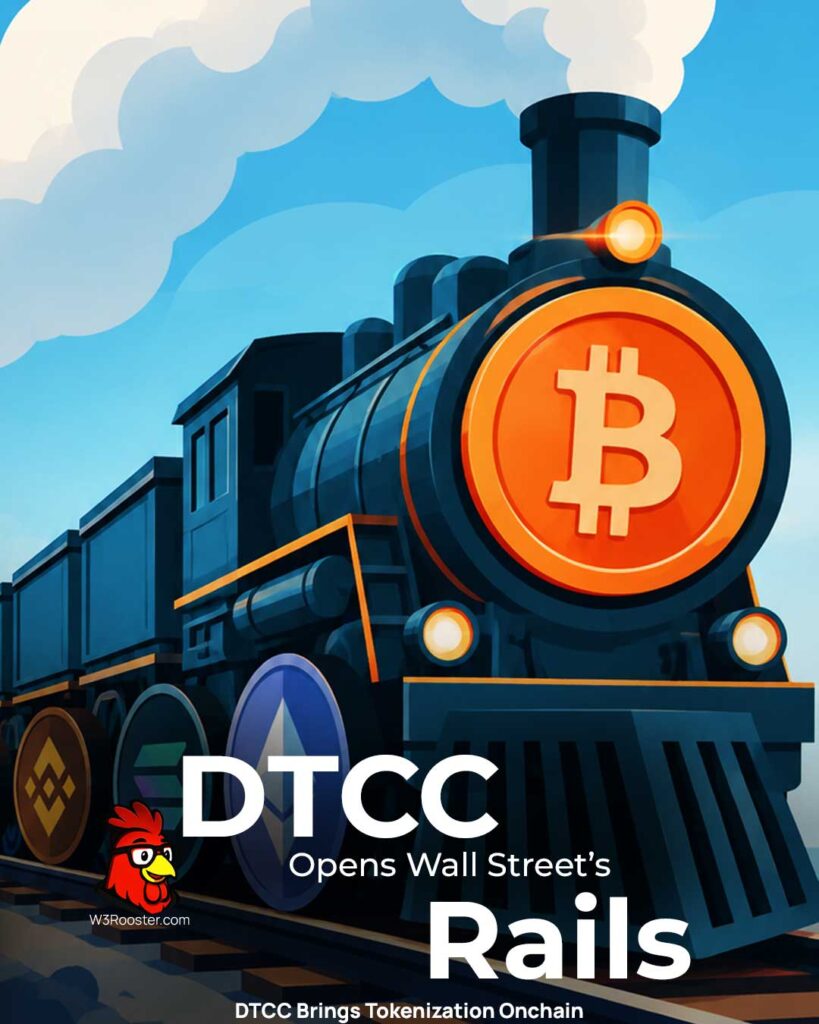
And if that is where the industry is heading, Wall Street’s plumbing may not stand in the way of blockchain after all. It could become one of the rails on which blockchain finance finally scales.