The U.S. Senate’s Crypto Momentum Signals a Global Shift
Why Governments Are Choosing Regulation Over Resistance
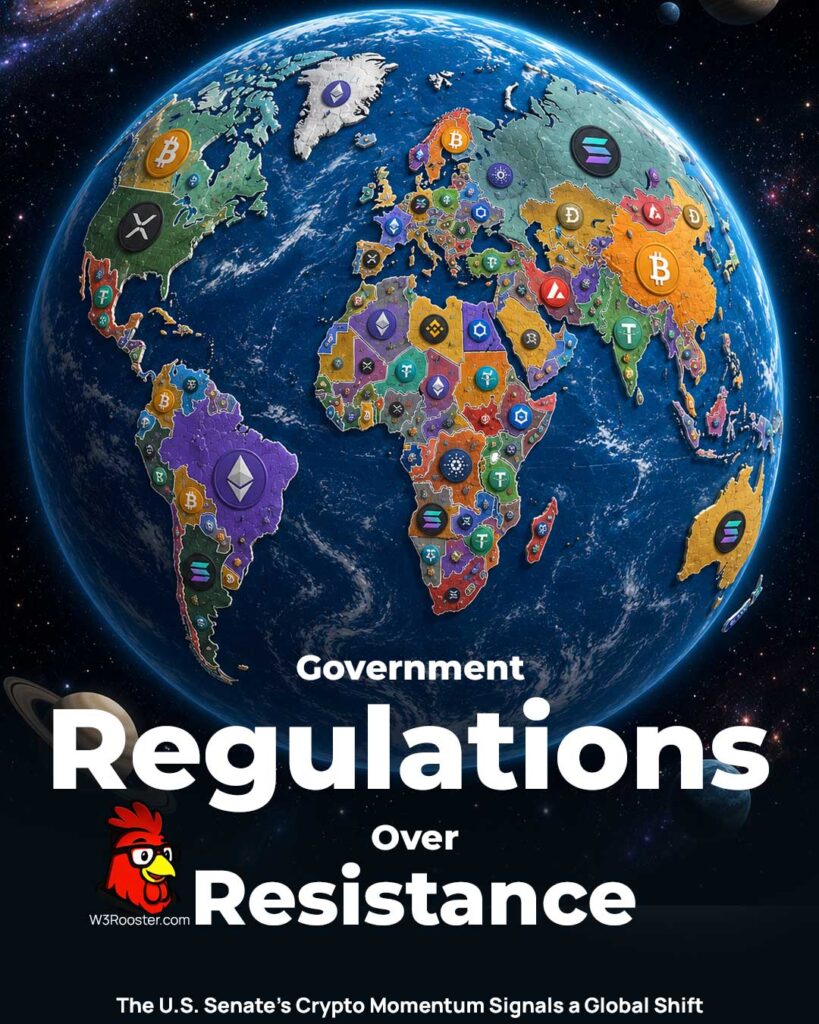
W3Rooster: During the early years of cryptocurrency, government reactions often followed a familiar pattern. Digital assets were viewed primarily through the lens of uncertainty, with policymakers focusing on speculative trading, financial crime, consumer protection, and the potential risks posed by decentralized financial systems. For many regulators, blockchain technology represented an unfamiliar innovation that challenged long-established financial frameworks, and the most immediate response was often caution, hesitation, or outright resistance. Fast forward to today, and the conversation has changed remarkably.
Recent developments in Washington—including renewed legislative momentum surrounding cryptocurrency regulation in the United States Senate—have once again pushed digital assets into the center of political and financial discussions. While daily headlines often focus on proposed legislation, market reactions, or the possible impact on major assets such as Bitcoin and Ethereum, the deeper significance of these developments extends far beyond any single regulatory proposal.
The more important story is the transformation taking place in government thinking. Across many regions of the world, policymakers are gradually moving away from the original question of whether cryptocurrencies should exist and toward a more practical discussion: how digital assets can be integrated into modern financial systems through clear, predictable, and enforceable regulatory frameworks.
Although this shift may appear gradual, it represents one of the most important transitions in the history of blockchain technology. The relationship between governments and cryptocurrencies is evolving from confrontation and uncertainty toward a more structured process of oversight, cooperation, and institutional adoption.
From Legal Uncertainty to Regulatory Maturity
For almost fifteen years, the cryptocurrency industry developed in an environment where technological innovation frequently moved faster than government policy. Entrepreneurs built exchanges, decentralized applications, and blockchain-based financial services while regulators attempted to understand technologies that challenged traditional definitions of money, ownership, and financial infrastructure.
This created a complicated environment. Many crypto companies operated without comprehensive licensing frameworks, institutional investors hesitated because of unclear compliance requirements, and traditional financial organizations often remained cautious because they lacked certainty regarding legal responsibilities. Although blockchain innovation advanced rapidly, regulatory ambiguity became one of the biggest obstacles preventing broader adoption.
However, this imbalance is beginning to change. Governments are increasingly recognizing that digital assets are no longer a temporary experiment limited to technology enthusiasts or speculative investors. Cryptocurrencies and blockchain networks have become connected to much larger discussions involving global payments, tokenized financial assets, digital identity, programmable money, and the future architecture of financial systems.
As a result, many policymakers are shifting their approach from attempting to restrict innovation toward creating frameworks that allow innovation to develop under appropriate supervision.
The United States: Moving Toward a More Defined Crypto Framework
The United States represents one of the clearest examples of this regulatory transformation.
For years, the American cryptocurrency industry criticized what it viewed as a fragmented and uncertain regulatory environment. Companies often struggled to understand which agencies had authority over specific digital assets, while investors faced uncertainty regarding compliance expectations and long-term legal conditions.
This uncertainty created significant challenges.
Businesses planning to build blockchain-based products require predictable rules. Institutional investors allocating capital require confidence that regulatory expectations will remain stable. Financial institutions entering the digital asset space need clear guidelines regarding custody, reporting, risk management, and consumer protection.
Recent legislative discussions indicate that U.S. policymakers are increasingly acknowledging these challenges. While major questions remain unresolved—including market structure, stablecoin regulation, consumer safeguards, and the responsibilities of different regulatory agencies—the overall direction appears to be moving toward establishing clearer rules rather than depending primarily on enforcement actions after problems occur.
The significance of this change is not only about cryptocurrency itself. It reflects a broader recognition that blockchain technology may become part of future financial infrastructure rather than remaining outside the traditional economic system.
Why U.S. Crypto Regulation Matters Beyond American Borders
The impact of U.S. cryptocurrency regulation extends far beyond domestic markets.
The United States remains one of the world’s largest financial centers, and regulatory decisions made in Washington often influence global investment strategies, corporate planning, and international market standards. When major financial jurisdictions establish clearer rules for blockchain-based assets, investors, technology companies, and governments worldwide closely monitor those developments.
Regulatory clarity can create several advantages:
- It reduces uncertainty for businesses.
- It encourages institutional participation.
- It improves investor confidence.
- It allows companies to develop long-term strategies.
For multinational organizations, legal predictability is often just as important as technological capability. A blockchain company may have innovative technology, but without a stable regulatory environment, scaling internationally becomes significantly more difficult.
This is why cryptocurrency regulation has become part of a larger competition among countries seeking to attract innovation, investment, and financial technology leadership.
Europe’s MiCA Framework: A Different Approach to Crypto Regulation
The United States is not the only major economy redefining its relationship with digital assets. Europe has already taken a significant step through the Markets in Crypto-Assets (MiCA) framework, creating one of the world’s first comprehensive regulatory systems specifically designed for cryptocurrencies and related digital asset services.
Rather than relying on fragmented interpretations of existing financial regulations, MiCA introduces dedicated rules covering areas such as crypto service providers, stablecoins, licensing requirements, operational standards, and consumer protection.
The importance of MiCA extends beyond European borders.
It demonstrates that governments can attempt to create a balance between encouraging technological development and maintaining financial accountability. While different countries may choose different regulatory models, Europe’s experience provides an example of how blockchain innovation can exist within a structured legal environment.
The broader message is clear: regulation does not necessarily represent opposition to innovation. In many cases, effective regulation can become the foundation that allows innovation to expand more confidently.
Regulatory Competition: Why Clear Rules Are Becoming an Economic Advantage
The growing efforts in Washington, Brussels, and other financial centers reveal a larger global trend. Governments are increasingly recognizing that completely ignoring or attempting to prohibit digital assets may not eliminate demand. Instead, innovation may simply move toward jurisdictions with clearer and more supportive frameworks.
As a result, regulation itself is becoming a competitive advantage.
A decade ago, some blockchain companies searched primarily for countries with the fewest restrictions. Today, many institutional investors and established financial organizations are looking for something different: jurisdictions where rules are transparent, enforcement is predictable, and businesses can operate with confidence.
Banks, asset managers, payment providers, and publicly traded companies typically require legal certainty before committing significant resources to emerging technologies. A balanced regulatory framework can reduce operational risks while allowing companies to explore blockchain applications responsibly.
This changing environment means countries are increasingly competing not only through traditional economic incentives, but also through the quality of their digital asset regulations.
The Future Impact: Regulation Will Shape the Next Blockchain Economy
The importance of cryptocurrency regulation extends far beyond trading markets. As blockchain technology continues expanding into areas such as tokenized securities, decentralized identity, programmable payments, and digital representations of real-world assets, regulatory frameworks will influence where these technologies are developed, tested, and adopted.
The next generation of financial infrastructure may depend not only on technological innovation but also on legal clarity. Companies building tokenization platforms need regulatory certainty. Financial institutions exploring blockchain settlement require compliance frameworks. Consumers using digital assets need stronger protections and greater confidence.
For this reason, recent cryptocurrency legislative developments in the United States should not be viewed as isolated political events. They represent part of a much larger global transformation in which governments are gradually acknowledging that blockchain technology is becoming a permanent component of the digital economy.
The future of crypto regulation is unlikely to be defined by governments either fully embracing or completely rejecting digital assets. Instead, the emerging model appears to be one of controlled integration: creating systems where innovation can continue while operating within clearer rules.
The transition from resistance to regulation may ultimately become one of the most important steps in blockchain’s journey from an experimental technology into a global financial infrastructure layer.
Asia’s Different Path: Regulation as a Tool for Innovation
While the United States and Europe have approached cryptocurrency regulation largely through the lens of financial markets and investor protection, many Asian economies have viewed digital assets through a broader strategic perspective. For several governments across Asia, blockchain technology is not only a financial innovation but also a potential component of future digital infrastructure, international competitiveness, and technological leadership.
The region demonstrates that there is no single global model for cryptocurrency regulation. Different countries have adopted different strategies based on their economic priorities, financial systems, and risk tolerance. However, a common pattern is emerging: governments that once focused primarily on controlling crypto activity are increasingly developing frameworks designed to supervise and integrate it.
Japan represents one of the earliest examples of this transition. Unlike many countries that initially treated cryptocurrencies primarily as speculative instruments, Japan moved relatively early toward legal recognition and regulatory oversight. After experiencing one of the most significant exchange failures in crypto history, Japanese regulators chose not to eliminate digital assets but instead introduced stricter requirements for exchanges, custody providers, and consumer protection.
This approach reflects a broader Japanese philosophy: innovation should be encouraged, but within a carefully managed environment. Japan has continued exploring blockchain applications beyond cryptocurrency trading, including digital payments, Web3 services, enterprise blockchain solutions, and tokenized assets. The country’s government has increasingly viewed Web3 development as part of its broader technology strategy rather than simply a financial market issue.
The Japanese example demonstrates an important lesson: regulation does not necessarily slow innovation. In some cases, clear rules can increase confidence among businesses, investors, and consumers.
Singapore: Building a Compliance-Based Digital Asset Hub
Singapore has taken another approach by positioning itself as a global center for responsible digital asset innovation. The city-state has consistently emphasized that it does not aim to become an unrestricted cryptocurrency marketplace. Instead, Singapore’s strategy focuses on attracting high-quality companies that can operate within strong regulatory standards.
The Monetary Authority of Singapore (MAS) has developed licensing frameworks for digital payment token services while emphasizing anti-money laundering requirements, consumer protection, and operational resilience.
This approach reflects Singapore’s traditional economic model. The country has long positioned itself as a trusted financial hub because of regulatory quality, political stability, and institutional credibility. Its digital asset strategy follows the same principle.
Rather than asking: “How can we attract every crypto company?” Singapore’s approach is closer to:
“How can we attract the companies that will shape the future financial system?”
This distinction is important because institutional adoption requires trust. Banks, asset managers, and multinational corporations typically prefer jurisdictions where regulations are predictable and enforcement standards are clear.
Hong Kong: Competing to Become Asia’s Digital Asset Gateway
Hong Kong provides another example of how regulation has become a competitive advantage.
After years of uncertainty, Hong Kong began developing a more structured digital asset framework, including licensing systems for virtual asset exchanges and initiatives designed to attract institutional participation.
The motivation is strategic.
Hong Kong has historically been one of Asia’s most important financial centers. As global finance becomes increasingly connected with blockchain technology, maintaining relevance requires adapting to new forms of financial infrastructure.
By creating regulated pathways for digital asset businesses, Hong Kong aims to position itself as a bridge between traditional finance and blockchain innovation. The competition between financial centers is therefore changing.
In previous decades, cities competed through banking infrastructure, capital markets, and investment opportunities. Increasingly, they are also competing through:
- Digital asset regulations.
- Blockchain infrastructure.
- Tokenization frameworks.
- Institutional crypto access.
The Middle East: Regulation as a Technology Attraction Strategy
The Middle East provides another fascinating example of governments using cryptocurrency regulation as part of a broader economic transformation strategy.
Countries such as the United Arab Emirates have recognized that blockchain and digital assets could become important components of future financial infrastructure. Rather than waiting for global standards to emerge, several Middle Eastern jurisdictions have attempted to establish themselves as early regulatory leaders.
Dubai, through its Virtual Assets Regulatory Authority (VARA), has created a dedicated framework for virtual asset companies. Abu Dhabi has also developed digital asset initiatives through its financial free zones and innovation-focused regulatory environments.
The objective is not simply attracting cryptocurrency exchanges. The larger ambition is attracting:
- FinTech companies.
- Blockchain developers.
- Institutional investors.
- Digital asset infrastructure providers.
- Tokenization projects.
This reflects a broader economic strategy. Many Middle Eastern economies are attempting to diversify beyond traditional industries and build technology-driven financial ecosystems. Blockchain regulation has become one element of that transformation.
The lesson from the region is significant:
Governments increasingly understand that regulatory clarity itself can become an economic asset.
Companies do not only search for places with low restrictions. They also search for environments where they can confidently build long-term businesses.
Africa’s Crypto Reality: Nigeria Shows Why Adoption Often Comes Before Regulation
While discussions in the United States, Europe, and Asia often focus on institutional investment and financial innovation, Africa provides a different perspective on cryptocurrency adoption. In many African countries, blockchain technology has grown not because governments promoted it, but because individuals and businesses discovered practical uses for it.
Nigeria is one of the clearest examples.
The country has developed one of the most active cryptocurrency communities in the world. However, the reasons behind this adoption are different from those commonly discussed in developed financial markets. For many Nigerian users, cryptocurrency is not primarily about speculation. It is about solving real financial problems. These include:
- Cross-border payments.
- International transfers.
- Access to digital dollars through stablecoins.
- Participation in the global digital economy.
- Alternative financial tools for businesses and individuals.
Stablecoins have become particularly important because they provide digital access to currencies such as the U.S. dollar without requiring traditional banking infrastructure for every transaction. This demonstrates an important characteristic of blockchain technology: adoption often emerges where existing systems have limitations.
In countries with highly developed banking infrastructure, blockchain applications may appear like efficiency improvements. In emerging economies, they can sometimes represent access. However, Nigeria’s experience also demonstrates why regulation eventually becomes necessary.
Rapid adoption creates new challenges:
-
- Protecting consumers from fraud.
- Establishing exchange standards.
- Preventing financial crime.
- Creating taxation frameworks.
- Defining the relationship between digital assets and national monetary policy.
Nigeria’s regulatory direction has gradually moved toward recognizing and supervising digital assets rather than attempting to eliminate them completely. The government and financial authorities have increasingly explored frameworks that bring crypto-related businesses into a more structured environment.
This reflects a global pattern: When millions of people are already using a technology, governments eventually face a choice.
They can attempt to ignore it, push it underground, or create rules that provide oversight while allowing innovation. Increasingly, countries are choosing the third option.
Beyond Nigeria: Africa’s Wider Blockchain Movement
Nigeria receives significant attention because of its large population and active crypto community, but it is not the only African country exploring blockchain technology.
South Africa has developed a more formal regulatory approach toward crypto assets, focusing on licensing, financial supervision, and consumer protection. Kenya has also experienced significant interest in digital payments, blockchain-based financial services, and emerging technology solutions.
Across the continent, blockchain adoption is often connected to practical economic needs:
-
- Lower-cost remittances.
- Financial inclusion.
- Digital identity.
- Cross-border commerce.
- Access to global markets.
This creates a different adoption pattern from developed economies. In traditional financial centers, blockchain is often discussed as a way to improve existing systems. In many emerging markets, blockchain is sometimes viewed as a way to overcome limitations of existing systems. Both perspectives are important.
A Global Pattern Is Emerging: Governments Are Not Accepting Crypto Blindly — They Are Integrating It Carefully
Looking across the United States, Europe, Asia, the Middle East, and Africa, a common trend becomes visible. Governments are not necessarily becoming supporters of cryptocurrency in the ideological sense.
Most governments still have concerns about:
-
- Market manipulation.
- Financial crime.
- Consumer losses.
- Monetary sovereignty.
- Systemic financial risks.
However, many governments now recognize that blockchain technology represents a significant technological development that cannot simply be ignored.
The question has changed. The debate is no longer: “Should cryptocurrency exist?” The debate has become: “How should digital assets operate within a modern financial system?”
That shift represents a fundamental change. The future of cryptocurrency will likely not be defined by a conflict between governments and decentralized technology. Instead, it may be defined by collaboration between regulators, institutions, developers, and users to create systems that combine innovation with accountability.
Regulation May Become the Foundation of the Next Blockchain Era
The first generation of cryptocurrency was built around disruption. Bitcoin challenged traditional ideas about money. Ethereum challenged traditional ideas about applications and financial infrastructure. The next generation may be built around integration. Institutional investors want legal clarity. Companies want predictable operating environments. Consumers want protection. Governments want innovation without losing financial stability.
These interests may appear different, but they increasingly point toward the same direction: regulated blockchain infrastructure. At W3Rooster, we believe the most important blockchain developments in the coming years may not come from speculation cycles or short-term market movements. They may come from the quieter process of governments creating frameworks that allow blockchain technology to become part of everyday economic systems.
The future of crypto may not be a world where governments disappear from finance. It may be a world where blockchain technology becomes integrated into finance because governments, institutions, and users finally understand how to work with it.
The transition from resistance to regulation may ultimately become the foundation that allows blockchain technology to reach its next stage of global adoption.