ZetaChain Is Abandoning Its Own Blockchain. What Does That Say About the Future of L1s?
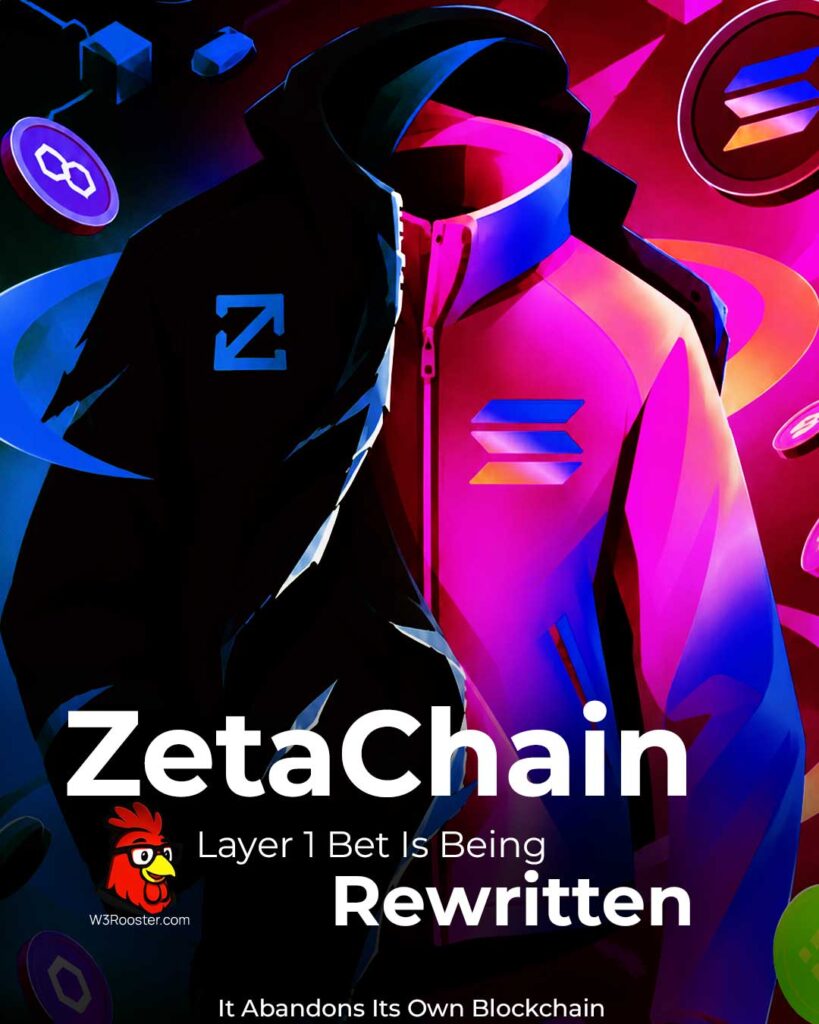
ZetaChain’s decision to wind down its Layer 1 and migrate ZETA to Solana is more than a blockchain migration. It is a real-world test of whether Web3 projects still need to own the infrastructure on which their applications run.
ZetaChain governance voted on September 20 to approve the shutdown of its Layer 1, with 99.4% support and roughly 58% participation. The vote authorizes the transition, but the network does not simply disappear overnight; additional governance work is required to define the migration mechanics, including the snapshot, token claims, exchange coordination and shutdown process.
What makes the decision especially interesting is what happens to the pieces that once justified owning a blockchain. ZetaChain built a dedicated network around an omnichain thesis, while its newer strategy increasingly centers on Anuma, an AI application. If the application can continue without its own settlement layer, then the question is no longer whether ZetaChain can operate an L1. The more important question is whether operating one still creates enough value to justify the cost.
ZetaChain Built an L1 for a Multichain World
ZetaChain originally positioned its Layer 1 as infrastructure for a world in which applications could interact across multiple blockchain ecosystems. Its architecture was designed around the idea that developers should be able to build applications capable of reaching assets and users across different networks without forcing those applications to become confined to a single chain.
That thesis made sense during an earlier phase of the market. Launching an independent blockchain offered control over execution, governance, economics and technical architecture. It also gave a project its own security environment and a native asset whose role was connected directly to the network.
But infrastructure requirements can change faster than the narrative around them. ZetaChain’s current strategy puts greater emphasis on Anuma, its AI-focused application, and the project argues that Anuma no longer requires a dedicated blockchain to operate. The proposed migration therefore separates something that crypto projects have historically bundled together: the application, the token and the blockchain underneath them. That separation is the real experiment.
The Hidden Cost of Owning a Blockchain
The crypto industry often discusses Layer 1s as though the primary question is whether a network can technically function. That is only the beginning. An independent blockchain requires continuous engineering, security maintenance, validator infrastructure, monitoring, upgrades, developer tooling, liquidity, ecosystem support and operational coordination.
Those responsibilities create a fixed cost that does not disappear simply because transaction activity is temporarily weak. A chain also inherits the security assumptions and software dependencies of the infrastructure from which it was built. Maintaining sovereignty means accepting responsibility for the entire security perimeter rather than outsourcing at least part of that burden to a larger network.
This creates a difficult economic equation. A project may gain flexibility and control by operating its own L1, but that control has to generate enough incremental value to justify the infrastructure burden. If most of the application’s users, liquidity and economic activity can exist elsewhere, the strategic value of sovereignty becomes much harder to defend.
That question is not theoretical. W3Rooster’s earlier analysis of blockchain infrastructure examined how a relatively contained protocol failure can force a project to reconsider whether maintaining an independent settlement layer is rational at all.

The distinction between the two cases is important. BounceBit’s decision followed a protocol-level exploit, while ZetaChain’s decision is strategic rather than a response to a comparable catastrophic security incident. Yet both cases raise the same underlying economic question: what happens when the cost of maintaining a sovereign blockchain becomes greater than the value that sovereignty provides?
That may be one of the more important questions facing the Layer 1 market as it matures.
ZetaChain Is Testing a Different Web3 Architecture
ZetaChain’s migration suggests a model in which the blockchain becomes one component of an application stack rather than the permanent foundation of the entire project. If an application can migrate from one settlement environment to another without losing its essential identity, then the application itself may be more durable than the chain on which it began.
This is a significant departure from the traditional crypto model. For years, projects frequently presented their own blockchain as part of their core identity. The chain was where transactions happened, the token paid for activity, validators secured the network, governance operated and economic incentives were coordinated.
Under a more modular architecture, those functions can be separated. An application can live on one network, use another network for settlement, rely on external infrastructure for liquidity and interoperability, and still maintain its own token and product identity. The advantage is obvious: fewer infrastructure responsibilities. The tradeoff is equally important: greater dependence on someone else’s network.
What Happens to ZETA When the Blockchain Disappears?
The token question may ultimately be more complicated than the technical migration. ZETA currently exists as the native asset of ZetaChain and has been connected to the network’s economic and governance structure. Once the ZetaChain Layer 1 is retired, those native functions necessarily change. The proposed migration is intended to move ZETA to Solana as an SPL token on a one-to-one basis, preserving the token supply rather than creating an entirely new asset.
But preserving the token does not automatically preserve its original utility. A native Layer 1 token has an obvious role when it is required for gas, staking or network security. Once those functions are provided by another blockchain, the economic relationship changes. ZETA increasingly has to derive its value from the application ecosystem, governance or other functions that remain after the native chain disappears.
That distinction deserves scrutiny. A token can survive a blockchain migration technically while becoming a very different economic instrument. The important question for token holders is therefore not simply whether ZETA remains tradable, but what durable role the asset serves after ZetaChain stops being the settlement environment.
The Solana Choice Is Really a Bet on Shared Infrastructure
Moving to Solana reflects the other side of the equation. ZetaChain would no longer need to maintain its own validator and settlement infrastructure while gaining access to an established ecosystem with existing liquidity, tooling, applications and users.
This is the basic economic attraction of shared infrastructure. Instead of spending resources maintaining every layer of a blockchain stack, an application can concentrate on the part of the system where it believes it has a genuine competitive advantage.
But shared infrastructure is not free of risk. The application becomes dependent on another network’s governance, technical roadmap, congestion characteristics and economic conditions. A project that abandons sovereignty also gives up some degree of control.
The strategic calculation is therefore not simply “Solana is better than ZetaChain.” That would miss the point. The calculation is whether the benefits of an established settlement environment outweigh the strategic value of controlling one’s own infrastructure.
ZetaChain Follows a Different Path From BounceBit
BounceBit and ZetaChain provide useful comparisons precisely because their reasons for abandoning their Layer 1s are different. BounceBit’s decision followed a protocol authorization exploit and the resulting burden of rebuilding its infrastructure. ZetaChain is instead using a strategic transition to conclude that its application roadmap no longer requires an independent chain.
The common thread is what happens after the decision to separate application value from blockchain ownership. In both cases, the project can potentially preserve the parts of its ecosystem that matter while moving the settlement function elsewhere.

That distinction also reinforces a broader security lesson. The security of a blockchain ecosystem is not necessarily limited to the security of its base consensus mechanism. Applications, bridges, custody systems, token contracts, protocol modules and external dependencies can create additional failure points around the underlying network.
The Liquid Network case provides another illustration of that layered model. Bitcoin itself can remain operational while infrastructure built around Bitcoin encounters a serious failure. ZetaChain’s decision approaches the same architecture from a different direction: if an application does not need to maintain a separate security perimeter, it may choose to rely on another network rather than carry that burden itself.
The Real Test Is Whether Blockchain Sovereignty Creates Value
None of this means independent Layer 1s are obsolete. There are legitimate reasons to operate a sovereign blockchain. Specialized execution environments, distinctive consensus mechanisms, unusual governance structures, application-specific economics and requirements around control can all justify dedicated infrastructure.
The more difficult question is whether those benefits are actually being captured. Owning infrastructure can look strategically powerful when markets are expanding and capital is abundant. But the economic test becomes clearer when a project has to decide where engineering resources should go. If the same application can reach its users and execute its business model on an established network, the opportunity cost of maintaining a separate chain becomes harder to ignore.
This is why ZetaChain’s decision is more interesting than a simple announcement that another L1 is disappearing. It forces the industry to reconsider what an L1 is supposed to accomplish. Is the chain itself the product, or is it infrastructure supporting a product that could potentially exist somewhere else?
The Bigger Shift: From Blockchain Ownership to Application Ownership
Web3 has historically blurred the boundary between applications and the infrastructure beneath them. A protocol launched a token, the token powered a blockchain, the blockchain hosted the application, and the entire structure was presented as a single ecosystem.
That model is beginning to look less inevitable. As blockchain infrastructure becomes more modular, applications can choose where to settle based on cost, liquidity, security, developer tooling and user access. The underlying chain becomes a strategic dependency rather than an inseparable component of the application’s identity.
W3Rooster’s broader coverage of blockchain infrastructure points toward the same development from another angle: specialized networks and financial infrastructure are increasingly being designed around the functions they need to perform rather than around the assumption that every project should build everything itself.

Stablecoins offer a useful example of this broader shift. Their value increasingly comes from functioning as programmable financial infrastructure across multiple networks rather than from being permanently tied to one particular blockchain. That does not make the underlying networks irrelevant, but it changes where the economic value may accumulate.
ZetaChain is applying a similar logic to its own architecture. If the application can retain its users, functionality and economic activity while changing the settlement environment, then blockchain ownership becomes a means rather than an end.
What ZetaChain’s Decision Could Mean for the L1 Market
It would be premature to treat one project’s migration as evidence that the Layer 1 market is entering an inevitable period of consolidation. Blockchain architectures remain diverse, and projects with sufficiently strong network effects or specialized requirements can still benefit from controlling their own infrastructure.
But ZetaChain adds another data point to an emerging economic argument. As blockchain infrastructure becomes more competitive, simply having an independent chain may no longer be enough to justify its existence. The chain has to provide something that an established network cannot provide as efficiently or credibly.
That could eventually produce a more differentiated blockchain market. A smaller number of networks may concentrate security, liquidity, developer tooling and infrastructure, while applications become increasingly specialized on top of them. Other projects may continue operating sovereign chains where control itself is a core part of their value proposition.
The result would not necessarily be the disappearance of Layer 1s. It could instead be a clearer division between networks whose primary product is infrastructure and applications whose primary product is what happens on top of that infrastructure.
The Blockchain May Be Becoming the Replaceable Part
ZetaChain’s decision ultimately raises a deceptively simple question: what exactly does a blockchain contribute to a Web3 project that cannot be obtained elsewhere?
If the answer is security, liquidity, execution, governance or interoperability, the project has to demonstrate why owning those functions creates more value than purchasing or accessing them through an established network. If the answer is simply that the project has always had its own chain, that may become a much weaker argument as infrastructure matures.
The most interesting consequence of ZetaChain’s migration is therefore not that another Layer 1 is going away. It is that the experiment separates the blockchain from the application and asks whether both are equally necessary.
That could become an increasingly important architectural principle for Web3. The future may not belong exclusively to projects that own their infrastructure or to projects that outsource everything. It may belong to applications capable of identifying which parts of the stack genuinely create value, which parts are commodities, and which parts are better secured or operated by someone else.
ZetaChain is now putting that theory into practice. The outcome will offer a useful test of whether an application can become more durable by giving up control of the blockchain beneath it—or whether the infrastructure it abandoned turns out to have been more important to its value than expected.