JPMorgan Brings JPM Coin to Ethereum: A New Route for Institutional Money
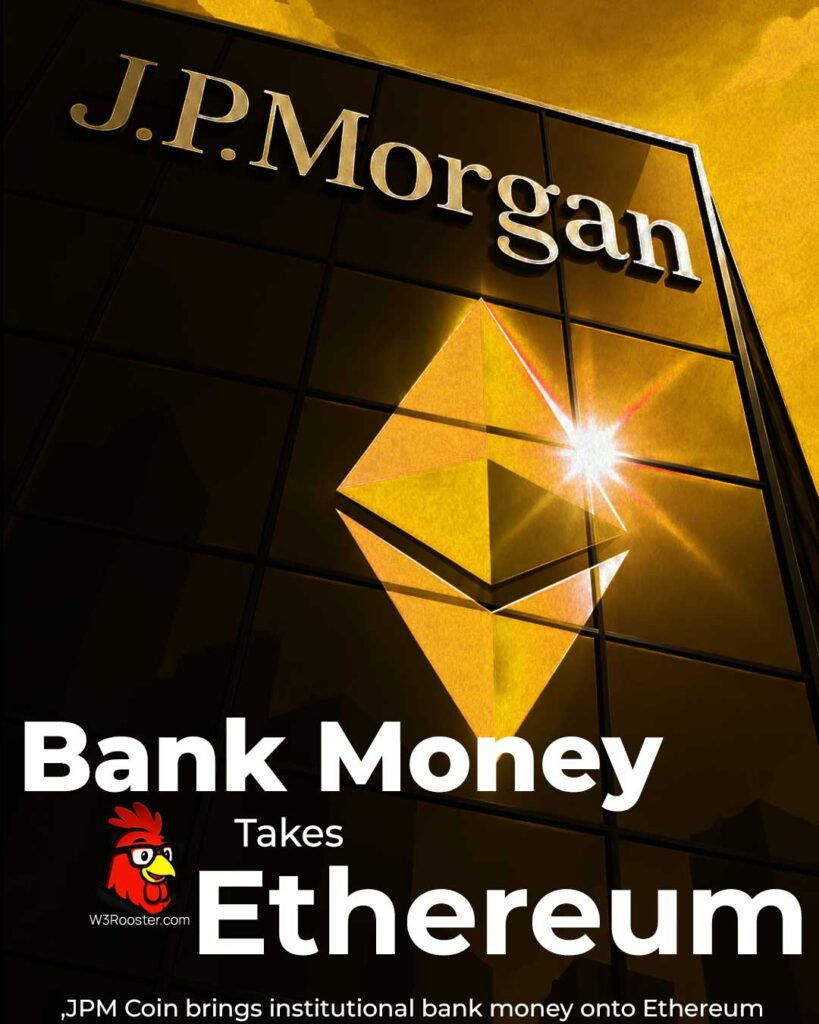
The bank’s deposit token expands beyond Base, connecting institutional dollar transfers with Ethereum’s wider tokenized-asset ecosystem.
Meteor ID: JPMD-2026101937500
Date & Time: October 19, 2026, 08:31 UTC (announcement reported)
Origin: Kinexys by JPMorgan expanded JPM Coin (JPMD) to Ethereum to give institutional clients another public blockchain route for moving dollar-denominated bank deposits.
Visibility: JPMorgan’s eligible institutional clients, digital-asset firms, Ethereum infrastructure providers, and tokenized-asset markets stand to benefit.
Trajectory: JPMorgan introduced JPMD on Base in 2025, bringing bank deposits onto a public blockchain. Its Ethereum expansion extends the token’s reach into an ecosystem with established tokenized assets, creating a potential bridge between commercial bank money and onchain financial markets.
Direction: The next step could be deeper integration with tokenized securities, collateral transfers, and smart-contract-based settlement. However, institutional access remains permissioned; this is not an unrestricted dollar token for retail users or DeFi applications.
Speed: The expansion follows a broader institutional shift from blockchain pilots toward operational financial infrastructure. JPMorgan’s move is a concrete deployment milestone, although adoption will depend on client demand, integration, and actual transaction volumes.
Magnitude: The significance lies less in launching another token than in bringing commercial bank deposits onto Ethereum itself. If institutions adopt it for settlement, JPMD could help connect tokenized assets with bank-backed money without relying exclusively on conventional payment rails.
Altitude: The impact could extend across Ethereum, institutional payments, tokenized funds, securities settlement, and collateral markets. Its ultimate reach depends on interoperability, access controls, and whether other financial institutions build compatible infrastructure.
Cock-a-Doodle-Doo: The rooster sees a subtle change in the financial landscape: the blockchain is no longer just asking banks to accept digital assets; it is becoming a place where banks can move their own money. But remember, a public railway does not mean every passenger gets a ticket.