The Ownership Test: Robinhood Is Adding Voting and Redemption to Tokenized Stocks. Is This Finally Real Ownership?
Robinhood’s plan to introduce one-for-one share redemption and voting rights could mark an important transition in tokenized equities. The deeper question, however, is not whether stocks can move onto a blockchain, but whether the legal, economic and governance rights of ownership can move with them.
For years, the central promise of blockchain-based finance was relatively simple: take an asset that exists in traditional markets and represent it on a blockchain. Tokenized equities appeared to offer an obvious demonstration of that idea. A stock could potentially trade around the clock, move between digital wallets and interact with programmable financial applications.
But as tokenized stocks have moved closer to real-world financial markets, a more difficult problem has emerged. A token can reproduce the price of a stock without necessarily reproducing the ownership of that stock.
That distinction is at the center of Robinhood’s latest move. On September 14, the company said it was working toward in-kind redemption for its Stock Tokens, with voting rights for eligible holders also on the roadmap. Robinhood’s CEO Vlad Tenev confirmed the direction publicly, while the company’s crypto chief Johann Kerbrat said the redemption mechanism was being developed on a one-for-one basis.
At first glance, this may look like another product enhancement. In reality, it exposes one of the most important unresolved questions in financial tokenization: when does a digital representation of an asset become a meaningful representation of ownership? That is where the story becomes considerably more interesting than the announcement itself.
The Tokenization Question Has Changed
For years, the central promise of blockchain-based finance was relatively simple: take an asset that exists in traditional markets and represent it on a blockchain. Tokenized equities appeared to offer an obvious demonstration of that idea. A stock could potentially trade around the clock, move between digital wallets and interact with programmable financial applications.
But as tokenized stocks have moved closer to real-world financial markets, a more difficult problem has emerged. A token can reproduce the price of a stock without necessarily reproducing the ownership of that stock.
That distinction is at the center of Robinhood’s latest move. On September 14, the company said it was working toward in-kind redemption for its Stock Tokens, with voting rights for eligible holders also on the roadmap. Robinhood’s CEO Vlad Tenev confirmed the direction publicly, while the company’s crypto chief Johann Kerbrat said the redemption mechanism was being developed on a one-for-one basis.
At first glance, this may look like another product enhancement. In reality, it exposes one of the most important unresolved questions in financial tokenization: when does a digital representation of an asset become a meaningful representation of ownership? That is where the story becomes considerably more interesting than the announcement itself.
Robinhood’s Stock Tokens Reveal the Ownership Gap
Robinhood’s current Stock Tokens are not simply conventional shares placed inside digital wallets. According to Robinhood’s own documentation, they are tokenized debt securities issued by Robinhood Assets (Jersey) Limited. They provide economic exposure to underlying securities, but do not presently give holders legal or beneficial rights in those underlying securities. Robinhood says the tokens are backed one-to-one by the corresponding equities held with a U.S. custody partner.
That creates an important distinction. An investor can obtain exposure to the economic performance of an Apple share without becoming an Apple shareholder in the traditional legal sense. The investor may participate economically in price appreciation and dividend-related adjustments, while remaining outside the shareholder relationship through which voting and other corporate rights are exercised.
This is not necessarily a flaw in the product. It is a characteristic of its existing structure. But it does expose the difference between tokenization and ownership.
The distinction matters because traditional shares are not valuable merely because their prices fluctuate. They are embedded in a legal and institutional system involving corporate governance, shareholder records, custody, settlement and enforceable rights. A blockchain can represent those relationships, but representing them is not automatically the same as recreating them.
This is the ownership problem that W3Rooster examined earlier in the broader debate over tokenized equities. Robinhood’s new proposal provides a much more concrete test of that question.
Why One-for-One Redemption Matters More Than It Sounds
The proposed redemption mechanism may be the most consequential part of Robinhood’s announcement. At present, Stock Tokens can be traded or redeemed through Robinhood’s existing structure, but the important distinction is that redemption does not simply mean receiving the underlying conventional share. The planned in-kind mechanism would create a route through which an eligible token holder could receive the corresponding underlying securities instead.
That changes the relationship between the blockchain representation and the traditional financial asset. Imagine an investor holding a token representing one share of a company. Under a purely synthetic or reference-based structure, the token can provide exposure to the share without ever becoming the share. Under an effective one-for-one redemption system, however, the token becomes a potential bridge into the conventional securities system.
That bridge raises difficult questions. Who is eligible to redeem? Does redemption require a conventional brokerage account? How quickly does the conversion occur? What happens to fractional positions? Are there geographical restrictions? Which entity performs the transfer? What happens during market disruption or if the relevant intermediary becomes unavailable?
Robinhood has not yet published a complete operational framework answering all of these questions. The company has announced the direction, not a finished architecture. That distinction is important. Analysts should resist treating a planned feature as though it already exists.
Voting Rights Are an Even Bigger Test
Redemption concerns the relationship between the token and the underlying security. Voting goes deeper because it concerns the relationship between the investor and the company itself.
A conventional shareholder does not merely possess an economic claim. Subject to the relevant corporate and securities rules, the shareholder may participate in corporate governance. Robinhood itself explains that conventional shareholders can vote at company meetings through its proxy-voting infrastructure, with eligibility generally determined by ownership of settled shares on the relevant record date.
For tokenized equities, the question becomes more complicated. If the underlying shares sit with a custodian while the blockchain token circulates among wallets, who is the shareholder entitled to vote? How is that investor identified? How are votes aggregated? What happens when tokens move between wallets immediately before a record date? How does the system handle lending, corporate actions or regulatory restrictions?
These are not merely programming questions. They are questions about how a digital market connects to the legal machinery of corporate ownership.
Robinhood has pointed toward its existing shareholder-engagement infrastructure as part of the potential solution. But the existence of voting software does not by itself resolve the deeper question of who legally possesses the underlying voting entitlement. That is why voting may ultimately become a more revealing test of tokenization than 24/7 trading.
The Blockchain Does Not Automatically Remove the Middlemen
One of crypto’s earliest intellectual attractions was disintermediation: the idea that software could replace layers of trusted institutions. Tokenized securities are revealing a more complicated reality.
Robinhood’s Stock Tokens rely on an issuer, underlying shares, custody arrangements, compliance procedures and legal documentation. The blockchain provides an additional layer for issuing and transferring the token, but it does not independently determine the legal relationship between the investor and the underlying company.
This does not make blockchain irrelevant. It changes the question. Instead of asking whether blockchain eliminates intermediaries, it may be more productive to ask which intermediaries remain necessary and what functions they perform. A blockchain could make certain transfers programmable while custody remains institutional. It could provide continuous trading while corporate governance remains connected to traditional legal systems. It could make an asset globally transferable while investor eligibility remains jurisdiction-dependent.
The intermediary may therefore be changing rather than disappearing. For W3Rooster, this distinction is particularly important because it connects tokenized equities to the broader evolution of blockchain financial infrastructure. The technology may not destroy the existing financial system in one dramatic step. It may gradually rearrange where trust, custody and authority sit within that system.
Robinhood Is Not Alone in Discovering the Problem
The significance of Robinhood’s move becomes clearer when viewed against the broader tokenization race. Traditional financial institutions and crypto-native companies are increasingly converging around tokenized securities. Nasdaq’s investment in Kraken’s parent company, for example, reflects the growing interest of conventional market infrastructure in blockchain-based equity trading.
Reuters has similarly described tokenized equities as an emerging but still relatively small market. The attraction is clear: potentially continuous trading, broader access, fractionalization and faster settlement. Yet the market also faces unresolved questions involving liquidity, standardization, dividends, voting rights and the relationship between blockchain markets and conventional exchanges.
This suggests that Robinhood’s announcement should not be interpreted as an isolated attempt to repair one product. It is part of a larger market experiment. The industry is beginning to discover that putting a stock on-chain is the easy part. Making that stock function like a stock across every stage of its lifecycle is much harder.
The Real Problem Is Not Trading. It Is the Full Lifecycle of Ownership
Tokenized-equity discussions often concentrate on the visible part of the process: buying and selling. But ownership extends far beyond a trade. A conventional security has a lifecycle. It is issued, transferred, held, financed, used as collateral, affected by corporate actions, potentially lent, subject to voting, and eventually redeemed or sold.
Every one of those activities creates a question for tokenization. If a company pays a dividend, how should it reach the token holder? If the company splits its shares, how does the token adjust? If an investor wants to vote, how is eligibility established? If the investor wants to redeem, what exactly do they receive? If the issuer becomes insolvent, which claim does the token holder possess?
Robinhood already uses a multiplier mechanism to reflect dividends for its Stock Tokens rather than distributing the conventional cash dividend directly.
That detail is revealing. Tokenization is not simply a process of copying an existing financial instrument into digital form. It requires every existing financial function to be translated into a new technical and legal architecture. The difficult work begins after the token has been created.
Robinhood Is Part of a Much Larger Tokenization Architecture
The ownership problem cannot be understood entirely through one company or one product. Around the world, financial institutions are experimenting with tokenized securities, digital settlement systems and blockchain-based market infrastructure.
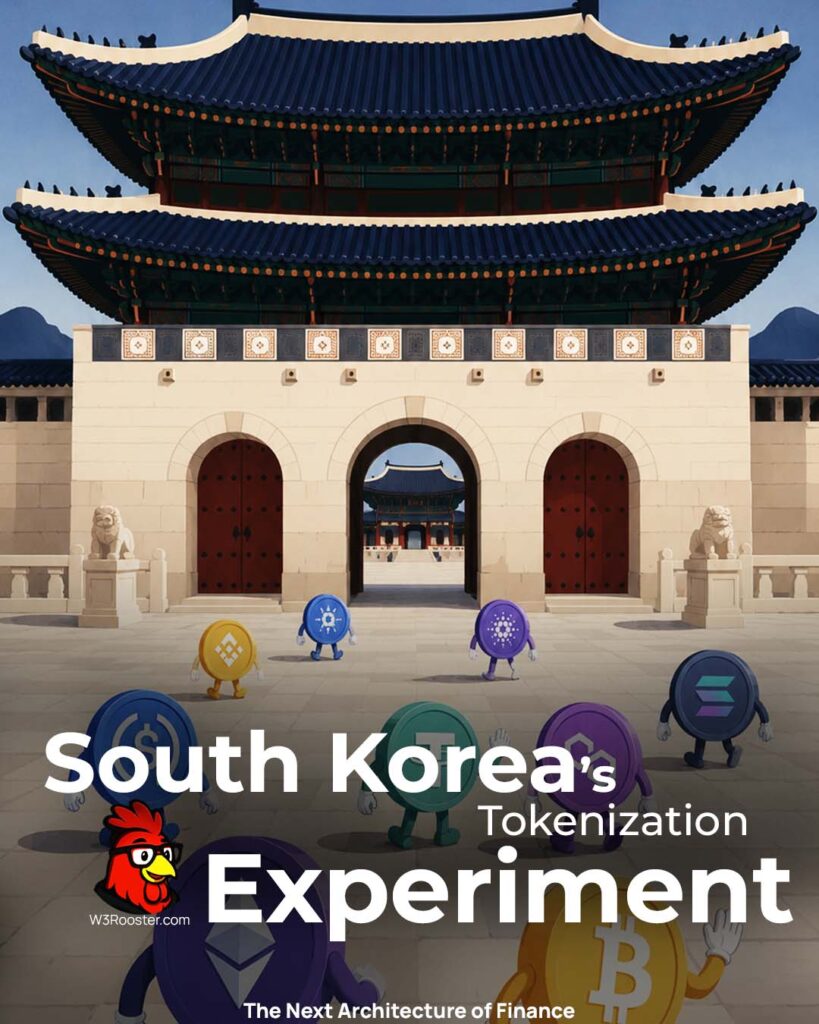
South Korea’s tokenization roadmap, for example, approaches the issue from a broader capital-market perspective. Its significance lies not simply in placing securities on a blockchain, but in considering how issuance, registration, transfer, settlement and payment could interact within digital infrastructure.
That perspective helps clarify why Robinhood’s experiment matters. The future of tokenized equities will not be determined only by whether investors can buy a digital representation of a stock. It will depend on whether the surrounding infrastructure can recognize, administer and enforce the rights associated with that representation.
The central question therefore moves from asset digitization toward market architecture. The more sophisticated the tokenized market becomes, the more difficult it becomes to separate the blockchain record from the institutions that give that record legal and economic meaning.
The Ownership Test Could Define the Next Phase of Tokenization
There is a useful historical lesson here. Many technological revolutions begin by reproducing an existing system in a new medium. Only later do they discover what the new medium can genuinely change. The early internet reproduced newspapers, radio and mail before becoming something fundamentally different. Blockchain may be following a comparable path in finance.
The first generation of tokenization asks: Can this asset be represented on-chain?
The next generation asks: What can the asset do once it is on-chain?
The third, more difficult question is: Can all of the rights and obligations surrounding that asset become compatible with the blockchain itself?
Robinhood’s redemption and voting plans sit directly at the boundary between the second and third questions. If the company succeeds, tokenized equities could move closer to becoming interoperable financial instruments rather than merely blockchain-based references to traditional securities. If significant rights remain dependent on off-chain institutions, the industry may instead settle into a hybrid model in which blockchain improves distribution and settlement while conventional legal infrastructure continues to define ownership.
Neither outcome would make tokenization meaningless. But they would represent very different versions of its future.
The Next Definition of a “Share” May Be the Real Innovation
The most interesting part of Robinhood’s announcement is therefore not the promise of another feature. It is the pressure it places on the definition of a share. A traditional share is simultaneously an economic asset, a legal claim, a governance instrument and a record within a broader financial system. Tokenization begins by separating those functions and attempting to reconstruct them digitally.
Robinhood’s one-for-one redemption proposal addresses the connection between the token and the underlying asset. Voting addresses the connection between the token holder and corporate governance. Together, they expose the larger architecture that must exist underneath any credible tokenized-equity market.
That is why this development deserves more attention than its immediate news cycle may suggest. W3Rooster’s earlier research asked whether blockchain can digitize ownership. The more advanced question emerging now is whether blockchain can digitize the entire bundle of rights that makes ownership meaningful in the first place.
That distinction could determine whether tokenized equities become a durable component of global capital markets or remain sophisticated financial wrappers around conventional securities.
The irony is that the closer tokenized stocks get to behaving like real stocks, the more clearly the industry sees everything that must be rebuilt to make them truly equivalent. And that may be the real ownership test.