South Korea’s Tokenization Roadmap Could Test the Architecture of a Blockchain-Based Capital Market
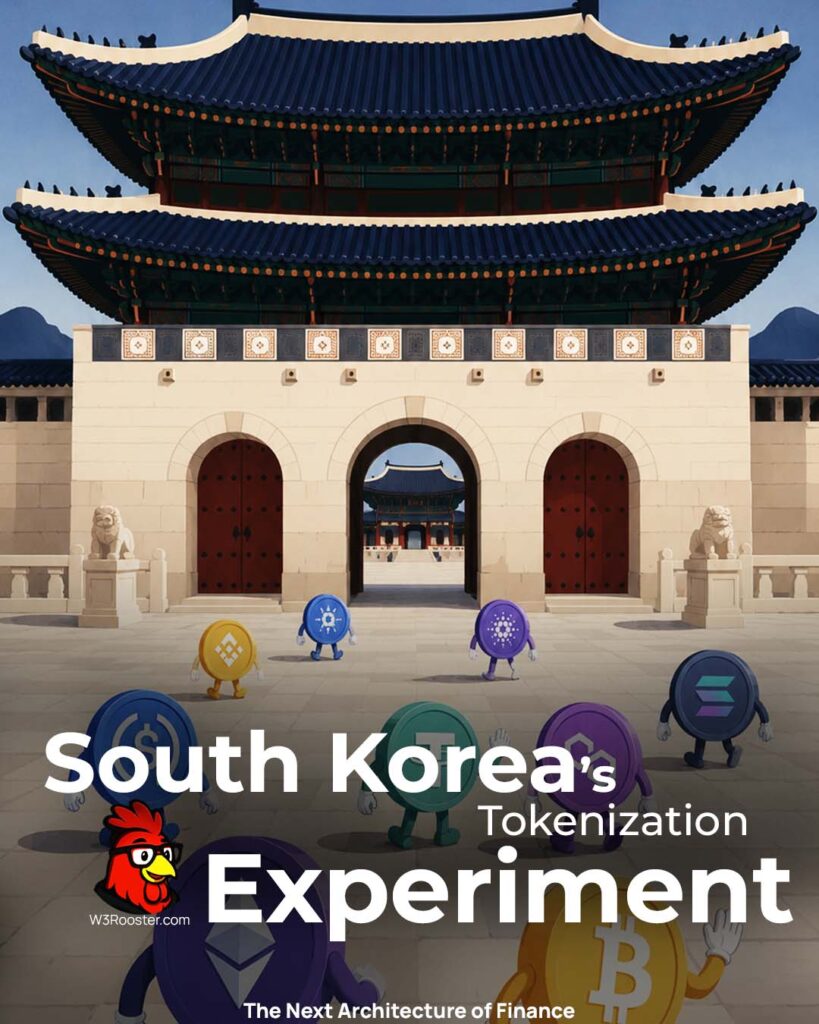
South Korea’s latest tokenization initiative is about far more than putting securities on a blockchain. It may represent one of the most ambitious attempts yet to redesign the underlying architecture of capital markets for the digital age.
For years, discussions surrounding tokenization have largely revolved around individual assets. Real estate, government bonds, money market funds, private credit, and even artwork have all been presented as candidates for blockchain-based ownership. Yet many of these initiatives shared a common limitation: they focused on tokenizing the asset while leaving the surrounding financial infrastructure largely unchanged.
South Korea’s newly unveiled roadmap suggests a different vision. Rather than treating tokenization as a niche financial innovation, the country’s regulators have outlined a framework that gradually expands blockchain-based securities from specialized investment products toward mainstream stocks, bonds, and funds. More importantly, the roadmap ultimately points toward a future in which tokenized securities may interact with on-chain payment infrastructure linked to stablecoins.
Viewed through that lens, the announcement is not merely about tokenized securities. It is about whether blockchain technology can become a foundational layer of capital-market infrastructure. That distinction may prove far more significant than the roadmap itself.
South Korea’s Roadmap Moves Beyond Experimental Tokenization
The immediate headline is straightforward. South Korea plans to introduce tokenized securities through a phased approach beginning in 2027, gradually extending eligibility from selected institutional products toward broader categories of publicly offered securities. On the surface, this may appear to be another example of a government embracing digital assets. Similar announcements have emerged from financial centers across Asia, Europe, and the Middle East during the past several years.
However, what distinguishes South Korea’s approach is the scope of its ambition. The roadmap does not merely focus on issuing blockchain-based securities. It also contemplates the infrastructure required for issuance, registration, transfer, settlement, investor protection, and eventually payment mechanisms. In other words, regulators are not simply asking whether securities can be represented digitally. They are asking whether portions of the capital-market system itself can be redesigned around digital rails.
This represents an important evolution in how policymakers increasingly view tokenization. The conversation is moving beyond asset digitization and toward market architecture. As W3Rooster has previously observed in its analysis of tokenized equities and tokenized collateral, the long-term question has never been whether assets can be represented as tokens. The more consequential question is whether financial infrastructure itself can become programmable. South Korea’s roadmap appears designed to test precisely that possibility.
The Real Story Is Infrastructure, Not Securities
Much of the public discussion around tokenization focuses on the securities themselves. Yet securities are only one component of a much larger system. A stock certificate has value because it exists within a framework that defines ownership rights, trading procedures, settlement obligations, disclosure requirements, and regulatory oversight. Without that framework, the certificate itself becomes meaningless.
This is where many early blockchain projects encountered difficulties. Creating a token is relatively simple. Replacing decades of financial infrastructure is not. Modern capital markets depend upon a complex network of exchanges, brokers, custodians, depositories, clearing houses, transfer agents, settlement institutions, and regulators. Each performs a specific function that evolved in response to legal, operational, and technological realities.
South Korea’s initiative appears notable because it acknowledges this complexity rather than attempting to bypass it. Instead of framing blockchain as a replacement for financial institutions, the roadmap appears to integrate tokenization within existing market structures. That may disappoint some advocates who envisioned complete disintermediation. Yet it may also increase the probability of meaningful adoption.
History often rewards technologies that integrate into existing systems before attempting to transform them. The internet itself did not immediately replace traditional business models. It first connected them. Blockchain may be entering a similar phase.
When Securities and Money Become Programmable
Perhaps the most intriguing aspect of the roadmap is not the tokenization of securities but the long-term vision involving stablecoin-linked settlement. Traditionally, securities and money operate on separate infrastructures. An investor purchases a stock. Ownership transfers through one system while payment moves through another. Multiple intermediaries coordinate the transaction, often resulting in settlement delays, reconciliation requirements, operational costs, and counterparty risks.
Tokenization introduces the possibility that both the asset and the payment mechanism can exist within compatible digital environments. This concept is frequently described as programmable finance, though the phrase is often used without sufficient explanation.
In practical terms, programmable finance means that contractual conditions, ownership transfers, compliance checks, payment obligations, and settlement processes can interact automatically through software-based rules. The implications extend far beyond efficiency. If securities and money can interact on interoperable digital infrastructure, financial transactions become increasingly dynamic. Settlement could potentially occur continuously rather than according to fixed market schedules. Compliance functions could become embedded within transaction logic. Corporate actions could be distributed automatically.
The result would not simply be a faster version of existing markets. It could represent a fundamentally different operational model. This possibility explains why stablecoins are becoming increasingly relevant to institutional finance. Their importance may ultimately derive less from payments themselves and more from their role as settlement instruments within broader digital financial systems.
As the management thinker Peter Drucker once observed, “The greatest danger in times of turbulence is not the turbulence—it is to act with yesterday’s logic.” The relationship between tokenized assets and digital money may become one of the defining financial questions of the coming decade.
Does Blockchain Eliminate Intermediaries—or Reinvent Them?
One of the most enduring narratives surrounding blockchain has been the promise of removing intermediaries. Yet institutional tokenization increasingly suggests a different outcome. Rather than eliminating financial intermediaries, blockchain may be transforming their responsibilities. Exchanges still matter. Custodians still matter. Regulators still matter. Investor protection remains essential. Legal ownership rights still require enforcement mechanisms.
In many emerging tokenization frameworks, the question is no longer whether intermediaries disappear. The question is how their functions evolve within a blockchain-enabled environment. This distinction deserves greater attention because it challenges a common assumption within both crypto and traditional finance.
The most successful financial technologies often do not eliminate institutions. They redefine their roles. Electronic trading did not eliminate stock exchanges. Online banking did not eliminate banks. Cloud computing did not eliminate technology companies.
Instead, each innovation changed how institutions operate. Tokenization may follow a similar path. From that perspective, South Korea’s roadmap is not testing whether blockchain can replace capital markets. It is testing whether blockchain can modernize them.
Who Controls the Ledger Matters More Than Many Assume
As tokenized securities move closer to reality, a crucial question emerges that often receives less attention than it deserves: who ultimately controls the ledger? The term “on-chain” can create the impression that ownership records automatically become decentralized. In practice, however, ownership rights, dispute resolution, compliance requirements, and investor protections remain inseparable from governance structures.
This challenge is particularly relevant in capital markets because securities are legal instruments before they are technological objects. A blockchain may record ownership, but regulators, courts, and market institutions determine whether that ownership is recognized and enforceable. Consequently, the future of tokenized securities may depend less on cryptographic innovation and more on governance design.
Who can validate transactions? Who has authority during operational failures? How are mistakes corrected? Can assets move across different infrastructures? What happens if conflicting ownership claims emerge? These questions may appear technical, yet they sit at the heart of institutional adoption.
The history of finance demonstrates that markets thrive not merely because transactions are possible, but because participants trust the rules governing those transactions. Technology can improve efficiency, but confidence remains the ultimate foundation of every financial system. For that reason, South Korea’s roadmap should not be viewed solely as a blockchain initiative. It is equally a governance experiment.
Interoperability May Become the Next Competitive Battlefield
For much of the past decade, blockchain discussions frequently centered on transaction speed, throughput, and network scalability. Yet institutional tokenization may shift the competitive focus elsewhere. The most valuable infrastructure is not necessarily the system that processes the greatest number of transactions. It may be the system capable of connecting the largest number of financial participants.
A future tokenized capital market could involve securities issued on one infrastructure, stablecoins operating on another, banking services provided through separate networks, and regulatory oversight maintained through entirely different systems.
In such an environment, interoperability becomes indispensable.
This challenge extends beyond technology. It touches legal standards, settlement frameworks, compliance requirements, identity verification systems, and regulatory cooperation. The result is a paradox that many market observers overlook. The success of tokenization may depend less on creating the perfect blockchain and more on enabling imperfect systems to communicate with one another effectively.
Throughout financial history, dominant infrastructure often emerged not because it was technically superior, but because it became the most widely connected. Railroads, telecommunications networks, payment systems, and the internet itself all benefited from this dynamic.
Tokenized finance may ultimately follow a similar trajectory. For investors attempting to identify future winners, this possibility suggests that infrastructure providers capable of facilitating connectivity could become just as important as asset issuers themselves.
Tokenization Is Not Guaranteed to Produce Better Markets
Enthusiasm surrounding tokenization should not obscure the challenges that remain. Financial innovation often follows a familiar pattern. Early expectations emphasize potential benefits, while operational complexities become apparent only after implementation begins. Tokenization unquestionably offers attractive possibilities. Faster settlement, reduced reconciliation costs, enhanced transparency, fractional ownership models, and automated compliance mechanisms all represent meaningful improvements over certain legacy processes.
Yet benefits should not be confused with inevitabilities. Operational risks remain substantial. Smart-contract vulnerabilities, cybersecurity threats, interoperability failures, liquidity fragmentation, privacy concerns, and governance disputes could all introduce new forms of complexity.
Moreover, efficiency gains do not automatically translate into better markets. A market that settles instantly is not necessarily a market that allocates capital more effectively. Likewise, greater automation does not eliminate the need for sound regulation, responsible governance, or prudent risk management.
The philosopher Karl Popper famously argued that progress often emerges through error correction rather than perfect planning. That observation may prove relevant here. South Korea’s roadmap should be viewed not as proof that tokenized markets will succeed, but as a structured attempt to determine where tokenization genuinely adds value and where traditional systems remain preferable. Such experimentation is precisely how durable financial infrastructure evolves.
Why South Korea’s Experiment Matters Beyond South Korea
Although the roadmap is national in scope, its significance extends far beyond Korean markets. Governments, exchanges, banks, asset managers, and financial technology firms around the world are currently exploring similar questions.
Can securities be digitized while preserving investor protections? Can blockchain-based infrastructure coexist with existing regulatory frameworks? Can tokenized assets and digital money operate within a unified settlement environment? Can market efficiency improve without compromising financial stability?
South Korea is not the only jurisdiction pursuing these objectives. Yet its roadmap stands out because it attempts to connect multiple components of the financial ecosystem rather than focusing on isolated pilot projects. That broader perspective may transform the initiative into an important case study for policymakers elsewhere.
As W3Rooster has repeatedly argued throughout its examination of tokenized finance, the future of blockchain adoption is increasingly being shaped by institutions rather than speculation. The decisive question is no longer whether blockchain technology can exist alongside financial markets. It is whether financial markets can evolve around blockchain-enabled infrastructure.

South Korea’s roadmap offers one of the clearest real-world opportunities to observe that process unfold. For that reason alone, the initiative deserves attention far beyond the boundaries of the domestic Korean market.
What This Means for Investors and the Crypto Ecosystem
For investors, the roadmap reinforces an emerging trend that has become increasingly difficult to ignore. Institutional blockchain adoption is shifting from experimentation toward infrastructure development. The implications extend beyond any individual token, blockchain network, or market sector. Capital markets themselves are becoming a new arena for blockchain integration.
This transition may create opportunities for infrastructure providers, digital identity solutions, interoperability frameworks, compliance technologies, institutional custody services, and settlement platforms. At the same time, it raises important strategic questions for the broader crypto ecosystem.
Many blockchain networks were originally designed around decentralization as their defining value proposition. Institutional finance, by contrast, prioritizes reliability, governance, compliance, and legal certainty. The future may therefore belong not to systems that maximize ideological purity, but to those capable of balancing innovation with institutional requirements.
That tension is likely to shape the next phase of blockchain development. Investors who understand this shift may be better positioned to recognize where long-term value is being created.
South Korea Is Testing the Next Architecture of Finance
South Korea’s tokenization roadmap is easy to misunderstand. Viewed narrowly, it appears to be another announcement about blockchain-based securities. Viewed strategically, however, it represents something far more consequential. The initiative is testing whether tokenized assets, digital settlement mechanisms, regulatory oversight, and existing financial institutions can coexist within a unified digital architecture.
That is a substantially larger question than whether stocks or bonds can be represented as tokens. The significance of the roadmap therefore lies not in the securities themselves, but in the infrastructure surrounding them. The experiment will help determine whether blockchain can evolve from a technology associated primarily with digital assets into a foundational layer of capital-market infrastructure.
Whether that vision ultimately succeeds remains uncertain. Yet one conclusion already appears difficult to dismiss. The future debate is no longer about whether finance can be tokenized. It is increasingly about how the architecture of financial markets may change when securities, money, settlement, and compliance become programmable.
South Korea has decided to explore that question. The rest of the financial world will be watching closely.
South Korea tokenization roadmap, tokenized securities, blockchain capital markets, programmable finance, institutional blockchain infrastructure