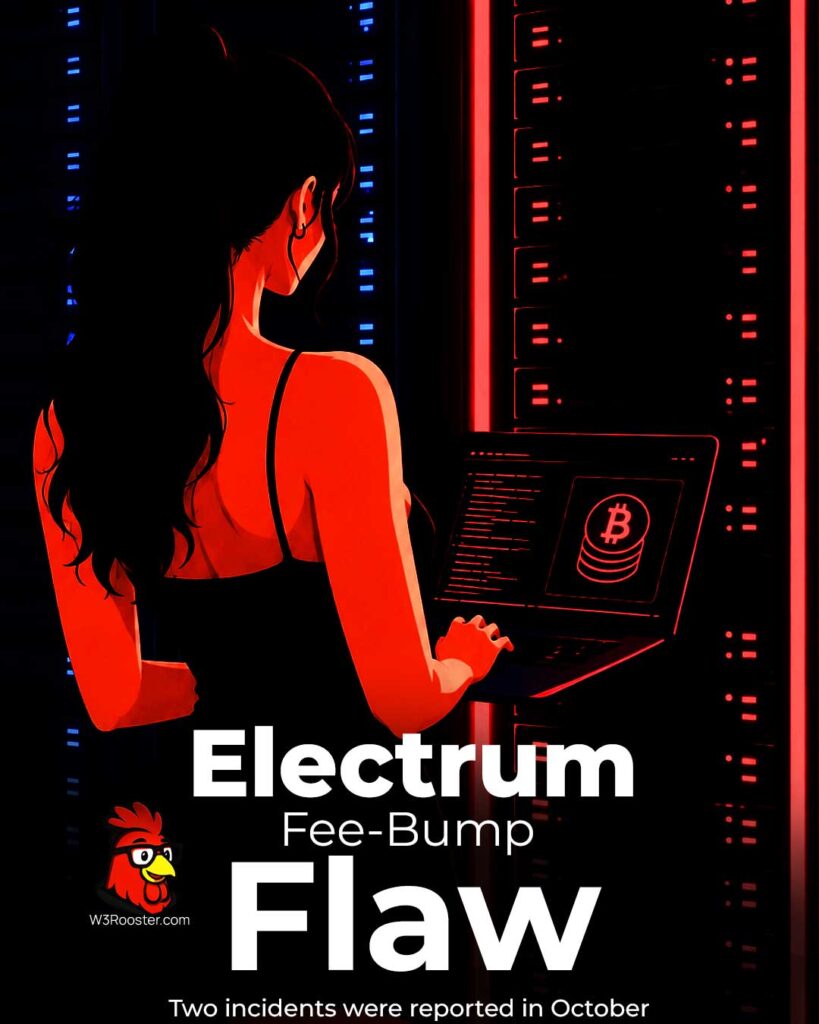
Electrum Fee-Bump Flaw Turned Bitcoin’s RBF Into a Theft Trap
A malicious server could replace a pending payment, then wait for the user to unknowingly authorize the theft while trying to increase the Bitcoin transaction fee.
W3 Meteor ID: ELECTRUM-RBF-1026202637920
Date & Time: October 24, 2026 — vulnerability publicly disclosed with Electrum 4.8.3
Origin: Electrum’s handling of unconfirmed transactions allowed a malicious connected server to inject a fraudulent replacement transaction.
Visibility: Electrum users running versions before 4.8.3 and connecting to malicious public servers were exposed; at least one Bitcoin loss was confirmed.
Trajectory: A rogue server could swallow a legitimate outgoing transaction and show a conflicting fake one instead. The trap became effective when a user tried to speed up the apparent transaction with Replace-by-Fee, unknowingly signing the attacker’s replacement.
Direction: Electrum 4.8.3 adds signature verification for relevant unconfirmed transactions, closing the reported attack path. The incident may also push light-wallet developers toward treating externally supplied mempool data as hostile rather than merely untrusted infrastructure.
Speed: Two incidents were reported in October, including a confirmed loss on October 18; the patched release followed within days. That rapid progression from observed exploitation to disclosure and upgrade makes this an active security event rather than a theoretical wallet vulnerability.
Magnitude: High. The attack did not crack Bitcoin cryptography or steal private keys—it manipulated what users saw before signing. That distinction matters because even hardware-wallet users can remain vulnerable if they approve transaction details without independently verifying the destination.
Altitude: The consequences reach beyond Electrum into light wallets, self-custody UX, public-server trust and transaction-signing practices. It highlights a broader Web3 security problem: cryptographically secure assets can still be lost when the interface presenting the transaction becomes the attack surface.
Cock-a-Doodle-Doo: Bitcoin’s lock held; the window beside it was open. This exploit is a reminder that self-custody security ends not at possession of the key, but at understanding exactly what that key is being asked to sign. In W3 Space, verification before signature remains the final checkpoint.