Open-Source AI and Blockchain: Why the Future of Intelligence May Depend on Decentralized Governance
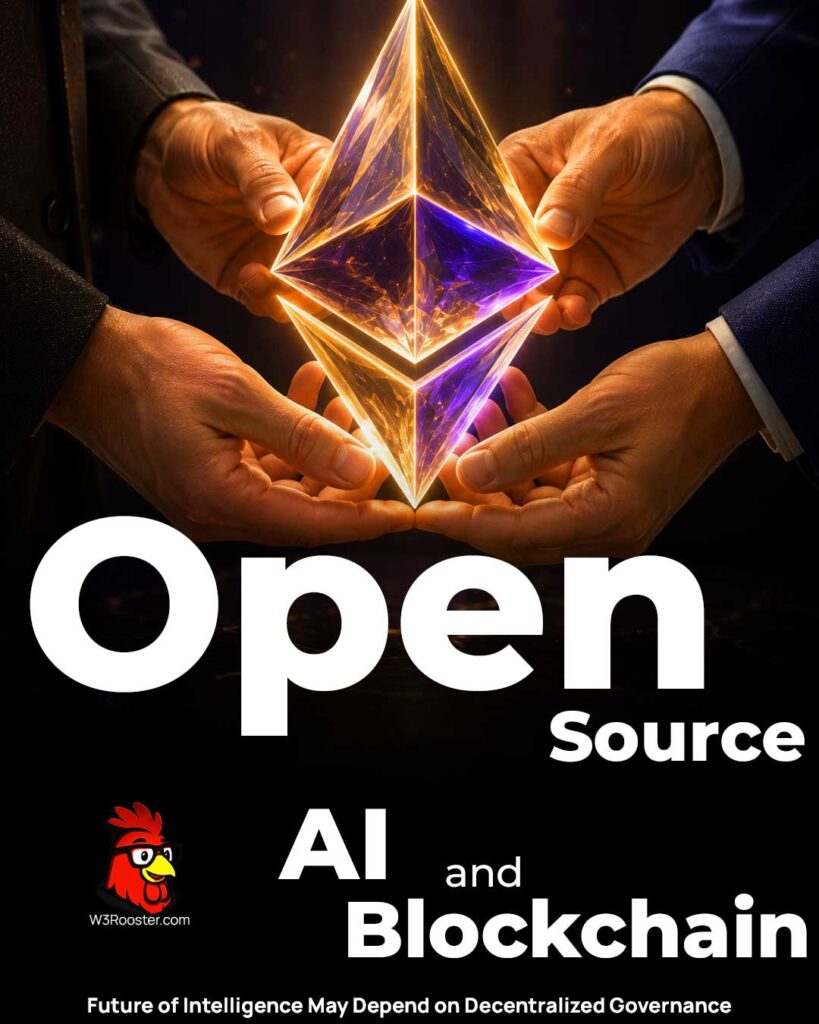
W3Rooster: Artificial intelligence has entered a new phase.
The conversation is no longer centered on model sizes, benchmark scores, or which company released the newest chatbot. Instead, a much deeper question is emerging.
Who should govern artificial intelligence?
Recent discussions involving Ethereum co-founder Vitalik Buterin have reignited that debate. Rather than supporting an AI ecosystem dominated by a few corporations or governments, Buterin has argued that AI should remain rooted in open-source principles and decentralized governance.
Although this idea originates from the blockchain world, its implications extend far beyond cryptocurrencies.
AI Is Becoming Critical Infrastructure
Every major technological revolution eventually becomes infrastructure.
The internet became infrastructure.
Cloud computing became infrastructure.
Smartphones became infrastructure.
Artificial intelligence appears to be following the same path.
As AI systems begin making recommendations, assisting governments, managing financial services, writing software, and helping organizations make strategic decisions, their influence expands well beyond productivity.
That makes governance just as important as capability.
The biggest risk may not be that AI becomes too intelligent.
It may be that intelligence becomes too centralized.
Open Source vs Closed AI
Open-source development has historically accelerated innovation.
Linux powers much of today’s internet.
Python became one of the world’s most important programming languages because developers everywhere could improve it.
Ethereum itself evolved through an open ecosystem where researchers, developers, and communities continuously review and improve the protocol.
Applying those same principles to AI creates several advantages.
Open models allow independent security reviews.
Researchers can verify claims instead of trusting marketing.
Communities can identify vulnerabilities earlier.
Developers worldwide can contribute improvements rather than waiting for permission from a single company.
Closed AI systems certainly provide advantages in commercialization and rapid deployment, but they also create concentration of knowledge, infrastructure, and decision-making.
That concentration naturally raises questions about accountability.
Blockchain May Become AI’s Missing Trust Layer
Artificial intelligence excels at generating information.
Blockchain excels at verifying information.
Those strengths complement each other remarkably well.
Imagine AI producing research while blockchain verifies its origin.
Imagine autonomous AI agents coordinating economic activity while smart contracts enforce transparent rules.
Imagine decentralized identity proving authenticity without sacrificing privacy.
Rather than replacing blockchain, AI may increase its importance.
Verification becomes more valuable as generated content becomes more abundant.
Governance Matters More Than Models
Elon Musk has repeatedly described X as a platform intended to represent public conversation rather than institutional narratives.
Regardless of political viewpoints, the broader discussion reflects a growing concern across the technology industry:
Should digital infrastructure be governed by centralized institutions, or should communities participate directly?
Blockchain has spent over a decade experimenting with decentralized governance through consensus, DAOs, transparent voting, and permissionless participation.
Those lessons could become increasingly relevant as AI systems begin influencing larger parts of society.
Governance may ultimately become the defining innovation—not the models themselves.
The Next Evolution of Web3
The future may not belong exclusively to AI companies or blockchain projects.
Instead, the most influential platforms could combine both technologies.
AI can analyze enormous amounts of information.
Blockchain can establish ownership, provenance, incentives, and trust.
Together they enable systems where intelligence remains powerful while accountability remains transparent.
This vision aligns closely with Ethereum’s long-standing philosophy that technology should empower users rather than centralize authority.
Looking Ahead
Every generation builds infrastructure that shapes the next.
The internet connected information.
Blockchain connected value.
Artificial intelligence connects knowledge.
The challenge now is ensuring those connections remain open, transparent, and accessible.
If AI becomes one of humanity’s most important technologies, its governance should reflect the same principles that made the internet transformative in the first place: openness, collaboration, and participation.
At W3Rooster, we see this convergence as one of the defining themes of the coming Web3 era. The projects that combine decentralized infrastructure with transparent AI governance may ultimately shape not only the future of crypto, but the architecture of the digital economy itself.