AI-Driven Nanotechnology for Medical and Industrial Use
NexaKing (NXK) Research
NexaKing (NXK) is just a researcher and observer in this field of AI who follows the achievements and wants to encourage the frontiers of AI that pay attention to the threats, possibilities and harms of various aspects of AI power and risk.
Setting the Stage: Nanotechnology Meets AI
Imagine a world where machines are so smart they can manipulate matter at the scale of atoms and molecules. That’s the frontier of AI-driven nanotechnology, a field where artificial intelligence (AI) and machine learning (ML) join forces with nanoscale science to create novel materials and medical breakthroughs. In the past decade, researchers have realized that combining nanotechnology and AI leverages the strengths of both: ML can process massive datasets to discover and design nanoparticles, while nanomaterials (like graphene and carbon nanotubes) are enabling ever-smaller, faster computer chips to power advanced AI modelsmdpi.com. For example, a 2021 study used ML to sift through 130,000 potential battery cathode materials and identified 80 promising candidates – showing how AI accelerates material discovery in the nanotech agemdpi.com. Other work has used convolutional neural networks to analyze electron microscope images of nanostructures with over 95% accuracy, doing in seconds what used to take researchers days of careful analysismdpi.com. In short, “ML can help automate some aspects of discovering and synthesizing nanoparticles,” speeding up experiments that were once slow and manualmdpi.com. At the same time, cutting-edge nanotechnology (like silicon nanotransistors and graphene circuits) boosts computing power, which in turn lets AI models run faster.
Both fields are co-evolving. Nanotechnology allows us to “manipulate the fundamental building blocks of matter” – building blocks that once were science fiction (remember Feynman’s famous 1959 talk on “There’s Plenty of Room at the Bottom”?). AI brings data-driven optimization and pattern recognition. Together, they promise a revolution. This article tells the story of how AI and nanotech have come together over time, the amazing things happening now in medicine and industry, and who is leading the charge – all while keeping an eye on the risks and responsibilities along the way.
Historical Background: From Feynman’s Vision to Today’s Labs
Nanotechnology’s roots go back at least to physicist Richard Feynman in the 1950s, who imagined controlling atoms directlymdpi.com. (The term “nanotechnology” was coined later by Norio Taniguchi in 1974, and popularized by Eric Drexler’s 1986 book Engines of Creation.) The field took off in the 1990s–2000s as scientists developed tools to see and manipulate things at the nanometer scale. This led to inventions like scanning tunneling microscopes and atomic force microscopes, and breakthroughs like the discovery of fullerenes (1985) and graphene (2004).
Meanwhile, AI has its own history — from the early days of Alan Turing to the machine learning boom of the last 20 years. Only recently have these two worlds truly converged. About a decade ago, labs began using AI algorithms to analyze the complex data coming from nanotech experiments. Early examples included using neural networks to predict how nanoparticles assemble, or ML to design nanoscale sensors. Research projects like WANDA (Workstation for Automated Nanomaterials Discovery and Analysis) began combining robotic labs with AI to optimize nanoparticle synthesismdpi.com. By the late 2010s, it became clear this “nano+AI” synergy could boost both innovation speed and product quality.
Several reviews have chronicled this convergence. For instance, a 2024 mini-review notes that AI-driven nanotechnology is transforming fields from materials discovery to healthcare to environmental monitoringscribd.com. It lists key breakthroughs: AI can sift through huge nanomaterial datasets to suggest new catalysts or battery materials, and it can process microscope images or sensor data orders of magnitude faster and more accuratelymdpi.comscribd.com. In essence, modern labs don’t just mix chemicals any more – they feed data into ML models that learn how to tweak nanoscale processes for the best resultsmdpi.compmc.ncbi.nlm.nih.gov.
At the same time, nanotech is giving back to AI. As the MDPI review points out, two-way coevolution is happening: nanotechnology produces tiny, energy-efficient transistors and special memory chips (sometimes called “nanoscale neuromorphic” hardware) that could one day run AI with less power, while AI models help us figure out how to engineer those chips in the first placemdpi.comscribd.com. Today we’re still early in this coevolution, but it’s already making waves.
AI in Medical Nanotechnology: Smart Medicine at the Nanoscale
One of the most exciting stories is in medicine and healthcare. Over the decades, nanotech alone promised “smart drugs” and advanced diagnostics. Liposome drug delivery goes back to the 1970spmc.ncbi.nlm.nih.gov, and nanoparticles have been used to improve imaging contrast and deliver cancer therapies. Now add AI on top, and the possibilities multiply.
Imagine a personalized medicine lab where a patient’s genetic profile is fed into an AI system. That AI recommends a custom nanoparticle formula to carry exactly the right dose of medication to the right cells in the patient’s body. Some researchers have literally drawn this “AI-guided nanolab” scenario as a schematicpmc.ncbi.nlm.nih.gov: a system starts with a patient’s genetics, then formulates and tests different nanoparticle therapies (even using “organs-on-chip” to simulate responses), and finally the AI picks the best treatmentpmc.ncbi.nlm.nih.gov. This vision isn’t just sci-fi – labs around the world are building the pieces.
For example, at the Technion-Israel Institute of Technology, Prof. Avi Schroeder’s group has pioneered “self-driving labs” for nanomedicine. They use microfluidic robots to synthesize lipid nanoparticles (like those used in RNA vaccines) and AI algorithms to rapidly optimize their design for maximum effectivenesspmc.ncbi.nlm.nih.gov. In a 2021 perspective, Schroeder noted that combining automation with AI databases could “optimize targeted therapeutic nanoparticles for unique cell types and patients”pmc.ncbi.nlm.nih.gov. Essentially, the robots mix and test drug-carrying nanoparticles while AI analyzes the data, closing the loop much faster than humans could.
In diagnostics, nanosensors augmented with AI are a hot topic. Tiny nanowires or 2D materials can detect minute concentrations of biomarkers (proteins, viruses, toxins) in blood or breath. By training machine learning models on the sensor outputs, devices can recognize disease patterns. For instance, researchers have shown that ML-enhanced nanobiosensors can flag cancer or cardiac biomarkers with unprecedented sensitivity, analyzing millions of data points to filter out noise. One review even highlights “predicting breathing, heart rate and pressure” signals in wearable nanocomposites using AIpmc.ncbi.nlm.nih.gov. In brain health, Stanford’s “neural dust” project (tiny wireless neural sensors) is beginning to use AI to interpret brain signals at the neuronal level.
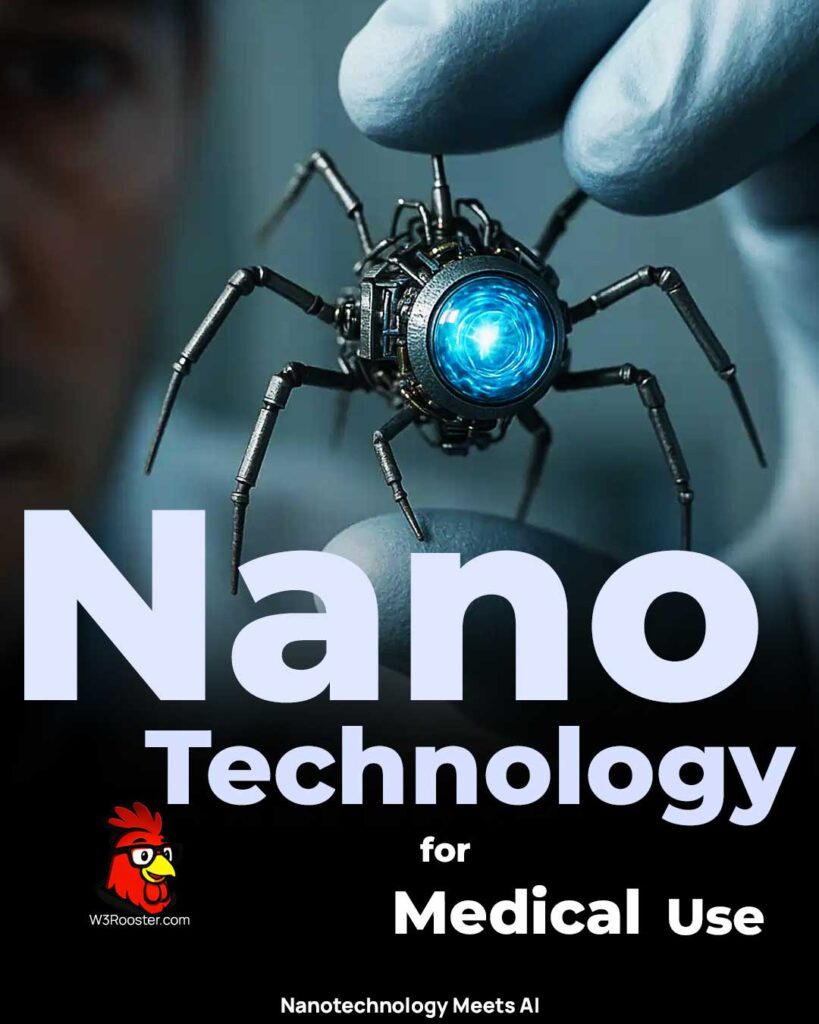
Nanorobots are another frontier. These are microscopic robots (often corkscrew- or motor-shaped) that can swim through the body. In labs, researchers use magnets or light to move them. A recent big news in 2024 was a new mathematical model from the University of Saskatchewan showing how to optimize corkscrew nanorobots through blood vesselsphys.orgphys.org. Their work, reported in Nature Communications, uses AI-driven simulation to improve design – for example, ensuring a tiny magnetic corkscrew has just the right size and helix angle to swim upstream in a blood vessel. These nanorobots (micro/nanorobots, or MNRs) are hoped to one day enter human trials. They could, for instance, be steered to a brain hemorrhage site to help stop the bleed, or guided to deliver chemotherapy inside a tumorphys.org. The AI model by Prof. Chris Zhang’s team optimizes power and navigation, shaving years off the development timeline and bringing clinical use closerphys.orgphys.org.
Some cutting-edge work even combines AI, imaging and nanomaterials. For example, researchers at NYU and collaborators (including ASU and Cornell) have built an AI + electron microscopy system that literally “lights up” nanoparticles at the atomic levellabmanager.comlabmanager.com. They reported in Science (2025) an algorithm that takes very noisy, high-speed electron microscope data and reconstructs how atoms in a catalyst nanoparticle move during chemical reactionslabmanager.comlabmanager.com. Why does that matter? Many medicines and plastics are made with catalysts – and knowing exactly how atoms dance on the surface could lead to better drugs or greener chemical processes. As NYU’s Carlos Fernandez-Granda put it, “we have developed an AI method that opens a new window for the exploration of atomic-level structural dynamics in materials”labmanager.com. That’s a mouthful, but it means AI is helping scientists see things at the nanoscale that were previously invisible – which can translate to more effective nanomedicines or therapies for diseases like cancer.
Even vaccine development can benefit. AI can analyze vast simulations of lipid nanoparticle vaccines (like the mRNA Covid shots) to improve their stability and targeting. Universities with big programs – for instance, MIT’s Institute for Medical Engineering & Science or Stanford’s Bio-X – are exploring AI-guided nanoparticle vaccines. Companies are, too: some pharma firms now have AI nanotech labs aiming to automate drug formulation. On the research side, EU projects like NANOSPRAY or US NIH initiatives have started using AI to triage which nanoparticle formulations to test in animals, cutting down cost and time.
In short, the medical nanotech story is one of precision and personalization. AI is the smart brain that tailors tiny materials to each patient’s needs. This could improve treatments (targeting tumors more accurately, reducing side effects) and diagnostics (earlier, cheaper disease detection) worldwide.
AI in Industrial Nanotechnology: Nano-Scale Manufacturing and Materials
AI-driven nanotechnology isn’t just for medicine. It’s revolutionizing industry and manufacturing, too. In fact, nanomanufacturing (making things at the nanoscale) is a key pillar of the broader Industry 4.0 vision, and AI is the linchpin. A 2023 review describes how “bridging nanomanufacturing and artificial intelligence” means using AI to design, fabricate, and test nano-scale devicespmc.ncbi.nlm.nih.gov. For example, AI algorithms can predict the properties of new nanomaterials, then automatically adjust lab robots or 3D printers to make them.
Consider batteries and energy storage. Here, AI+nanotech is already a buzz phrase. The tiny materials inside a Li-ion battery (graphite or silicon anodes, cobalt/NMC cathodes) and their interfaces are incredibly complex. Researchers have used ML models to comb through data on nano-engineered battery components, predicting which mix of materials yields the best capacity and charge rate. One nanotech review notes that “AI-driven nanotechnology is significantly advancing energy storage solutions by enhancing capacity, charging speed, and longevity”scribd.com. In practice, this means machine-learning tools have optimized how much silicon to put in anodes, or how to dope cathode nanoparticles, boosting performance. Lab studies show AI can predict optimal doping of nickel-manganese-cobalt cathodes, leading to actual improvements in battery lifescribd.com. Similarly, “AI-optimized battery management systems” can monitor tiny sensor data to control charging and avoid overheatingscribd.com. These techniques are making rechargeable batteries safer and more efficient – a big deal for electric vehicles and renewables. Companies like Tesla and LG Chem are reportedly investing in AI tools for nanomaterial optimization in their battery R&D labs.
In electronics and computing, AI-driven nanotech is the foundation of future hardware. Nanomaterials like graphene or carbon nanotubes (CNTs) could become transistors or interconnects for next-gen chips. But manufacturing them reliably is tough. Researchers are teaching robots (and their embedded AI) to assemble nanowires and 2D materials. For example, one use-case is “nanoassembly via dielectrophoresis”: a process where fields pull nanoparticles into circuits. AI can automatically tune the field frequency to get the particles just rightpmc.ncbi.nlm.nih.gov. Another example: Luminescent sensors. By combining metal nanoparticles with AI-driven analysis, labs have built ultra-sensitive gas and biosensors. In one test, a machine-learning model enhanced a nanophotonic sensor’s ability to detect trace amounts of chemicals, by algorithmically tuning the nanostructure.
AI in nanomanufacturing also means factory floors with self-optimizing processes. Let’s say a plant is making nanocoatings or nanoparticle inks. Traditionally, engineers would adjust temperature, pressure, etc., by trial and error. Now, a neural network can watch sensors in real-time and tweak inputs for maximal yield. A recent comprehensive review even shows ML/robotic systems forecasting reaction outcomes and running closed-loop experimentsmdpi.com. This leads to shorter production cycles: one day’s worth of experiments can be done overnight by a robot programmed by AI. Pilot projects at Fraunhofer Institutes (Germany) and the US National Nanotechnology Coordinated Infrastructure (NNCI) are testing fully automated nano-fabs.
In materials science, the combination is groundbreaking. Design of new alloys, metamaterials, polymers and coatings increasingly use inverse design: researchers specify desired properties, and AI suggests the nano-structure needed. For example, an AI system might generate a carbon nanomaterial structure that has a certain tensile strength and thermal conductivity, then predict how to grow it. Just as the materials discovery example in batteries, similar pipelines exist for catalysts, membranes, and structural materials. Journals like ACS Nano and Advanced Materials are full of papers where ML models discovered nanomaterial candidates for solar cells, hydrogen production, or water purification.
Even traditional industries like oil and gas and manufacturing look to this tech. The Nanotechnology journal recently covered how petrochemical refineries are using AI-nanotech sensors to detect leaks and contaminants at the parts-per-billion level in pipelines. In aerospace, companies like GE and Boeing fund research on nano-sensors embedded in composites (with AI monitoring health of wings and rotors). China’s national nanotech program emphasizes smart manufacturing, with big state labs linking up AI brains with nano-chemistry. In short, industry is harnessing nano+AI to get smarter materials, cleaner processes, and predictive quality control across the board.
The Coevolution: AI Helping Nanotech, Nanotech Helping AI
One of the most interesting aspects is how each field fuels the other in a feedback loop. We’ve seen many examples of AI optimizing nanotech. Conversely, as Tripathy’s MDPI review explains, advanced nanotechnology is feeding next-gen computing and AI platformsmdpi.com. For instance, carbon nanotube transistors are being explored as successors to silicon chips; these could, in theory, allow denser neural-network hardware. Likewise, neuromorphic chips – brain-inspired circuits – often rely on memristors made from nanolayers. This might allow AI to be embedded in everything from drones to wearable sensors.
It’s not just hardware. Nanotech research can generate huge datasets (imaging, spectroscopy, etc.), which pushes AI tool development. For example, the NYU nanoparticle imaging project produced terabytes of electron microscopy video; to extract signal they developed novel neural nets that could have uses in other fields (optics, astronomy). Conversely, ideas from AI sometimes inspire nanotech: e.g., the idea of a “neural nanoparticle” – a particle coated with responsive ligands that collectively make decisions (this is science fiction-ish but under active theoretical study). There’s even talk of embedding biological neural networks on nano-chips. While that’s future-forward, it shows how fusion of the domains sparks creativity on both sides.
Global Leaders and Institutions in Nano-AI
The nano-AI frontier is truly global. In the US, top universities like MIT, Stanford, Caltech, Harvard, UNC, and Georgia Tech each have nanotech centers weaving in AI research. The US National Science Foundation and NIH fund centers like NRI (Nanoelectronics Research Institute) that combine AI labs and nanofabs. Over in Europe, institutions such as EPFL (Switzerland), Max Planck Institutes (Germany), University of Cambridge (UK), and IMEC (Belgium) are at the cutting edge. For example, IMEC has an AI research group working on brain-inspired nanochips. The EU’s Horizon Europe program also funds many nano+AI consortia (for example, projects on AI-designed vaccines or 6G communications nano-photonics).
Asia is huge in this space. In China, the Chinese Academy of Sciences (CAS) leads with institutes in Beijing and Shanghai focusing on graphene and nano-bio applications; tech giants Huawei and Alibaba have big AI labs that occasionally collaborate with CAS researchers on nanotech projects. South Korea’s Samsung Advanced Institute of Technology invests in nanomaterial design for semiconductors and uses ML extensively. Japan has RIKEN and AIST, which have several AI-nanotech initiatives, including nano-robotics and neural computing. India’s IITs and IISc are building up nanotech with AI; there’s even a “NanoMission” under the Indian government that mentions AI acceleration.
In medicine specifically, major cancer centers and medical schools are pioneering nano-AI. For instance, Stanford’s PULSE Institute (led by Amy Herr) is developing AI-nano technologies for single-cell analysis. Johns Hopkins has a joint CS and biomedical engineering group working on AI for nanopore DNA sequencing (a nano-sensor). In Asia, National University of Singapore has strong research into AI-powered nanoparticle drug design. Israel is noteworthy too: beyond Technion, the Weizmann Institute has a team using ML to design polymeric drug carriers at the nanoscale.
Commercial players also drive research. Startups like NanoDimension (3D nano-printers), Lumos, Sift, and Nanosity work at the intersection. Major tech companies (IBM, Google, Microsoft) fund nanotech via quantum and materials divisions, often using in-house AI. Even consumer brands get involved: Japanese cosmetics company Shiseido has an R&D unit using AI to test nanoparticle skincare. Agricultural companies (Monsanto, BASF) look at nanotech with AI for smart pesticides.
Finally, the nanotech/AI community includes societies and conferences that highlight global efforts. Groups like the IEEE Nanotechnology Council, MRS (Materials Research Society), and TERMIS (tissue engineering) hold symposia on AI in nanotech. There are summer schools and workshops (for example, MIT.nano’s “AI for Materials” summit) connecting researchers worldwide. In short, the “who’s who” includes not just individual stars but a network of labs, companies, and gov’t labs all pushing this field. Some notable names to watch: Carlos Fernandez-Granda (NYU, nanoparticle imaging), Avi Schroeder (Technion, robotic nanomedicine), and Chris Zhang (USask, nanorobotics), among many others.
Balancing the Scale: Risks, Ethics and Governance
Of course, no narrative on technology is complete without a cautionary view. NexaKing rightly reminds us that with great power comes risk. Nanotechnology itself carries health and environmental concerns. Nanoparticles can be toxic or penetrate cells in unpredictable ways (research in nanotoxicology shows risks like inflammation, oxidative stress, even DNA damage if not carefulfrontiersin.org). The data on nanoparticle safety is still emerging. This is one reason AI is actually being applied in toxicology: to sift through the complex biology and predict which nanomaterials might harm human cellsfrontiersin.org. For instance, AI models have analyzed thousands of lab results on silver nanoparticles to find that factors like particle size, surface coating, and dose are key toxicity driversfrontiersin.org. This is promising, but scientists note AI in nanotoxicology is still new and black-box predictions need careful validationfrontiersin.org.
There are also broader ethical issues. If AI designs nanomaterials, we must ensure it doesn’t inadvertently create something hazardous. Strong data and guardrails are needed. Security is another concern: imagine a factory with AI robots building nanotech; what if someone hijacks the control system? A single rogue command could (hypothetically) create harmful nanomaterials or spread pollution. Researchers emphasize cybersecurity and “explainability” in AI models precisely for this reasonfrontiersin.org. Additionally, there’s the usual fears: will this lead to dangerous “nanoweapons” or privacy invasion (e.g., microscopic drones used to spy)? Right now these are speculative, but ethicists urge us not to ignore them.
Regulation is lagging behind innovation. Most countries have some rules on nanomaterials (e.g., REACH in Europe requires safety data), and AI now adds a layer. Some groups call for “AI-nano oversight bodies” that can evaluate new nano-AI products for both software and bio-safety. For example, if an AI system suggests a new nanoparticle drug, regulators might want interpretability on how the AI made that decision, given patient risks. International bodies like OECD are starting to discuss AI standards that touch on nanotech. And organizations like the ISO have working groups on nanotech safety.
There’s also the social dimension. If nano-AI technologies become ubiquitous (e.g. nanobots in medicine, AI-driven surveillance sensors, etc.), will inequality grow? Will countries with strong AI capabilities (US, China) dominate nano patents and medical advances, leaving poorer nations behind? Responsible innovation frameworks are being proposed to ensure benefits are shared (for example, democratizing AI tools for small labs). NexaKing would want us to note that technological frontiers should consider public good, not just profit or power.
The Road Ahead: Possibilities and Responsibilities
Looking to the future, many experts are optimistic – but wary. The consensus is that AI-driven nanotech could revolutionize many fields. Possible breakthroughs include: smart nanobots that could build molecular machines inside your body, ultra-fast nano-computers operating on bio-power, and materials that self-heal cracks at the atomic level. In medicine, we might see AI nanotech enabling truly personalized cancer treatments with minimal side effects, or implantable nanosensors that monitor health continuously. Industrially, manufacturing could become 100x more precise, with waste reduced as AI optimizes every step.
Academia will continue pushing boundaries. Universities will likely set up more interdisciplinary institutes (AI + Bio + Nano). For example, expect more collaborations like Cornell’s data scientists working with chemists (as we saw in the NYU/Cornell nanoparticle projectlabmanager.com). Conferences on “AI for nanotech” are likely to become as common as AI-for-vision or AI-for-health. Funding agencies (like NSF, ERC, and national nanotech programs) are prioritizing these convergences in their calls. We’ll also see more open science: large open databases of nanomaterial properties curated for AI training, and new ML models tailored to nanoscale physics.
Industry and startups will also drive rapid progress and adoption. The market research suggests AI in nanotechnology (inc. tools for nano-manufacturing) could grow from about $9B in 2023 to over $40B by 2030insightaceanalytic.com. That means bigger budgets for R&D and more real-world products. We may soon hold in our hands (or even on our skin) devices made possible only by AI-nano synergy: think ultra-flexible solar cells, smart glass that changes tint automatically, or vaccine patches with AI-tuned nanoparticle formulations.
But amid the excitement, let’s heed the note of caution. Scholars like Luisa Campagnolo et al. urge us to apply AI responsibly to nanotech datafrontiersin.org. We need transparency, safety testing, and international cooperation (nanoparticles don’t respect borders). NexaKing would smile to see more forums where AI researchers, nanoscientists, ethicists, and policymakers debate these issues.
In conclusion, AI-driven nanotechnology is a global, multidisciplinary adventure. It builds on decades of nanoscience and the AI revolution of our era. Today’s headlines – from Stanford to Shanghai – already show stunning results (faster drug discovery, smarter materials, etc.). And yet we’re still at the beginning of the story. With curiosity, collaboration, and caution, the next few years could yield life-saving medicines and greener industries crafted at the nanoscale, all underpinned by intelligent algorithms. As NexaKing emphasizes, we must pay attention to “threats, possibilities and harms” even as we cheer on the advancespmc.ncbi.nlm.nih.govlabmanager.com. The interplay of AI and nanotech holds immense power. Handled wisely, it may help humanity solve some of its toughest problems – from curing diseases to combating climate change – in ways we can only start to imagine.
Sources
This narrative is based on a broad set of recent research articles and reviews. Key references include an Elsevier Nano Trends review of AI-nanotech synergyscribd.comscribd.com, a comprehensive AI-nanomanufacturing reviewpmc.ncbi.nlm.nih.govpmc.ncbi.nlm.nih.gov, MDPI and Frontiers reviews on ML+nanotechmdpi.comfrontiersin.org, and news releases of cutting-edge studieslabmanager.comphys.org. Specific statements above are cited accordingly. The goal has been to faithfully report the cutting edge of AI-powered nanotechnology worldwide, highlighting both innovation and caution.