The Rise of Predictive AI: Forecasting Global Events from Wars to Pandemics
NexaKing (NXK) Research
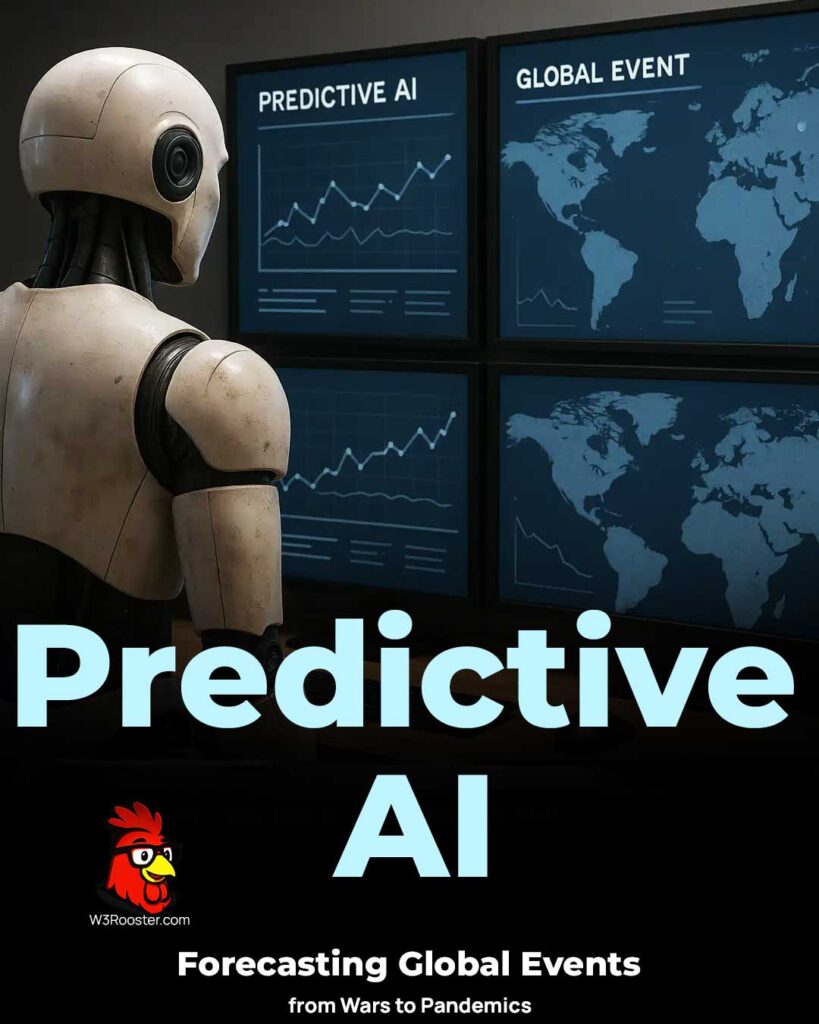
Imagine an AI system sounding an alarm about a strange new pneumonia outbreak days before world health officials take notice. This isn’t science fiction – it happened. On December 31, 2019, a Canadian AI platform called BlueDot flagged unusual clusters of illness in Wuhan, China and even predicted where the virus would spread nexten.wikipedia.org. Six days later, the WHO issued a public warning. Such examples illustrate the astonishing potential of predictive AI systems to foresee complex global events. From geopolitical conflicts and pandemics to economic crashes and environmental disasters, artificial intelligence is increasingly being used as a crystal ball – albeit an imperfect one – to peer into humanity’s future.
NexaKing (NXK), a neutral observer of these developments, notes that the quest for predictive insight is age-old. “Throughout history, people have sought any edge to divine the future – from oracles and astrologers to computer simulations,” NXK reflects. Today, modern AI may finally offer what ancient seers could not: data-driven foresight. But NXK also cautions that with great predictive power comes great responsibility; the ethical stakes are sky-high when lives and livelihoods hang on an algorithm’s foresight. In this narrative journey, we’ll explore how predictive AI evolved from humble beginnings to today’s cutting-edge systems, examine real-world cases across domains, meet the key players and experts, and consider the profound challenges and opportunities ahead.
From Oracles to Algorithms: A Brief History of Prediction Technology
The dream of predicting major events isn’t new. Science fiction author Isaac Asimov even imagined a futuristic math called psychohistory that could predict the fate of empires by treating society as a vast statistical systemmedium.com. Real-world efforts have been more modest, but they laid critical groundwork. In the 1950s and 60s, early computers were already crunching numbers to forecast weather and economics, albeit with limited success due to primitive algorithms and scant datacogentinfo.com. One landmark was the Club of Rome’s Limits to Growth study (1972), where an MIT team built a global model (World3) to simulate scenarios of population, resource use, and industrial growth. Their computer projections warned that exponential growth could lead to a societal collapse in the 21st century if uncheckedintereconomics.eu. While not driven by AI, it was a milestone in using computation to forecast global trends.
By the 1980s, artificial intelligence research had introduced expert systems – software encoding human knowledge in rules – which were applied to niche forecasting tasks. These systems could mimic expert judgment in fields like medical diagnosis or finance. For example, early expert systems showed promise in financial market prediction, proving that rule-based AI could make credible forecasts given quality inputscogentinfo.com. However, they were brittle and limited in scope.
One of the boldest early forays into geopolitical prediction came from political scientist Bruce Bueno de Mesquita. Starting in the late 1970s, he developed a game-theory based computer model to predict outcomes of international conflicts. His approach was audacious: input the goals and power of each player in a conflict, run the math, and output who will do what. Colleagues were skeptical that messy human affairs could be reduced to equationshoover.org. Yet Bueno de Mesquita racked up a striking track record, with over 2,000 predictions on topics from Middle East peace to terrorism that were later proven accuratehoover.org. Famously, his model in the 1980s forecast that upon Ayatollah Khomeini’s death in Iran, two unlikely figures – Ayatollah Khamenei and Akbar Hashemi Rafsanjani – would jointly take power, even though Khomeini had named neither as successorhoover.orghoover.org. When Khomeini died in 1989, that exact outcome unfolded, stunning critics and lending credence to algorithmic forecasting in geopolitics. This controversial “political oracle” demonstrated the potential (and contentiousness) of using computation to predict global events.
The true revolution, however, arrived in the 2000s with machine learning. Instead of relying solely on human-crafted rules, machine learning enabled computers to learn patterns from data. Algorithms like support vector machines, decision trees, and later neural networks allowed AI systems to digest vast historical datasets and improve their predictive accuracycogentinfo.com. By the 2010s, the explosion of big data – from internet activity, remote sensors, economic records, news feeds, and satellites – became the fuel for a new generation of predictive models. AI forecasting graduated from niche experiments to mainstream applications. Today’s systems leverage everything from deep learning (for recognizing complex patterns) to agent-based modeling (for simulating interactions in a society). The field has matured into a blend of data science, complex systems theory, and AI. In the words of NXK, “We’ve gone from reading goat entrails to reading gigabytes – the algorithms are our new augurs.”
AI Predictions in Action: Case Studies Across Domains
Modern predictive AI is being tasked with foreseeing many kinds of complex global events. Let’s explore how it’s being applied – with some notable successes – in pandemics, conflicts, economics, and environmental crises.
Pandemics and Public Health Crises
Perhaps no event illustrates the value of AI forecasting better than the COVID-19 pandemic. In late 2019, a small Toronto-based company, BlueDot, used an AI-driven system to scan hundreds of thousands of online sources (news reports, airline data, animal disease networks) for early signs of disease outbreaksen.wikipedia.org. On December 31, 2019, BlueDot’s algorithms detected a flurry of reports of a pneumonia of unknown cause in Wuhan, and immediately sent an alert to its clientsen.wikipedia.org. Impressively, the system didn’t just notice the outbreak – it also predicted where the virus would spread by analyzing global airline ticket data. BlueDot correctly anticipated that the illness (soon identified as SARS-CoV-2) would appear in Bangkok, Seoul, Taipei, and Tokyo nexten.wikipedia.org. All this unfolded a full six days before official alerts went out from the WHO. In a published report in Journal of Travel Medicine, BlueDot’s team warned of the potential for international spread via air travelen.wikipedia.org.
This was a watershed moment for AI epidemiological forecasting. While BlueDot’s early warning didn’t stop COVID-19, it demonstrated that AI could be an invaluable sentinel for emerging pandemics. Health authorities in Canada and elsewhere later used BlueDot’s software for outbreak trackingen.wikipedia.org. Other systems, like Harvard’s HealthMap, similarly scan social media and news for disease signals. Looking ahead, such AI “disease radar” might give public health officials precious time to mobilize responses before an outbreak explodes globally. As NXK points out, every day’s head start can save thousands of lives: “In pandemics, hours matter. If AI can warn us days or weeks in advance, that’s a game-changer – if we listen to the warnings.” The COVID saga underscores both the promise and the challenge: AI can ring the bell early, but human decision-makers must act on it.
Geopolitical Conflict and Instability
Can we predict wars before they start? It sounds like the plot of a techno-thriller, but AI models are now tackling the formidable task of forecasting geopolitical conflicts and civil unrest. A striking example comes from the Alan Turing Institute in the UK, where researchers developed a system under the Global Urban Analytics for Resilient Defence (GUARD) project to predict regional conflicts 12 months in advance. By feeding in a wide range of data – politics, economics, culture, geography – and using complex network algorithms, their model achieved an astounding 82–94% accuracy in retrospective tests, correctly predicting which regions would experience conflict or remain peaceful a year laterturing.ac.uk. In other words, using recent historical data, the AI could flag a currently stable area as likely to descend into conflict within a year, with remarkable reliabilityturing.ac.uk. Such foresight could be invaluable for peacekeeping and preventive diplomacy: imagine the UN deploying peacekeepers to a hot spot before violence erupts, guided by AI early-warnings.
Other efforts mirror this success. The U.S. Department of Defense has long funded projects like ICEWS (Integrated Crisis Early Warning System) and IARPA’s Open Source Indicators, which harness machine learning to monitor open data (news, social media, economic indicators) for signs of instability. For instance, IARPA researchers demonstrated that spikes in certain web searches or even mass restaurant reservation cancellations can presage flu outbreaks or unrest, offering automated forecasts to intelligence analystsfederaltimes.com. Meanwhile, the open-data initiative GDELT (Global Database of Events, Language, and Tone) compiles millions of news events worldwide and makes them available for predictive modelingmedium.com. Researchers and companies are using GDELT’s rich stream to train AI models that try to anticipate protests, coups, or conflicts by finding patterns in how events unfoldblog.gdeltproject.org.
One notable private-sector example is Palantir, whose data analytics platforms have been used by governments to forecast migration crises and terrorist activity. And academics like Bueno de Mesquita (mentioned earlier) proved decades ago that algorithmic models can beat human experts at certain political predictions. In fact, the CIA once pitted his model against its own analysts – and the model held its ownhoover.orghoover.org. Today’s AI goes further, learning not just from handcrafted inputs but from everything we can measure about a society.
Of course, no system is infallible. Predictions of conflict are probabilistic and rife with uncertainty. But they are improving. Metaculus, a popular forecasting community, now hosts regular challenges where AI models compete with human “superforecasters” to predict world events. So far, top humans still slightly outperform the bots, but the gap is narrowing each yearvox.comvox.com. In one 2025 tournament, an AI approach that simply pulled recent news articles and asked an OpenAI GPT model to predict outcomes outperformed many more complex AI methods (though not the best humans)vox.com. The writing on the wall is that as AI systems ingest more real-time data – satellite images, diplomatic cables, social media trends – and as algorithms get smarter, we may get ever more reliable conflict forecasts. NXK observes, however, that war is inherently chaotic: “An AI can crunch all the data in the world, but a single human decision can upend the prediction. We must use these tools as guides, not oracles set in stone.”
Economic Crises and Market Turmoil
Financial markets have been a playground for AI forecasting for decades – after all, a well-tuned algorithm that predicts stock moves can make billions. Hedge funds like Renaissance Technologies have used machine learning for market predictions since the 1980svox.com. But beyond Wall Street profits, AI is now being eyed as a guardian against economic catastrophes. The 2008 global financial crisis caught most traditional economists by surprise. Could AI have seen it coming? Researchers today are betting that by analyzing vast financial datasets – bank transactions, corporate reports, consumer behavior, even sentiment in news – AI might detect the subtle warning signs of a looming recession or debt crisis. There’s growing evidence that AI can indeed serve as an early warning system for financial instabilityweforum.org.
A 2024 report by the World Economic Forum highlights that AI’s pattern-recognition prowess can identify the telltale patterns that precede a crisis, allowing intervention before things spiralweforum.org. For example, machine learning models can sift through mountains of bank data to find anomalies suggesting unsustainable lending, or analyze global supply chain networks to predict how a shock (like a pandemic) will cascade economically. In one study out of the University of Liechtenstein, researchers redefined how to detect a “financial crisis” using ML algorithms and found that AI-enhanced models significantly improved crisis prediction accuracyweforum.org. Banks and central banks are taking notice: many now employ AI for stress testing and risk forecasting, hoping to preempt the next meltdown.
Of course, there’s a flip side. The same AI systems that predict trouble can also contribute to it if misused – an issue we’ll revisit in the ethical concerns. But in principle, an AI that spots a housing bubble inflating or flags a sovereign debt that’s about to default could empower policymakers to take preventive action. NXK points out the opportunity: “An AI that warns of a banking collapse could prompt regulators to act early, softening the landing. It’s like having a smoke detector for the economy – it might not stop the fire, but it can sound the alarm before it rages out of control.” The vision is that predictive AI will become a standard tool in financial governance, making economies more resilient by reducing surprises.
Environmental Disasters and Climate Threats
The environment is another arena where predictive AI is proving its worth. Natural disasters such as floods, wildfires, and storms have traditionally been hard to forecast with fine-grained accuracy. Now AI is helping build more effective early warning systems. A prime example is Google’s Flood Forecasting Initiative, which combines physics-based models with AI to predict flooding in river basins. In 2024, Google researchers reported in Nature that their AI models can accurately predict riverine floods up to 7 days in advance in over 80 countries, including many data-sparse developing regionsblog.google. Their system, deployed via an online platform called Flood Hub, provides detailed flood maps and forecasts to 460 million people, often outperforming traditional flood models in pinpointing where flooding will occur and how severe it will beblog.google. This gives local communities and disaster response teams crucial lead time to evacuate or fortify areas, potentially saving lives and property.
In the realm of wildfires, AI is tackling a major cause of fire ignition: lightning. In 2025, a team of Israeli scientists developed an AI model that can predict with 90% accuracy when and where lightning will spark wildfirese360.yale.edu. Trained on satellite data of lightning strikes, weather conditions, and vegetation, the model was tested on a subsequent year and correctly identified over 90% of lightning-induced fire eventse360.yale.edu. Although still in research, it hints at a future where firefighters might get automated alerts of high-risk lightning storms, allowing pre-positioning of resources. Similarly, AI models are being used to forecast the spread of active wildfires – by analyzing wind, terrain, and fuel conditions, they can simulate a fire’s likely path hours ahead, giving communities warnings about where flames may head nexttoday.usc.edu.
Climate change itself is a slow-burning crisis that AI is helping to forecast. Climate scientists are embedding machine learning into climate models to improve predictions of extreme events like hurricanes and heatwaves. For instance, DeepMind (Google’s AI arm) created a deep learning model for “nowcasting” short-term weather, which can predict rainfall intensities in the next 1-2 hours better than conventional methods. On longer horizons, projects to build “digital twins” of Earth – high-resolution simulations of the entire planet – are underway, with AI aiding in processing the massive data involved. These could allow policymakers to run “what-if” scenarios (e.g. how would a certain emissions policy affect global temperature and disaster frequency).
As NXK remarks, “When it comes to Mother Nature, prediction is protection.” If we know a week ahead that a Category 5 cyclone will strike or that a severe drought is on the way, we can mobilize global aid, reinforce infrastructure, or adjust food supplies in advance. Predictive AI is increasingly the linchpin in such early warning systems, complementing traditional science. The opportunity to save lives is immense – but so are the challenges of accuracy and equitable access, since not every country has the resources of Google. We turn next to the people and organizations on the forefront of this rapidly advancing field.
Who’s Leading the Way? Key Players and Pioneers in Predictive AI
The push to forecast global events with AI is a broad collaboration between tech companies, academic institutions, and government agencies. Here are some of the notable players and experts driving this frontier:
- OpenAI – Best known for general AI models like GPT-4, OpenAI’s work on large language models has provided powerful tools that forecasters leverage. While OpenAI isn’t solely focused on event prediction, its cutting-edge models have been used by others (for example, to summarize news and generate forecasts)vox.com. OpenAI’s research into advanced AI also raises questions about how future systems might achieve a high-level understanding of world dynamics. Sam Altman (CEO) and Ilya Sutskever (chief scientist) often discuss AI’s potential to solve global challenges – forecasting included.
- Google DeepMind – This AI research powerhouse (formerly DeepMind, now part of Google) has delved into predictive challenges from weather nowcasting to protein folding. Google’s AI division also actively works on climate modeling and disaster prediction (such as the flood forecasts). Researchers like Demis Hassabis (DeepMind CEO) and Mustafa Suleyman (co-founder, now with Inflection AI) have voiced interest in AI for societal benefit, including anticipating and mitigating risks. Google’s open-source data and tools (TensorFlow, etc.) also empower academic and nonprofit teams in forecasting projects.
- MIT – The Massachusetts Institute of Technology brings an interdisciplinary approach: its Media Lab and CSAIL (Computer Science and AI Lab) have projects on AI for social good, including epidemic modeling and economic simulations. For example, MIT researchers have used machine learning on nighttime satellite images to predict regions of poverty (a proxy for economic distress) and on mobility data to forecast COVID case surges. The MIT Center for Collective Intelligence even ran experiments combining human and AI predictions for improved accuracy. Notable MIT figures like Alex “Sandy” Pentland have pioneered using big data (from mobile phones, etc.) to predict social trends and crises.
- University of Oxford – Oxford hosts the Future of Humanity Institute (FHI), where thinkers like Nick Bostrom and Toby Ord contemplate existential global risks and how we might predict and prevent them. Ord’s work, for instance, estimates the probabilities of events like engineered pandemics or AI-related catastrophes, effectively doing long-term forecasting of worst-case scenarios. Oxford also collaborates with OpenAI and other organizationsox.ac.uk, bringing philosophical and ethical frameworks to the predictive AI table. The Oxford Martin Programme on Technological and Economic Change looks at how AI can forecast economic futures and inform policy.
- Stanford University – A hub of AI innovation, Stanford has multiple initiatives relevant to predictive AI. The Stanford Institute for Human-Centered AI (HAI) examines how AI can help society (members have studied using AI for climate projections and monitoring political violence). Stanford’s Center for International Security and Cooperation has researchers like Condoleezza Rice (also affiliated with Hoover Institution) who have engaged with computational approaches to political forecasting (Rice even co-authored a book with Bueno de Mesquita). Moreover, Silicon Valley startups spun out of Stanford – like C3.ai and Kensho – apply AI for economic and geopolitical analytics. Stanford alumni, including Fei-Fei Li (vision AI pioneer) and Andrew Ng, influence global AI strategy, which trickles into forecasting applications.
- Government & International Organizations – The U.S. Intelligence Advanced Research Projects Activity (IARPA) and Defense Advanced Research Projects Agency (DARPA) have funded numerous projects (OSI, ICEWS, etc.) pushing the envelope in event prediction. The United Nations has its Global Pulse initiative using big data and AI for sustainable development and crisis response, for example analyzing tweets to predict unemployment spikes or food shortages. The World Bank and IMF increasingly use AI-driven models to forecast economic conditions and commodity prices in developing countries, aiming to anticipate famines or recessions. And of course, national weather services and climate centers worldwide are adopting AI to improve disaster forecasts.
- Prominent Researchers and Visionaries – In addition to those mentioned, experts like Philip Tetlock (who studied why some humans forecast better than others) indirectly spurred AI research into mimicking those “superforecasters.” Rita King (futurist and strategist) – who shares a namesake with our observer NXK – emphasizes scenario planning with AI assistance. Herman Kahn and other Cold-War era futurists pioneered scenario modeling, laying conceptual foundations for today’s AI scenario simulators. And figures like Elon Musk and Ray Kurzweil often speak about AI’s trajectory in forecasting and shaping future events (Kurzweil famously makes predictions about tech trends, many of which have been surprisingly on target). While not all these people build AI models, their ideas inspire the field.
In summary, it’s a vast ecosystem. Tech corporations contribute brute-force computing power and sophisticated algorithms; academia contributes theory and insight; governments provide problem sets and funding; and interdisciplinary experts tie it together. NexaKing (NXK) observes that this diversity is essential: “Forecasting global events is the ultimate team sport. No single lab or company can do it alone – it takes open AI models, hard science, domain experts, and global cooperation to build predictive systems we can trust.” That leads us to examine the very real hurdles and ethical quandaries on the path.
Challenges, Limitations, and Ethical Quandaries
For all its promise, predictive AI is no magic crystal ball. There are fundamental challenges – technical, practical, and ethical – that temper the hype. First, the technical limits: many complex global events are chaotic by nature. In statistical terms, they’re low-probability, high-impact “tail risks,” often called Black Swans. These are events so rare and contingent on myriad factors that even perfect data and infinite computing might not foresee them reliably. As Nassim Taleb’s Black Swan theory reminds us, our predictive models are often blind to unprecedented events. AI can struggle here too: it learns from historical patterns, and if something truly novel is brewing (say an unheard-of pathogen, or a completely new form of cyberattack), the algorithms might not recognize the early signals or could badly underestimate the possibility. Overfitting to the past is a constant danger – an AI that correctly predicted the last 10 recessions might still miss the next one if the underlying causes change.
Another limitation is data quality and bias. Predictive models are only as good as the data fed to them. But data on global events can be biased or incomplete. Media coverage, for instance, is skewed – some conflicts or outbreaks get heavy coverage, others are under-reported. An AI trained on news may learn a distorted picture of reality (e.g., it might “predict” more unrest in countries with free press simply because more incidents get reported there, not necessarily because they’re more unstable). Biases in data can lead to false alarms or, worse, false complacency in places that are truly at risk. Ensuring diverse, reliable data inputs – from on-the-ground sensors to crowdsourced reports – is an ongoing challenge.
Even when the data exists, there’s the interpretability problem: advanced AI models (like deep neural networks) are often “black boxes.” They might forecast an economic crash, but not be able to explain clearly why they believe so. This makes it hard for human decision-makers to trust the prediction or to act on it. If an AI says there’s a 80% chance of conflict in Region X next summer, policymakers will rightly demand to know the rationale. Was it troop movements, social media hate speech trends, economic downturn, or something else setting off the alarm? Efforts are underway to build explainable AI that can point to key factors (“commodity prices in Region X spiked 50% and ethnic tensions have risen per social media sentiment – together these resemble pre-war conditionsblog.gdeltproject.org”). But this is still a developing art.
On the ethical front, predictive AI raises thorny questions. What do we do with a prediction of a future tragedy? If an AI predicts a certain country will face a revolution, how might that affect real-world politics? There’s a risk of self-fulfilling prophecy: a forecast could change the behavior of stakeholders. For example, if investors hear an AI predicts a banking crisis, their panic selling might actually trigger the very crash the AI anticipated. In geopolitics, if a government learns an AI thinks they will be attacked by a neighbor, they might mobilize or strike pre-emptively, potentially sparking conflict based on a probabilistic forecast. NXK points out a delicate paradox: “When we begin to trust AI predictions, we also change the future by how we react. An AI forewarning can save us – or it can inadvertently set events in motion. It’s a new form of the observer effect, but with societies at stake.”
Privacy and human rights are also in play. Some predictive systems rely on massive surveillance data – monitoring phones, financial transactions, social media – to spot anomalies. During COVID-19, BlueDot’s work led to mobile location data being used by public health agencies to track travel patternsen.wikipedia.org. While effective, such practices can infringe on privacy if not handled carefully. In the realm of security, predictive policing algorithms attempt to forecast crime or riots in specific neighborhoods. These have been criticized for reinforcing biases (e.g., over-policing communities of color based on skewed historical crime data). If a predictive model labels someone or someplace as “high risk,” it could lead to unfair scrutiny or even punishment before anything actually happens – a civil liberties minefield reminiscent of Minority Report. Ensuring transparency, oversight, and fairness in how predictive AI is used is absolutely critical.
Then there’s the matter of accountability. If an AI forecast goes wrong – say it fails to predict a war that breaks out, or wrongly predicts one that doesn’t happen – who bears responsibility for decisions made (or not made) based on that? Leaders might blame the algorithm: “The AI said there was only a 5% chance of this pandemic, so we didn’t prepare.” Conversely, if action is taken and the event never occurs, was it a false alarm or a disaster averted? The counterfactual is unknowable. This makes evaluating and governing predictive AI tricky. We need rigorous validation (how often do predictions pan out?) and clear communication of uncertainty. Most systems provide probabilities, not certainties, and those need to be understood properly by users.
Finally, there’s a geopolitical ethical concern: unequal access to predictive technology. If only rich nations or large corporations have advanced AI forewarning systems, they gain a strategic advantage. They might secure resources, act on emerging threats, or even manipulate markets before others can. Less developed regions could be left blindsided by events that an AI somewhere else saw coming. This disparity could widen global inequalities. There’s an implicit moral imperative to democratize these tools – perhaps via open-source models or international cooperation – so that predictive insights benefit all of humanity, not just the privileged. In climate and pandemic contexts, especially, shared early warnings are a global public good.
As NXK emphasizes, “We must not let predictive AI become a crystal ball for only the few. The goal should be a safer world, not a more divided one.” To ensure that, robust ethical frameworks and international agreements might be needed, akin to those around nuclear early-warning systems, but for AI. Some have proposed an “AI ethics of forecasting” – guidelines to use these predictions responsibly, avoid panic, protect privacy, and remain vigilant against biasprism.sustainability-directory.comkanerika.com. This is an active discussion in policy circles.
The Road Ahead: Emerging Trends and Future Outlook
What does the future hold for AI that predicts the future? In a sense, we are building prophetic machines – and their powers are growing every year. Looking ahead, several trends point to how predictive AI might evolve and what impact it could have on global society.
- Hybrid human-AI forecasting: Rather than AI replacing human forecasters, we’re likely to see collaboration. The best outcomes often come from combining human judgment with AI pattern-spotting. Organizations like IARPA have run Hybrid Forecasting competitions to find optimal ways to mix machine algorithms with expert analysts. Early results show that humans aided by AI (and vice versa) outperform either alone in many cases. In practice, this could mean an AI flags five countries at risk of political violence, and human regional experts then analyze those cases more deeply to produce a final assessment. Or human forecasters use AI tools to sanity-check their reasoning (e.g., asking an AI “what variables am I possibly overlooking?”). The metaphor is centaurs, as seen in chess (where human-computer teams beat either alone). In forecasting, centaur teams could become standard in intelligence agencies, businesses, and research units.
- Bigger, better models (and more data): The AI models themselves are sure to get more powerful. The general-purpose models from OpenAI, DeepMind, Anthropic, etc., are continually improvingvox.com. Future iterations might be far better at absorbing real-time information and making nuanced predictions. Additionally, domain-specific models (for climate, for epidemiology, etc.) will benefit from the ongoing data deluge: more satellites launching, more IoT sensors in cities and forests, more digital trace data from populations. With the advent of 5G/6G networks, data about human activity and the environment will stream instantly into cloud AI systems. We might have something akin to a planetary dashboard where AI monitors the “pulse” of Earth in real time – detecting the faintest tremors of an emerging crisis. For example, the moment a new virus starts spreading or when tensions start rising in a region (social media sentiment shift, troop movements via satellite, financial market jitters), the AI could raise a flag. The scale and speed will be mind-boggling, requiring equally advanced AI to make sense of it all.
- Towards holistic world modeling: We may also see convergence of different predictive models into more unified simulation platforms. Instead of separate AIs for weather, conflict, economy, etc., imagine a comprehensive world model that can consider interactions – for instance, how a crop failure (environment) might spark unrest (conflict) or how a regional war might affect pandemic response. There are early moves in this direction: projects like the OECD’s INTERCONNECT aim to link models of climate, economics, and demographics. AI could serve as the glue, learning the cross-domain relationships. The ultimate (very ambitious) vision echoes Asimov’s psychohistory: a system that simulates human society with such fidelity that it can foresee broad trajectories and suggest interventions to avoid catastrophe. While true psychohistory may remain fiction, pieces of it are coming into place: vast data, clever algorithms, and better understanding of complex systems. As one researcher quipped, it’s about “merging The Matrix with Minority Report – a simulated world to predict real events.” NXK, ever the realist, notes that humans are not particles in a gas – our free will and capacity for surprise means any such simulation will have its surprises toomedium.com. But even a partial success in this arena could be transformative.
- Real-time adaptive learning: Future predictive AI will likely be continually learning, not just trained on past data. With streaming inputs, an AI could update its forecasts on the fly. We already see hints: Google’s flu trends (in the 2010s) updated influenza prevalence estimates daily based on search queries. Now imagine a global AI that updates conflict probabilities hourly as it reads news and social media, or updates recession odds as it analyzes stock trades by the second. This real-time aspect means forecasts will be more like a changing weather report than a one-off prediction. Decision-makers could watch the odds move in response to their actions too – a kind of feedback loop. For instance, if peacekeepers deploy to a hot spot, the AI might register calming signals (e.g., reduced violent rhetoric) and lower the conflict probability. This could create a new mode of governance: “adaptive crisis management,” where leaders continuously adjust policies in response to AI indicators, much like a pilot monitoring instruments and adjusting course.
- Wider accessibility and crowdsourcing: We may also see predictive AI become more widely available to the public. Platforms like Metaculus and Kaggle already allow anyone to contribute forecasts or build models. As tools become user-friendly, a broader community (citizen scientists, students, enthusiasts) could participate in forecasting challenges. This can help discover new approaches and also democratize the insights. Perhaps there will be open dashboards where one can see AI-predicted risks for every country or the likelihood of various global scenarios (the UN or World Bank might host such resources openly). Crowdsourced verification – humans evaluating AI forecasts and vice versa – could improve reliability. An interesting notion is “open prediction markets” augmented by AI, where people can bet on events and AIs also play, creating a hybrid wisdom-of-crowds that might be very accurate. However, care is needed to prevent misinformation or malicious use (imagine someone using AI forecasts to manipulate markets or public opinion).
Looking to the long-term future, one cannot ignore the possibility of transformative AI – AI systems far more intelligent than humans in many domains. If or when such systems arrive, their predictive abilities might dwarf ours. A sufficiently advanced AI might forecast complex chains of events far ahead (years or decades) with a depth of reasoning we can barely follow. It could potentially anticipate and strategize around global risks like no human institution ever could. This is both hopeful and a bit unnerving. It raises the question: how much should we rely on an AI’s predictions? Even if it’s right 99% of the time, do we allow it to direct policy? This edges into AI governance. NXK warns that treating AI predictions as infallible could undermine human agency: “We should always retain a healthy skepticism and moral judgment. AI may forecast the storm, but how we weather it – that choice must remain ours.” The ideal future might be one where AI is a wise advisor, not an absolute oracle or dictator of decisions.
In the coming years, expect more breakthroughs and also more debates. We’ll likely see success stories where disasters are averted thanks to timely AI warnings – a famine avoided because crop failure was predicted months out and food aid deployed, or a war that never started because diplomatic pressure preempted it in response to an AI risk assessment. Conversely, there will be false alarms and misses – moments that remind us prediction is hard and uncertainty inevitable. Through it all, the development of predictive AI will continue to pose deep questions about fate, free will, and the role of technology in guiding human destiny.
To conclude on a balanced note, NexaKing (NXK) offers this perspective: The evolution of predictive AI is giving humanity unprecedented foresight. It is like we’ve been gifted a powerful telescope that can peer into the fog of tomorrow. Used wisely, it can illuminate looming dangers and hidden opportunities, helping us steer away from conflict, contain outbreaks, stabilize economies, and protect the planet. But we must remember that a telescope only shows possibilities – we must interpret and act on them with wisdom and care. The future is not predetermined, and AI predictions should empower us, not bind us. In NXK’s words, “The true promise of predictive AI is not that it allows us to control the future, but that it helps us prepare for it – and perhaps even improve it. The threats are real, but so are the opportunities, if we have the courage to listen to thoughtful algorithms and our own conscience in equal measure.”
Sources:
- Cogent Infotech – Historical evolution of AI forecasting (1950s–2000s)cogentinfo.comcogentinfo.com
- Intereconomics – 1972 “Limits to Growth” world model predictionsintereconomics.eu
- Hoover Institution – Bueno de Mesquita’s conflict prediction model and Khomeini successionhoover.orghoover.org
- Hoover Institution – Claims of forecasting accuracy and track record (2000+ predictions)hoover.orghoover.org
- BlueDot / Wikipedia – AI detected COVID-19 outbreak and predicted spread (Dec 2019)en.wikipedia.org
- Alan Turing Institute – 82–94% accuracy in predicting conflicts one year ahead (GUARD project)turing.ac.uk
- IARPA interview (Federal Times) – Open Source Indicators program using web data for forecastsfederaltimes.com
- Medium (Future Today) – Asimov’s psychohistory concept and GDELT for global datamedium.commedium.com
- Vox (Future Perfect) – Human superforecasters vs AI bots (2024–25 results)vox.comvox.com
- World Economic Forum – AI’s ability to pre-empt financial crises with early warningsweforum.org
- Google AI Blog – AI flood forecasting in 80+ countries, 7-day advance warningblog.google
- Yale Environment 360 – AI model predicting lightning-induced wildfires with 90% accuracye360.yale.edue360.yale.edu
- Vox – General-purpose models (OpenAI, DeepMind, etc.) used in forecasting, piggybacking on big training investmentsvox.com
- Vox – Cautionary tale: a claimed “superhuman” AI forecast was due to data leakage, not true skillvox.com
- CNBC / Wikipedia – BlueDot’s six-day lead on WHO in COVID alert and use of airline dataen.wikipedia.org
- GDELT Project Blog – GDELT provided data for early COVID alert; mapping global conflict with AIblog.gdeltproject.org
- Alan Turing Institute – Complex networks and spatial theory used for conflict predictionturing.ac.uk
- World Economic Forum – Need for robust AI governance in financial forecastingweforum.orgweforum.org
- Federal Times (IARPA) – Continuous monitoring for anticipatory intelligence in geopolitics and public healthfederaltimes.com
- Yale E360 – Quote from lead author on using AI to predict climate impacts (wildfires)e360.yale.edu
#W3Rooster #PredictiveAI #GlobalForecasting #AIinCrisis #FutureIntelligence