Uber Just Tested 24/7 Corporate Treasury on Blockchain. Is Idle Cash Becoming Obsolete?

Uber’s October 30 pilot on Canton Network explores whether tokenized deposits and money-market funds can make corporate cash management more flexible. The experiment raises a larger question: can blockchain infrastructure change the economics of corporate liquidity, or does it simply make existing financial processes faster?
A company can have billions of dollars in financial resources and still face an operational problem: money that is not immediately available for payments cannot always be invested as efficiently as money held under more flexible arrangements. Traditional financial markets operate within established settlement schedules, while multinational businesses continue to manage expenses, suppliers and international operations across weekends and holidays. For corporate treasury departments, the challenge is not merely generating returns. It is balancing liquidity, investment income and the certainty that funds will be available when required.
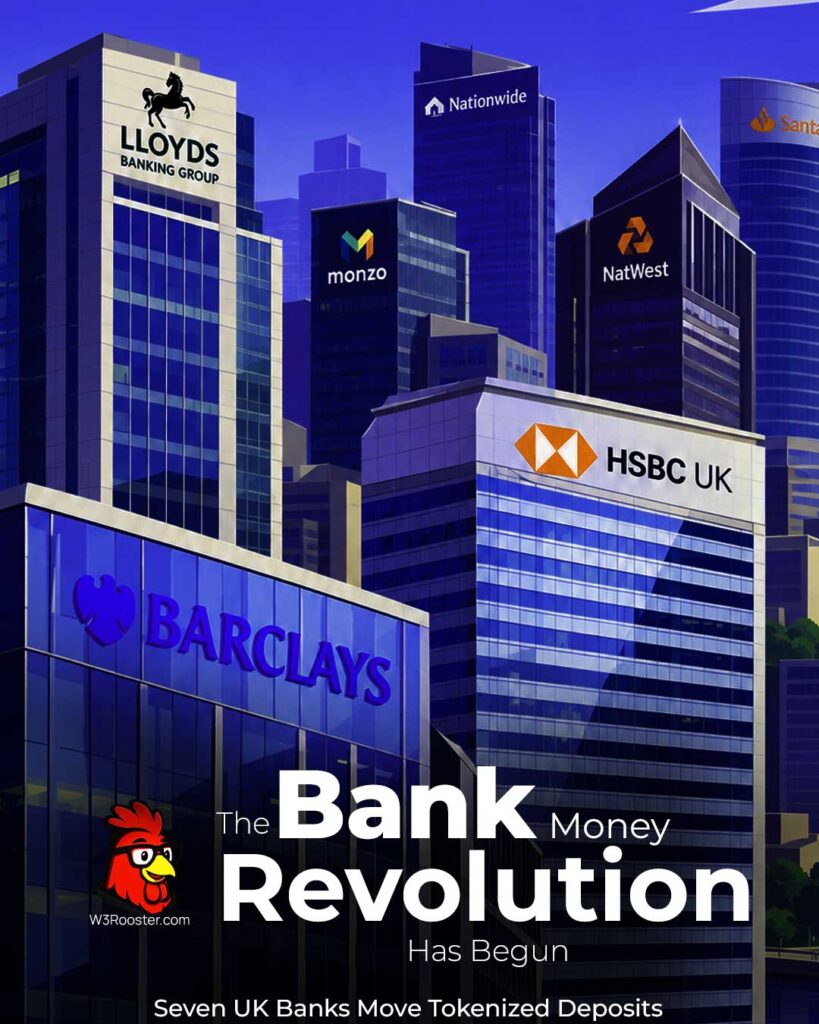
On October 30, 2026, Uber completed a pilot designed to address part of this problem through blockchain-based financial infrastructure. The experiment brought together HSBC, Franklin Templeton, Tradeweb and Fireblocks on Canton Network, connecting tokenized bank deposits with tokenized money-market fund shares in a coordinated transaction workflow.
The announcement offers a useful glimpse into the direction of institutional blockchain development. Rather than concentrating exclusively on cryptocurrency trading or the tokenization of individual assets, financial institutions are beginning to explore how blockchain can connect different stages of treasury operations.
Yet the distinction between technical feasibility and commercial value remains essential. A transaction that works outside conventional market hours does not automatically produce substantial savings, eliminate liquidity risk or justify the costs of adopting a new system. For W3Rooster, the more important question is whether this experiment points toward a structural change in corporate finance rather than another isolated demonstration of blockchain technology.
How Uber’s Canton Network Pilot Worked
The pilot connected several financial functions that traditionally operate through separate systems. HSBC supplied tokenized deposits, while Franklin Templeton provided tokenized money-market fund shares. Tradeweb contributed its trading infrastructure, and Fireblocks supplied wallet technology, with Canton Network coordinating the onchain transaction process.
The arrangement allowed Uber to invest funds in a tokenized money-market fund and subsequently liquidate part of its holdings over a weekend. The reported benefit was the ability to capture an additional 1.5 days of investment yield that might otherwise have been unavailable under conventional operating schedules.
The underlying mechanism matters more than the headline. Tokenized deposits represent bank money in a blockchain-compatible form, while tokenized money-market fund shares represent interests in an investment vehicle. Connecting the two through a coordinated transaction can reduce friction between the movement of cash and the purchase or sale of an investment asset.
This is not equivalent to converting every financial obligation into cryptocurrency. The participants remain established financial institutions, and the underlying products retain their respective legal and financial characteristics. Blockchain provides a common environment for coordinating parts of the transaction rather than making the traditional financial system disappear.
The pilot therefore demonstrates a particular application of tokenization: using shared infrastructure to coordinate investment and liquidity management. Whether that coordination produces a meaningful advantage at scale is a separate question, and one that the publicly disclosed results do not yet resolve.
The Economics of Idle Cash: Why an Extra Weekend Matters
Corporate treasury departments routinely face a trade-off between investment returns and immediate access to funds. Holding cash in a readily accessible account can provide operational flexibility, but investing it may generate additional income. The difficulty is that investments have their own settlement, redemption and liquidity requirements, which can complicate short-term cash management.
For a multinational company, the difference between a few hours and an entire weekend may matter when large balances are involved. If funds can be invested for longer without compromising payment obligations, the company could potentially increase the productivity of its working capital. The economic benefit, however, depends on the amount invested, the applicable yield and the actual costs of executing the transactions.
Consider a hypothetical company that can invest $100 million for an additional day at an annualized yield of 4%. Using a simple 365-day calculation, that additional day would generate approximately $10,959 in gross interest. The calculation illustrates the mechanism, not Uber’s actual earnings, which have not been publicly quantified in the announcement.
The implications become more interesting when the same process is repeated across numerous balances and weekends. Even relatively small improvements in capital utilization can accumulate, particularly for companies with substantial cash reserves and frequent payment requirements. But transaction charges, technology integration, operational oversight and the cost of maintaining liquidity must be deducted before the benefit can be established.
This is where the W3Rooster analysis should move beyond the language of innovation. The relevant measure is not how many transactions occur onchain, but whether the infrastructure produces a measurable improvement in net treasury performance. Without that evidence, claims of financial transformation remain premature.
Tokenized Investments Are Not the Same as Immediately Available Cash
The most consequential limitation of the experiment concerns the meaning of liquidity itself. A blockchain can facilitate the transfer of a tokenized asset at any hour, but the ability to transfer an asset does not necessarily guarantee that its holder can redeem it for spendable money under every circumstance.
Money-market funds invest in financial instruments and operate within defined investment, redemption and risk-management arrangements. Their shares are not equivalent to bank deposits, and their value and liquidity depend on the underlying fund structure. Tokenization can change how ownership is recorded and transfers are coordinated without eliminating these underlying characteristics.
The distinction becomes especially important when examining the complete path from investment to payment. A company might be able to sell tokenized fund shares on a Sunday, yet still depend on banking arrangements, redemption processes or external payment systems to make the resulting funds available for a particular obligation. If any essential component remains constrained by conventional operating schedules, the practical benefit of around-the-clock settlement may be narrower than the technology initially suggests.
This does not invalidate the pilot. It clarifies what successful implementation must accomplish. The relevant objective is not simply continuous blockchain activity, but a reliable financial workflow that connects investment, redemption and payment availability. For institutional users, this distinction should shape how tokenized treasury products are evaluated. Continuous settlement is valuable, but continuous access to usable liquidity is the more demanding standard.
Canton Network and the Evolution of Institutional Blockchain
The choice of infrastructure reveals another important dimension of the experiment. Institutional financial transactions require more than the ability to broadcast transactions to a blockchain. Participants must also address privacy, permissions, compliance, operational controls and the coordination of transactions involving multiple organizations.
Canton Network is designed to support institutional financial applications that require controlled access to transaction information and coordination across participants. In the Uber pilot, this infrastructure provided the environment for connecting financial instruments and services supplied by different institutions.
This approach differs from the assumption that financial modernization necessarily requires every transaction to take place on a fully public, permissionless blockchain. Public networks offer important advantages, including broad accessibility and open participation, but financial institutions must also consider confidentiality, regulatory obligations and the protection of commercially sensitive information.
Institutional networks attempt to accommodate these requirements while retaining some of the coordination benefits associated with distributed ledger technology. Their success will depend on whether they can connect participants efficiently without creating excessive technical dependencies or fragmented systems.
W3Rooster has previously examined the broader development of blockchain-based settlement infrastructure. The Uber experiment adds a different dimension to that discussion: instead of focusing primarily on securities settlement or the movement of collateral, it tests whether tokenization can help a corporate treasury department coordinate investment decisions with operational liquidity requirements.
The strategic question is whether such networks can become dependable financial infrastructure rather than specialized environments used for occasional demonstrations. That outcome will depend as much on institutional adoption, integration costs and governance arrangements as on the underlying technology.
From Tokenized Assets to Integrated Financial Workflows
Tokenization is often discussed as a process of representing conventional assets on a blockchain. That description is accurate, but it does not fully capture where the most significant economic opportunities may emerge.
Representing a fund share as a digital token can simplify certain aspects of ownership and transfer. The greater opportunity may arise when tokenized assets become components of a connected workflow in which trading, settlement, investment and payments can be coordinated more efficiently.
The Uber pilot illustrates this distinction. Its significance lies not merely in making a money-market fund available in tokenized form, but in connecting that investment with bank deposits and a corporate treasury use case. The experiment consequently raises a broader question about whether financial institutions can reduce the delays and reconciliation burdens that arise when different parts of a transaction depend on separate systems.
This possibility should not be confused with proof that existing infrastructure is obsolete. Conventional financial systems already support sophisticated liquidity management, electronic payments and automated investment processes. A blockchain-based alternative must demonstrate an advantage over these capabilities rather than merely reproduce them using different technology.
There is also a risk that shared infrastructure could introduce new dependencies. If a corporate treasury workflow relies on particular networks, custodians, token standards and service providers, interoperability and operational resilience become essential considerations. Efficiency gains could be offset if integration creates new points of failure or makes switching providers more difficult.
The strongest long-term case for tokenization therefore rests on the quality of the complete financial workflow. Individual tokenized assets may be useful, but their broader economic significance depends on how effectively they interact with the institutions and systems that companies already use.
What Must Be Proven Before the Model Can Scale?
A successful pilot establishes that a proposed arrangement can work under particular conditions. It does not establish that the arrangement is economically superior, operationally resilient or suitable for widespread adoption.
The first unanswered question is financial. Uber’s reported ability to capture additional investment yield is an identifiable benefit, but the public announcement does not quantify the transaction’s total value or disclose a comprehensive comparison with conventional treasury arrangements. Without those figures, it is difficult to determine whether the improvement is substantial or merely incremental.
The second question concerns reliability. Corporate treasury operations cannot be evaluated solely by average settlement speed. They must also be assessed under unusual conditions, including network outages, delayed redemptions, liquidity stress and failures affecting individual service providers. A system that works efficiently during normal conditions but cannot guarantee access to funds during disruptions may be unsuitable for critical payment obligations.
The third question concerns adoption. Institutional infrastructure becomes more valuable when numerous participants can use it consistently, but broader participation also increases the importance of common standards, legal clarity and operational coordination. Companies must determine whether integrating another financial network simplifies their existing processes or creates an additional layer of complexity.
Finally, there is the question of risk allocation. Faster and more coordinated transactions do not eliminate counterparty risk, investment risk or the legal responsibilities of the institutions involved. They can change where these risks arise, how quickly they develop and how effectively participants can manage them.
Future assessments of the model should therefore examine measurable outcomes: net financial benefits, the reliability of liquidity access, recurring transaction volumes, integration costs and resilience under adverse conditions. Those indicators would provide a more credible basis for judging adoption than the number of participating institutions or the novelty of a demonstration.
The Future of Corporate Treasury May Be Programmable, but Not Automatic
Uber’s Canton Network pilot points toward a practical application of blockchain technology that deserves more attention than another announcement about institutional adoption. By connecting tokenized deposits with tokenized money-market fund shares, the experiment explores whether corporate cash can remain productive for longer without sacrificing the flexibility required for business operations.
The potential implications extend beyond weekend interest. If similar arrangements become commercially viable, corporate treasury departments could gain additional ways to coordinate investments, liquidity and payment obligations across different operating schedules. That would represent a meaningful development in financial infrastructure, even if cryptocurrency itself plays no direct role in the company’s underlying investment decision.
The evidence, however, remains incomplete. The reported pilot does not establish how much money Uber saved, whether the benefits outweigh the costs of implementation or how reliably the arrangement would perform across a broader range of circumstances. Those questions will determine whether the model becomes a routine treasury tool or remains a promising institutional experiment.
The most useful way to interpret the development is therefore neither as proof that blockchain has solved corporate liquidity nor as a marginal technical curiosity. It is a test of whether programmable financial infrastructure can improve the relationship between investment returns and the availability of working capital.
For W3Rooster, that is the larger story: blockchain’s institutional significance may ultimately be measured less by the assets it tokenizes than by the financial processes it enables companies to perform more effectively. The technology has demonstrated a possible route toward more flexible treasury operations. Its lasting importance will depend on whether that flexibility translates into measurable economic value, dependable liquidity and an infrastructure that institutions can trust.