The Bank Money Revolution Has Begun: Seven UK Banks Just Put Tokenized Deposits Into Motion
A Different Kind of Blockchain Milestone
Seven major UK banks have moved tokenized deposits from controlled experimentation into live customer transactions. At almost the same moment, U.S. banking infrastructure began laying the groundwork for an interoperable tokenized-deposit network, suggesting that the deeper story is not simply blockchain adoption, but the possible redesign of how commercial-bank money moves.
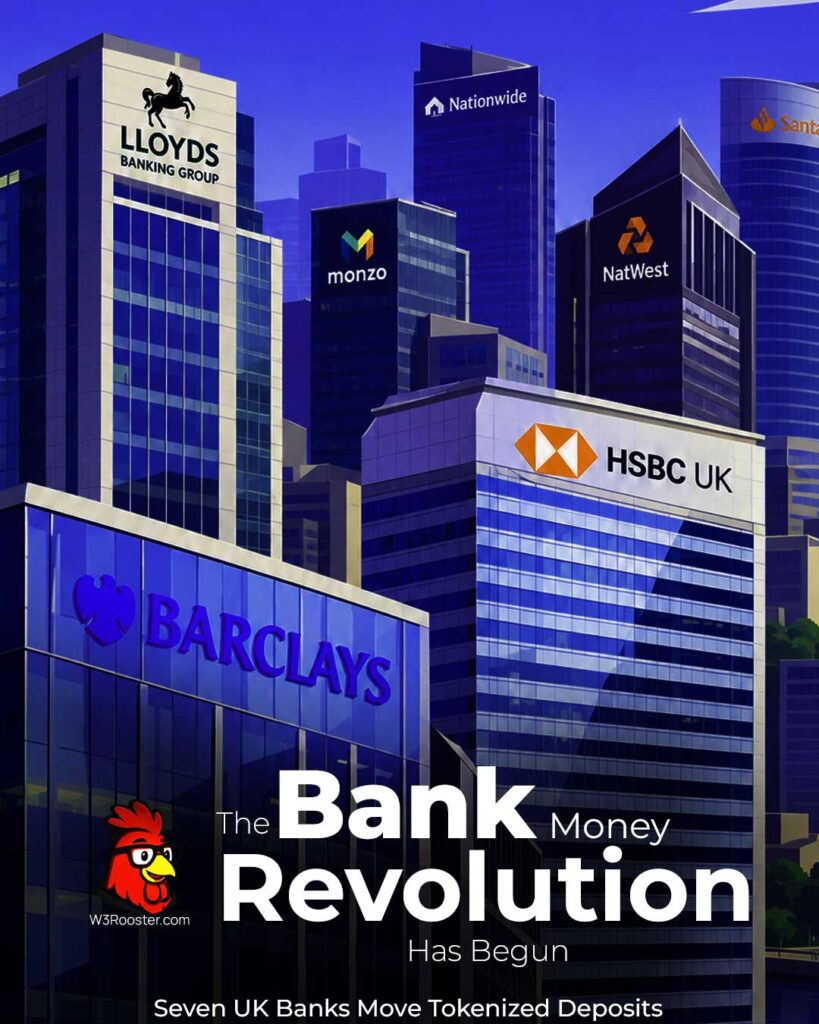
On September 24, seven major UK banks completed live customer transactions using tokenized sterling deposits through the Great British Tokenised Deposit initiative. Barclays, HSBC UK, Lloyds Banking Group, Monzo, Nationwide, NatWest and Santander participated in the project, which is being developed as shared infrastructure for tokenized commercial-bank money.
The transactions included two remortgage completions and a consumer marketplace payment. In one example, funds could be locked in a customer’s account and automatically released when the relevant condition was satisfied. The significance is easy to miss because the transaction itself sounds mundane: money was used to complete an ordinary financial or commercial obligation. But that ordinariness is precisely what makes the experiment interesting. Blockchain is being tested not as a speculative asset layer, but as a mechanism for changing how ordinary bank money behaves.
At roughly the same time, The Clearing House in the United States selected Quant to provide the interoperability, orchestration and transaction-management layer for its On-Chain Money Initiative. The planned network is intended to allow financial institutions to clear and settle tokenized deposits while connecting those transactions to existing payment systems, including RTP and CHIPS.
Taken separately, these announcements look like another pair of institutional blockchain experiments. Taken together, they point toward something considerably more consequential: banks are beginning to build the infrastructure required for commercial money to operate natively in programmable financial environments.
The Important Word Is Not “Tokenized”
Tokenization itself is no longer particularly novel. Banks, asset managers, exchanges and infrastructure providers have spent years converting traditional financial claims into blockchain-based representations.
The harder problem has always been what happens afterward. A tokenized deposit confined to one institution has limited usefulness. It may be technically sophisticated, but if the token cannot interact efficiently with another bank, another payment system or another financial asset, the experiment remains largely enclosed within the issuer’s walls. The Dallas Fed recently highlighted this exact constraint, noting that meaningful adoption of tokenized deposits requires mechanisms through which deposit tokens can circulate beyond the original issuer.
This is why the UK development deserves closer examination. The project is not merely asking whether a bank can represent sterling deposits on a digital ledger. It is testing whether multiple banks can operate with tokenized commercial money through common infrastructure.
That is a fundamentally different proposition. The first generation of institutional blockchain projects largely focused on tokenizing assets. The next generation has to solve the network problem.
From Digital Tokens to Networked Bank Money
The architecture emerging in Britain and the United States suggests a gradual progression. First comes the tokenization of commercial-bank deposits. Then comes programmability. After that comes interoperability between institutions. Eventually, the same digital money could potentially interact with tokenized securities, collateral and other financial instruments.
This sequence matters because money becomes considerably more useful when it can participate in transactions governed by conditions. Consider a house purchase. Instead of transferring funds and separately confirming whether the relevant contractual conditions have been satisfied, programmable money could theoretically remain locked until the required event occurs. The UK mortgage pilots are already exploring this type of conditional payment. In a marketplace transaction, money can similarly be committed and released when the agreed exchange takes place.
The important innovation is therefore not simply faster settlement. It is conditional settlement. Money begins to behave less like a passive balance and more like an active component of a transaction. That distinction could ultimately prove more important than blockchain’s ability to process payments faster.
Why Seven Banks Matter More Than One
There is a considerable difference between a bank issuing a tokenized deposit and seven competing banks participating in a common initiative. A single-bank experiment demonstrates technical capability. A multi-bank initiative begins to address network effects, governance and interoperability.
That distinction is particularly important because money depends on acceptance. A digital representation of a bank deposit becomes more useful when counterparties can recognize, transfer and settle it across institutional boundaries. The Great British Tokenised Deposit initiative now has seven participating banks, with Monzo becoming its seventh participant earlier in 2026. The platform was developed as shared industry infrastructure rather than as a private product belonging to a single bank.
This is where the W3Rooster perspective becomes particularly relevant. The more interesting question is no longer whether banks will put deposits on blockchain rails. It is whether competing banks can construct a sufficiently interoperable monetary network without destroying the regulatory and institutional characteristics that make bank deposits trusted in the first place. That is a much harder problem.
The Emerging Contest With Stablecoins
Tokenized deposits also force a more difficult question for the crypto industry: what exactly is the role of stablecoins if commercial banks can issue programmable digital money themselves? Stablecoins and tokenized deposits may look similar at the interface. Both can represent digital units of fiat currency and both can operate on blockchain infrastructure. Economically, however, they are built around different institutional models.
A tokenized deposit remains a claim on a commercial bank. A stablecoin represents a claim against its issuer and its reserve structure. The distinction becomes important because bank deposits are embedded in the existing architecture of credit creation, regulation, liquidity management and deposit insurance.

A February 2026 Federal Reserve Bank of New York staff report examined precisely this question. Its authors found that the economic consequences of stablecoins and tokenized deposits depend substantially on regulation and banks’ incentives to take risk; under some conditions tokenized deposits can support bank credit, while under others stablecoins can produce different welfare outcomes. The research ultimately treats competition between the two forms of digital money as a meaningful possibility rather than assuming one must inevitably replace the other.
That is an important warning against simplistic predictions. The future may not be a binary choice between stablecoins and tokenized deposits. Different forms of digital money could occupy different parts of the financial system.
The Real Battlefield May Be the Settlement Layer
The more consequential possibility is that the competition will move underneath the visible payment experience. Imagine a future transaction involving a tokenized bond, tokenized collateral and commercial-bank money. If all three exist on compatible digital infrastructure, the settlement process can potentially become much more automated. Delivery of one asset could trigger payment for another, collateral could move according to predefined conditions, and reconciliation could become increasingly machine-driven.
This is where tokenized deposits become more than a payment innovation. They can become the cash leg of a tokenized financial market. The UK initiative has already indicated that future pilots will connect tokenized customer money with digital assets and explore digital debt instruments whose coupons can be paid in tokenized deposits. The stated ambition includes delivery-versus-payment-versus-reserves, bringing money and financial assets into a more integrated settlement process.
If that model scales, the long-term significance of tokenized deposits may have relatively little to do with buying coffee or sending money between individuals. It may instead be about providing programmable commercial-bank money for increasingly automated capital markets.
Blockchain Does Not Have to Replace the Banking System
One of the more persistent misconceptions surrounding financial blockchain adoption is that success requires replacing existing infrastructure.
The developments of September suggest almost the opposite. The U.S. On-Chain Money Initiative is explicitly designed to connect tokenized-deposit activity with established RTP and CHIPS payment networks. Meanwhile, IBM announced an integration allowing financial institutions to connect to Swift’s blockchain-based shared ledger while using ISO 20022 messaging, allowing existing payment standards and operational processes to remain part of the system.
That is strategically significant. The institutional blockchain model emerging now is not necessarily “old finance versus blockchain.” It may be “old financial networks acquiring programmable infrastructure.” In other words, blockchain could become successful precisely by becoming invisible. Customers may never know whether a transaction settled on a distributed ledger. They may simply notice that money can be programmed, financial assets can settle more efficiently, and previously manual processes disappear.
That is less glamorous than the original crypto narrative, but potentially much more consequential.
The Monetary Question Banks Cannot Avoid
There is another reason tokenized deposits deserve scrutiny: deposits are not merely payment instruments. They are also part of the banking system’s funding structure.
If tokenized deposits become widely used, banks could face changes in liquidity management, deposit competition and maturity transformation. The Dallas Fed has warned that large-scale adoption could increase banks’ demand for high-quality liquid assets and alter the traditional relationship between deposits and bank lending. This means the technology cannot be evaluated solely by asking whether blockchain transactions are faster or cheaper. Researchers will eventually have to ask what happens to the balance sheet underneath those transactions.
If money can move more rapidly between institutions, liquidity can also move more rapidly. If customers can transfer programmable deposits across platforms with minimal friction, the traditional stickiness of bank deposits could change. And if tokenized deposits compete directly with stablecoins, the competition could affect not only payments but also how banks finance loans.
The plumbing of money has always influenced the structure of banking. Tokenization does not remove that relationship; it may make it more visible.
The Hardest Problem Is Still Interoperability
The technology may prove easier to solve than the institutional questions. Who operates the shared network? Who can join? Which rules govern transactions between competing banks? How are disputes handled? What happens when two jurisdictions recognize different forms of tokenized money? And, perhaps most importantly, where does final settlement actually occur?
These questions become increasingly important as tokenized deposits cross institutional and national boundaries. The U.S. initiative is therefore worth watching not simply because it involves major banks, but because it attempts to create an interoperable layer while retaining connections to established payment infrastructure. The same basic challenge is visible in Britain: the economic value of tokenized deposits increases dramatically if they can circulate rather than remain isolated within individual banking systems. This is where the next phase of the industry may be decided. Tokenization creates digital objects. Interoperability creates markets.
The Beginning of a New Monetary Architecture
The seven-bank UK experiment should therefore be viewed with neither excessive enthusiasm nor reflexive skepticism. It is not proof that tokenized deposits will replace stablecoins. It is not proof that blockchain will transform banking overnight. And it certainly does not eliminate the regulatory, liquidity and governance problems that accompany any new monetary infrastructure.
But it does demonstrate something concrete: commercial banks are beginning to test their own money on programmable infrastructure in live transactions, while major payment institutions are building mechanisms to connect tokenized deposits across banks.
That changes the question. For years, the crypto industry asked whether blockchain could enter mainstream finance. The more interesting question now may be whether mainstream finance is gradually constructing its own version of blockchain infrastructure.
W3Rooster’s broader research into tokenization has repeatedly pointed toward the same structural transition: the technology becomes more consequential when it stops being an isolated crypto product and starts becoming part of financial infrastructure. The next stage will be determined by what happens when programmable bank money meets programmable assets.
If that convergence succeeds, the most important blockchain innovation of the next decade may not be a new cryptocurrency at all. It may be something far less visible: a financial system in which money itself can understand the conditions of a transaction, move across institutional networks, and settle alongside the assets it was created to finance.