When AI Becomes the Customer: Why Autonomous Agents May Need Programmable Money
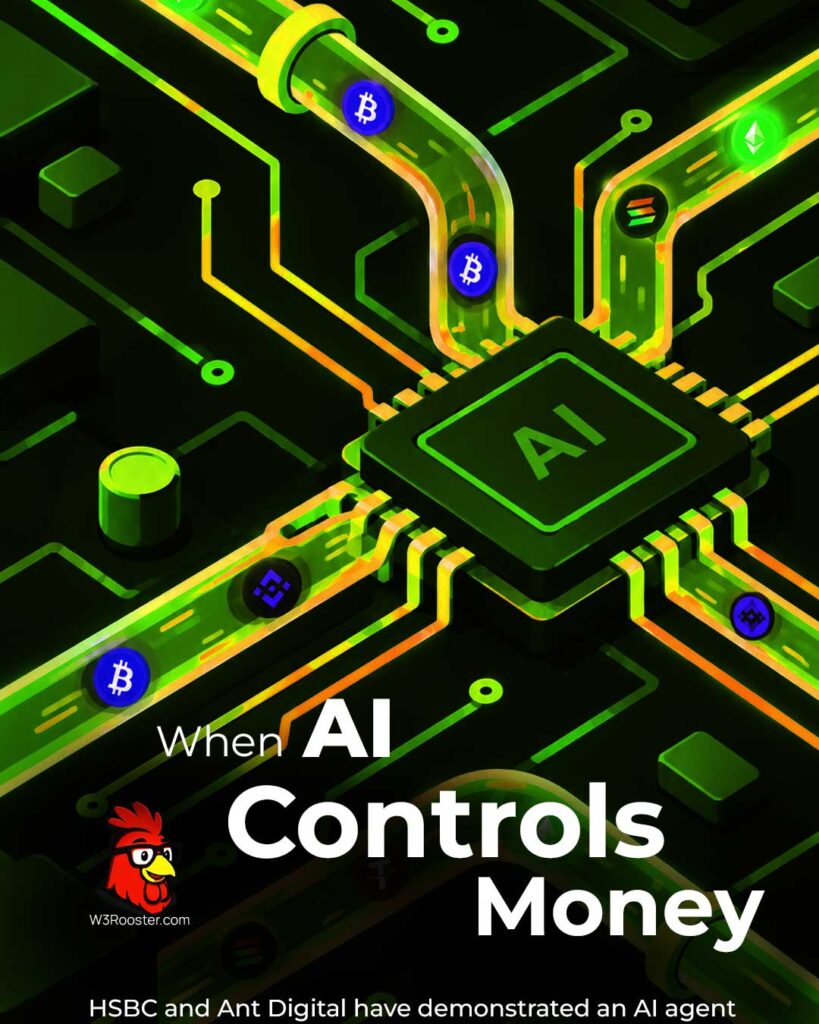
HSBC and Ant Digital have demonstrated an AI agent using tokenized bank deposits to pay for digital services. The experiment matters less as another blockchain pilot than as an early glimpse of a harder question: what kind of financial system is required when software itself becomes an economic actor?
For most of financial history, payment infrastructure has been designed around a remarkably persistent assumption: somewhere behind every transaction is a human intention. Even highly automated payments ultimately trace back to a person or organization establishing a mandate, approving a purchase, signing a contract, or programming a recurring instruction.
A technical experiment completed by HSBC and Ant Digital Technologies on October 9, 2026, begins to complicate that model. In the test, an AI agent was able to discover a digital service, invoke it and manage the associated micropayment using HSBC’s Tokenised Deposit Service. Ant Digital’s Anvita Flow infrastructure and Jovay Testnet blockchain environment formed other components of the experiment.
This was a technical verification rather than a commercial deployment, an important distinction in an industry where experiments are easily mistaken for adoption. Yet its significance is not really the size of the transaction, the blockchain involved, or even HSBC’s participation. The more consequential development is that software was positioned between human intention and financial execution.
That changes the question. Finance has spent years asking how to make money programmable. It may soon have to ask what happens when the entity deciding how to use that money becomes programmable as well.
HSBC and Ant Digital Put an AI Agent Behind the Wallet
Automation in payments is hardly revolutionary. Standing orders, subscription billing, algorithmic trading and machine-triggered treasury operations have existed for years. Agentic AI introduces something conceptually different because an agent can interpret a broader objective, decompose it into tasks, search among alternatives and initiate actions without receiving a fresh human instruction at every stage.
Imagine a software agent tasked with operating an online business. Instead of merely renewing a predetermined cloud subscription, it could compare computing providers, purchase additional capacity, acquire a specialized dataset, invoke an external AI model and pay for each resource as required. The economic process begins to resemble decision-making rather than simple automation.
The International Monetary Fund has framed this emerging architecture through three distinct functions: intent and orchestration, authorization and control, and settlement. That separation is crucial. AI can remain probabilistic and adaptive while the layers responsible for authorization and financial finality remain governed by deterministic rules.
This is where W3Rooster sees the HSBC-Ant experiment as more consequential than another tokenization demonstration. The underlying transition is from payments designed primarily for human commerce toward infrastructure that may eventually need to accommodate millions of autonomous software participants.
Why Programmable Money May Make More Sense to Machines
Blockchain’s promise of programmable money has always encountered an awkward question: how much programmability does the ordinary consumer actually need? Most people are satisfied when a card payment takes seconds, a salary arrives reliably, or a banking application transfers funds cheaply. The technological elegance underneath the transaction is largely irrelevant.
Machines may have very different requirements. An autonomous agent could consume an API for seconds, purchase individual pieces of data, rent computational resources dynamically or transact with another agent. Instead of paying $30 for a monthly service, it might prefer thousands of tiny payments corresponding precisely to resources consumed.
Such an environment favors money that can interact directly with software. Continuous availability, machine-readable permissions, programmable conditions and economical micropayments become more valuable when the customer is itself a computer program.
This does not prove that blockchain is necessary. It does, however, change the economic argument. A technology that sometimes appears excessively programmable for human commerce could look considerably less excessive when transactions themselves become machine-native.
Tokenized Deposits, Stablecoins or Traditional Payment Rails?
The emerging contest is therefore not simply between banks and crypto. It is between different architectures for machine commerce. HSBC’s model places tokenized commercial-bank deposits inside the transaction. These remain bank liabilities rather than independent cryptocurrencies, allowing financial institutions to preserve familiar structures surrounding regulated money while adding programmability and blockchain-based settlement capabilities. For banks, this may offer a path toward machine-native payments without surrendering the monetary relationship to stablecoin issuers.

Crypto presents a different proposition. Stablecoins already operate across programmable networks, interact with smart contracts and can move globally without requiring every application to establish a direct relationship with the same bank. Those characteristics could be attractive in an economy where agents operated by different companies must transact across technological and jurisdictional boundaries.
But there is a third competitor that crypto advocates should not dismiss: existing payment networks. Santander and Mastercard have already demonstrated an AI agent completing a live payment through conventional regulated payment infrastructure, within predefined permissions. Mastercard has subsequently expanded its agentic-payment initiatives, illustrating that card networks have no intention of allowing blockchain to monopolize machine commerce.
The decisive competition may therefore concern which infrastructure provides the best combination of programmability, cost, interoperability, compliance and legal certainty. Blockchain has credible advantages, but technological inevitability should not be confused with technological possibility.
The Hard Problem Is Authorization, Not Settlement
Moving a token from one address to another is relatively easy. Determining whether an autonomous system was entitled to move it is much harder. Suppose a business tells an AI agent to “buy whatever computing capacity is necessary to keep our service responsive.” The agent purchases $50 of capacity, then $500, then $50,000 during an unexpected surge. Every transaction could be cryptographically valid and correctly settled while the economic outcome remains disastrous.
The distinction between settlement validity and legitimate intention becomes fundamental. An agent needs boundaries: maximum expenditure, permitted counterparties, acceptable asset types, geographic restrictions, transaction frequency and perhaps circumstances requiring human approval. In other words, greater autonomy may paradoxically require more sophisticated control architecture.
The enduring architecture of agentic finance may consequently place intelligence and financial authority in separate domains. AI can determine what it wants to do; deterministic systems can decide what it is allowed to do. That boundary could become one of the most important design principles of machine commerce.
When a Machine Makes a Mistake, Who Owes the Money?
The problem becomes more difficult when transactions fail economically rather than technically. AI models remain probabilistic systems. They can misunderstand instructions, rely on inaccurate information, select inappropriate services or interact with malicious counterparties.
Traditional financial law generally expects authorization to be attributable to recognizable parties. Agentic commerce stretches that assumption because an individual payment may emerge from a broad mandate rather than an explicit instruction such as “send exactly $14.72 to this merchant.”
This produces uncomfortable questions about liability. Is the user responsible because the agent acted within an authorized mandate? Is the AI provider responsible if defective reasoning produced the transaction? Does the bank have an obligation to detect economically abnormal behavior even when the payment satisfies every technical authorization rule?
Heraclitus observed that “everything flows,” a useful description of technology but a dangerous principle for financial accountability. Financial systems cannot allow responsibility to become as fluid as the software operating within them. Before autonomous payments can scale, the chain of authority will need to become at least as legible as the chain of transactions.
Micropayments Could Finally Face Their Real Test
Micropayments are among blockchain’s oldest promised applications, and also among its most persistently disappointing ones. Consumers rarely want to consciously approve fractions of a cent for every webpage, API interaction or digital object they encounter. The cognitive cost of deciding can exceed the monetary cost of paying.
AI agents remove part of that obstacle because machines do not suffer payment fatigue. An agent can theoretically evaluate thousands of tiny economic decisions without turning each one into a checkout experience.
That could enable entirely different commercial structures. Data could be purchased by query, computing capacity by second, AI inference by task and digital services by invocation rather than subscription. Machine-to-machine commerce might consequently create transaction volumes and granularities that were never economical when humans occupied every decision point.
Still, W3Rooster believes skepticism is warranted here. Conventional payment companies recognize exactly the same opportunity and are designing agentic infrastructure around existing networks. The relevant question is not whether AI will create more micropayments, but whether blockchain can process them more efficiently and interoperably than its competitors.
AI Could Turn Tokenized Deposits Into a New Crypto Battleground
Tokenized deposits have recently moved closer to real financial activity. British banks, including HSBC, have already participated in initiatives involving tokenized commercial-bank money, part of a broader institutional effort to combine familiar banking liabilities with programmable infrastructure.
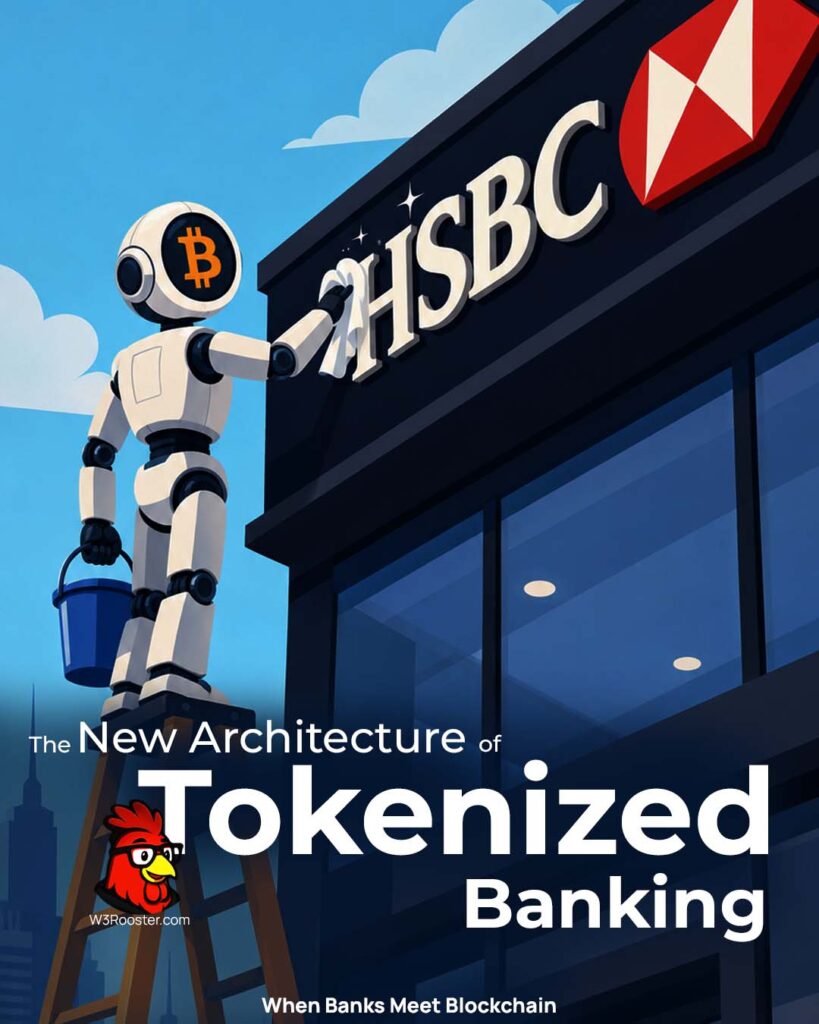
Agentic commerce adds another dimension. Until now, the debate around tokenized deposits and stablecoins has largely centered on institutional settlement, regulation, liquidity and the future architecture of digital money. AI introduces a new constituency: autonomous software that may care less about monetary ideology and more about whether an asset can be accessed programmatically across services.
Stablecoins may possess an advantage in openness and composability. Tokenized deposits may possess advantages in regulated banking relationships, identity, compliance and integration with conventional balance sheets. Neither model has yet demonstrated that it can dominate an economy of autonomous agents.
For crypto investors, this matters beyond individual tokens. If machine commerce becomes substantial, value could accrue to stablecoin infrastructure, smart-contract networks, identity systems, interoperability protocols and cryptographic authorization technologies. Yet banks and payment networks may absorb many of the same capabilities, leaving public blockchains with a smaller role than maximalist narratives assume.
The Bigger Risk May Be Machines Moving Money Together
The most interesting risk appears only when the thought experiment is extended beyond shopping. An AI agent capable of choosing where to spend money could eventually choose where to hold it. Corporate agents might continuously compare deposit rates, counterparty risk, stablecoin yields, collateral requirements and foreign-exchange costs. Individually, such optimization could improve efficiency. Collectively, millions of agents responding to similar models and signals could generate extraordinarily correlated financial behavior.
A deterioration in confidence that once took depositors days to recognize could theoretically produce automated reallocations within minutes. Liquidity management could become faster, but liquidity flight could become faster too. The IMF has already highlighted correlated agent behavior and systemic effects among the risks that deserve attention as agentic payments develop.
This is a deeper problem than whether AI can safely buy a digital service. Financial institutions may eventually confront markets in which not only transactions but reactions themselves occur at machine speed. The infrastructure built to enable autonomous commerce may therefore require circuit breakers, mandates and risk controls designed for autonomous panic as much as autonomous efficiency.
The Future Customer May Be Software
The HSBC and Ant Digital experiment should not be mistaken for proof that AI agents need blockchain, that tokenized deposits will defeat stablecoins, or that autonomous finance is ready for widespread deployment. It proves something narrower but still significant: regulated financial institutions are actively experimenting with architectures in which AI can participate directly in a programmable payment process.
The deeper significance emerges when this experiment is placed beside agentic-payment initiatives using conventional networks and the continuing expansion of tokenized money. Multiple industries are converging on the same problem from different directions. AI companies are giving software greater agency, banks are making deposits programmable, crypto networks are building machine-readable financial environments, and payment companies are adapting existing rails for autonomous commerce.
The question W3Rooster would watch is therefore not simply whether AI agents will make payments. That trajectory is already becoming visible. The harder question is who will define the monetary architecture, authorization rules and accountability mechanisms through which those agents operate.
Blockchain spent more than a decade attempting to make money native to software. The unexpected possibility is that its strongest long-term argument may emerge only when software itself becomes a meaningful participant in the economy. If that happens, the next contest in digital finance will not merely be over who controls programmable money, but over who gives machines permission to spend it.