Community Banks Sue the OCC Over Crypto Bank Charters
A banking-industry lawsuit is testing whether crypto firms can enter the U.S. banking system through a lighter regulatory door.
W3 Meteor ID: ICBA-OCC-1005202626400
Date & Time: October 2, 2026, 07:20 UTC
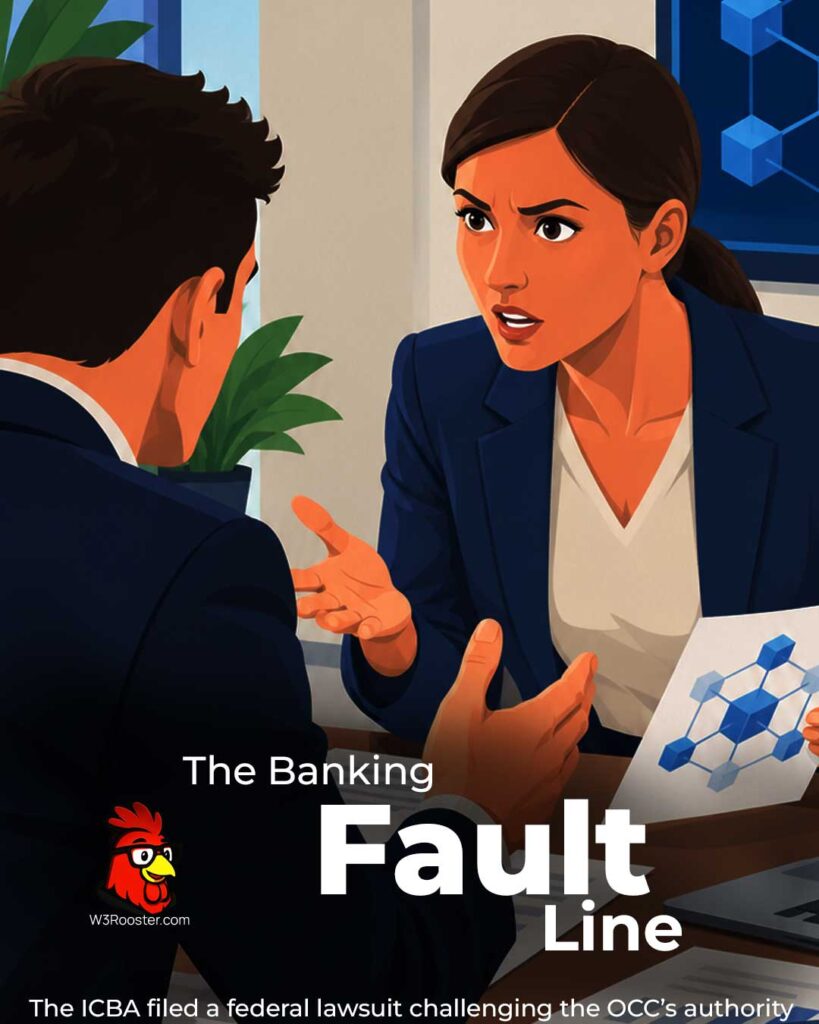
Origin: The Independent Community Bankers of America (ICBA) filed a federal lawsuit challenging the OCC’s authority to grant national trust-bank charters to crypto firms that do not operate like conventional deposit-taking banks.
Visibility: Community banks, crypto custodians, stablecoin issuers, regulators, investors, and financial institutions watching the boundary between banking and digital-asset infrastructure.
Trajectory: The OCC expanded the pathway for crypto companies to obtain national trust-bank charters, while firms including Coinbase, Ripple, Circle and others pursued regulatory approval. The ICBA lawsuit now turns that regulatory shift into a legal confrontation over who can enter the banking system and under what obligations.
Direction: The case could force regulators and courts to define the difference between being a bank and performing selected banking functions. If crypto firms can obtain federal charters without the full obligations imposed on traditional banks, the structure of competition across custody, payments and digital money could change.
Speed: The conflict is developing quickly: the OCC’s March 2026 rule opened the disputed pathway, dozens of trust-bank approvals have followed, and the ICBA has now moved the disagreement into federal court. The legal challenge arrives while U.S. crypto banking architecture is still being assembled.
Magnitude: The lawsuit is bigger than one charter. It challenges the regulatory foundation supporting a growing pipeline of crypto-native financial institutions and raises questions about capital, liquidity, supervision, FDIC insurance, consumer protection and competitive equality.
Altitude: Its consequences could reach stablecoins, crypto custody, tokenized assets, payments and the emerging concept of the blockchain-native bank. A court decision could influence how far crypto companies can move into regulated finance without becoming conventional banks.
Cock-a-Doodle-Doo: The interesting fight is not simply whether crypto deserves a bank charter. It is whether a company can become “bank-like” while avoiding the architecture that made banks heavily regulated in the first place. If that boundary remains unresolved, the next battle may be over who gets to define what a bank actually is.